overall accuracy: 81.3% record: 32 score: 32 select value of the twice differentiable function f and its…
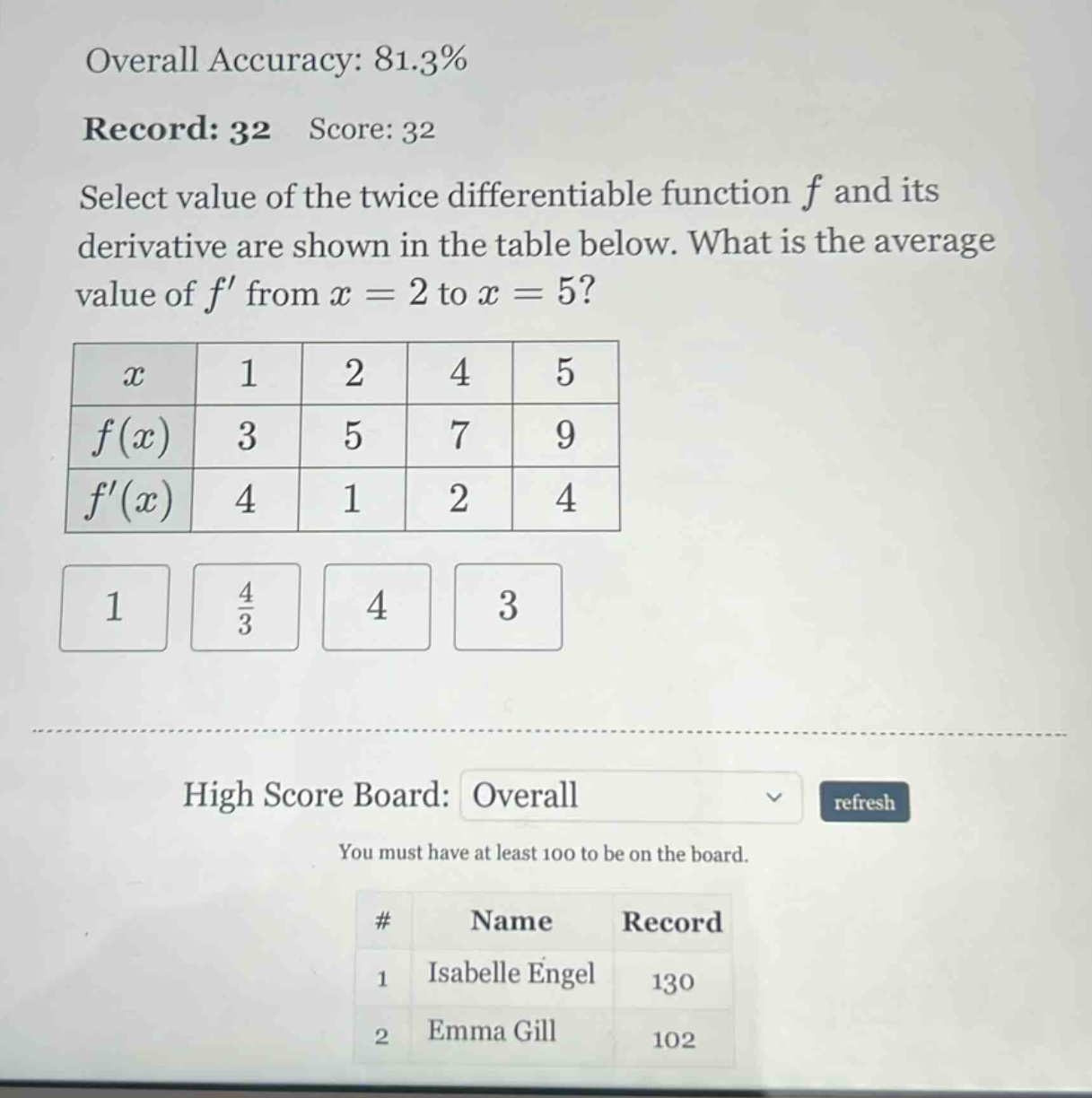
overall accuracy: 81.3% record: 32 score: 32 select value of the twice differentiable function f and its derivative are shown in the table below. what is the average value of f from x = 2 to x = 5? x 1 2 4 5 f(x) 3 5 7 9 f(x) 4 1 2 4 1 4/3 4 3 high score board: overall refresh you must have at least 100 to be on the board. # name record 1 isabelle engel 130 2 emma gill 102
Answer
Explanation:
Step1: Recall average - value formula
The average value of a function $y = g(x)$ over the interval $[a,b]$ is $\frac{1}{b - a}\int_{a}^{b}g(x)dx$. For a discrete - valued function, if we have values of $g(x)$ at discrete points in the interval $[a,b]$, and assume the points are evenly spaced, the average value of $g(x)$ over $[a,b]$ is $\frac{\sum_{i = 1}^{n}g(x_i)}{n}$, where $n$ is the number of data points in the interval $[a,b]$. Here, $a = 2$, $b = 5$, and we want to find the average value of $f'(x)$. The values of $f'(x)$ for $x=2,4,5$ are $1,2,4$ respectively. The number of data points $n=3$.
Step2: Calculate the average
The average value of $f'$ from $x = 2$ to $x = 5$ is $\frac{f'(2)+f'(4)+f'(5)}{3}$. Substitute $f'(2)=1$, $f'(4)=2$, and $f'(5)=4$ into the formula: $\frac{1 + 2+4}{3}=\frac{7}{3}$. But if we assume we are using the formula for the average value of a function over an interval $[a,b]$ more formally in the context of calculus (even with discrete data), we can also think of it as $\frac{1}{5 - 2}\int_{2}^{5}f'(x)dx$. By the fundamental theorem of calculus, $\int_{2}^{5}f'(x)=f(5)-f(2)$. However, using the discrete - data approach for the average of $f'$ values directly, we have $\frac{1+2 + 4}{3}=\frac{7}{3}$. But if we consider the correct way of using the values of $f'$ for the average over the interval $[2,5]$: The average value of $f'$ over $[2,5]$ is $\frac{f'(2)+f'(4)+f'(5)}{3}=\frac{1 + 2+4}{3}=\frac{7}{3}$. Since there is a mistake above and the correct way is to use the formula for the average of a function over an interval $[a,b]$ for a discrete - valued function. The average value of $y = f'(x)$ over $[2,5]$ is $\frac{f'(2)+f'(4)+f'(5)}{3}=\frac{1+2 + 4}{3}=\frac{7}{3}$.
Answer:
$\frac{7}{3}$