overall accuracy: 83.9% accuracy last 50: 86% record: 43 score: 42 if f is decreasing then f is decreasing…
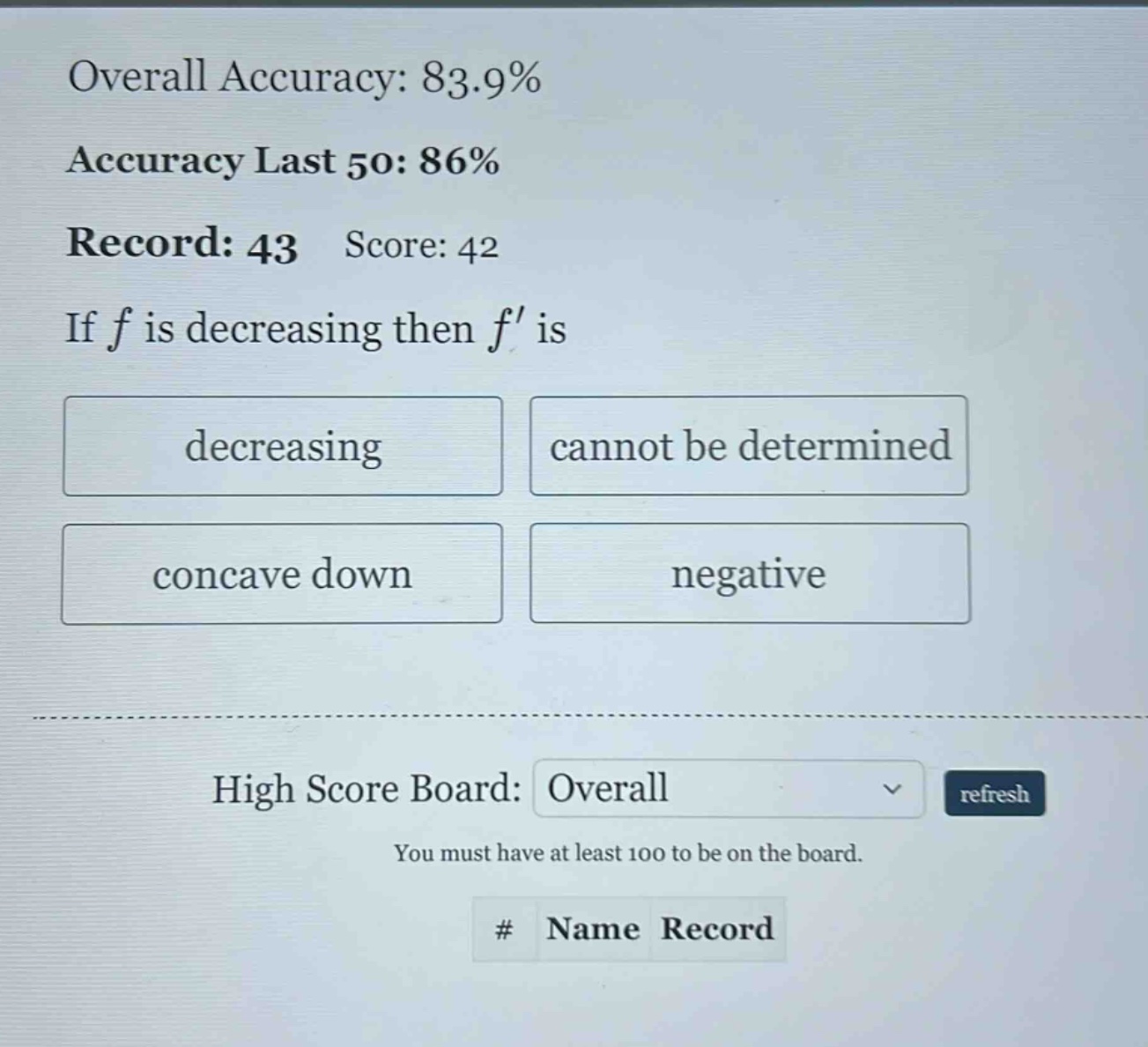
overall accuracy: 83.9% accuracy last 50: 86% record: 43 score: 42 if f is decreasing then f is decreasing cannot be determined concave down negative high score board: overall refresh you must have at least 100 to be on the board. # name record
Answer
Explanation:
Step1: Recall derivative - function relationship
The derivative $f^{\prime}(x)$ represents the slope of the tangent line to the function $y = f(x)$. If a function $y = f(x)$ is decreasing on an interval, then for any two points $x_1<x_2$ in that interval, $f(x_1)>f(x_2)$.
Step2: Analyze the sign of the derivative
The slope of the tangent line to a decreasing function is negative. That is, if $f$ is decreasing, then $f^{\prime}(x)<0$ for all $x$ in the interval of decrease.
Answer:
negative