overall accuracy: 85.5% accuracy last 50: 86% record: 40 score: 39 for a particle moving along the x - axis…
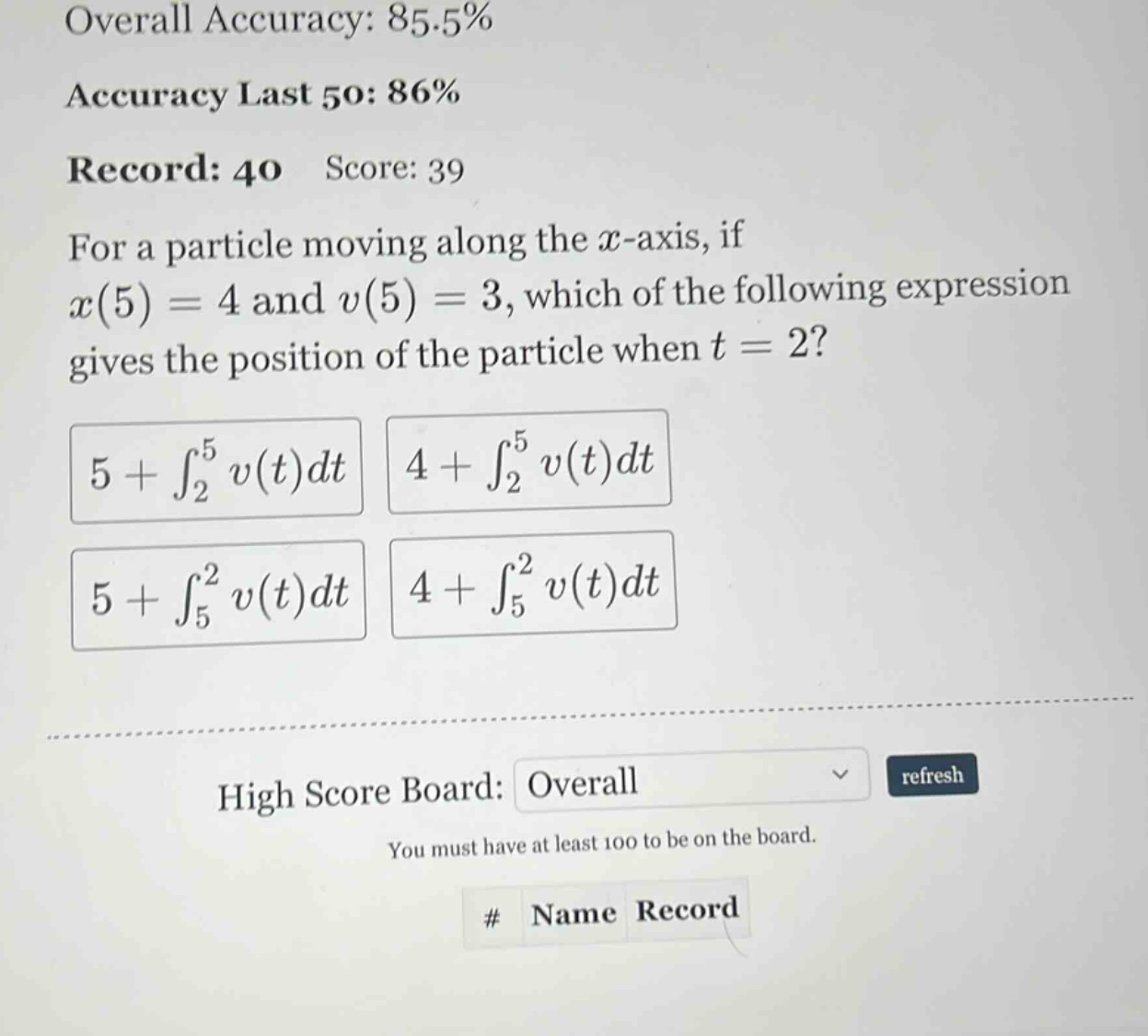
overall accuracy: 85.5% accuracy last 50: 86% record: 40 score: 39 for a particle moving along the x - axis, if x(5)=4 and v(5)=3, which of the following expression gives the position of the particle when t = 2? 5+∫₂⁵v(t)dt 4+∫₂⁵v(t)dt 5+∫₅²v(t)dt 4+∫₅²v(t)dt high score board: overall refresh you must have at least 100 to be on the board. # name record
Answer
Explanation:
Step1: Recall the position - velocity relationship
The relationship between position $x(t)$ and velocity $v(t)$ is given by $x(t)-x(a)=\int_{a}^{t}v(s)ds$. We want to find $x(2)$ given $x(5) = 4$ and $v(t)$.
Step2: Rearrange the formula
We can rewrite the formula as $x(2)=x(5)+\int_{5}^{2}v(t)dt$. Since $x(5) = 4$, the expression for the position of the particle at $t = 2$ is $4+\int_{5}^{2}v(t)dt$.
Answer:
$4+\int_{5}^{2}v(t)dt$