overall accuracy: 85.7% accuracy last 50: 86% record: 40 score: 40 if n(x)=z(q(x)), then n(x)= z(q(x))q(x)…
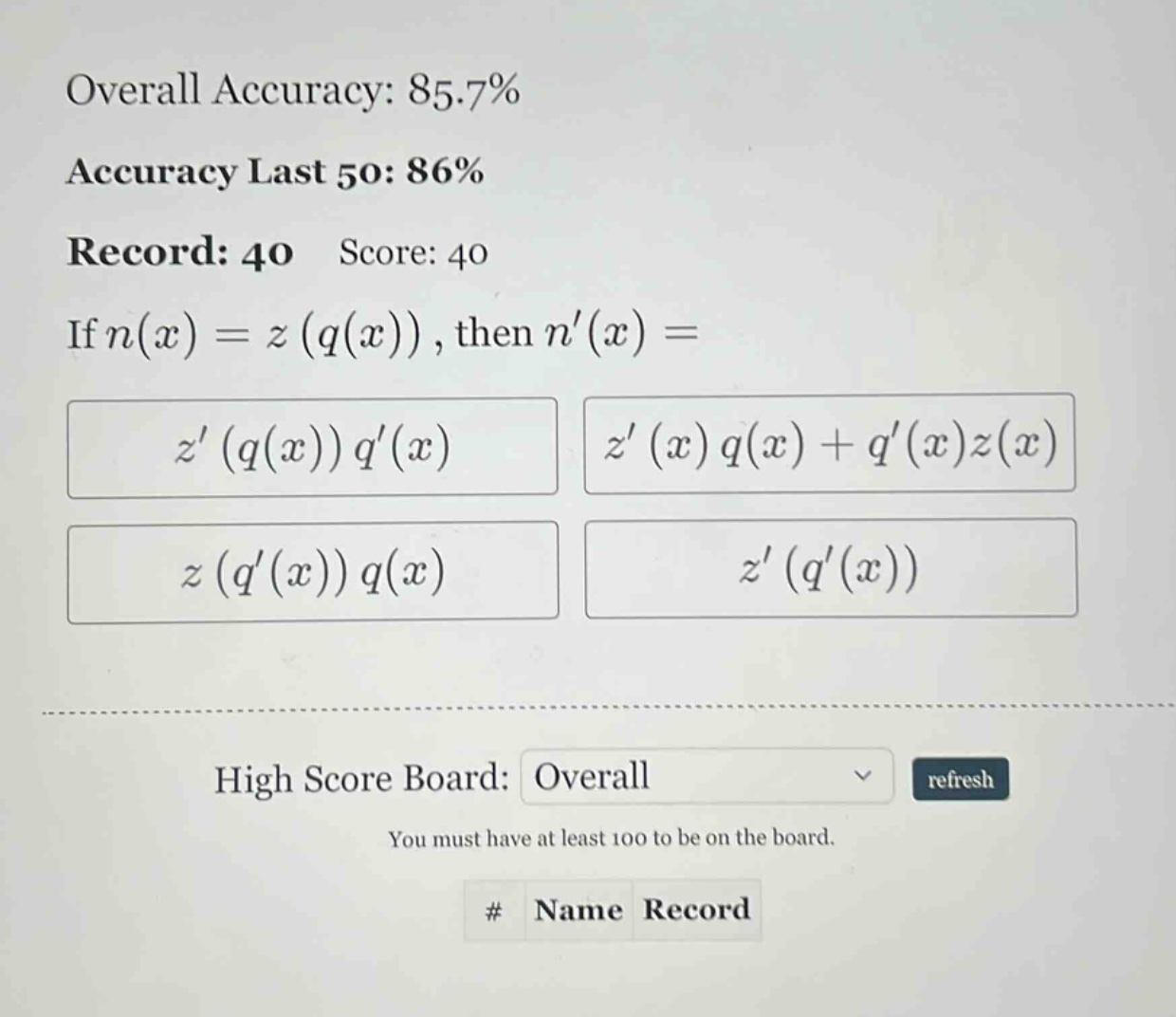
overall accuracy: 85.7% accuracy last 50: 86% record: 40 score: 40 if n(x)=z(q(x)), then n(x)= z(q(x))q(x) z(x)q(x)+q(x)z(x) z(q(x))q(x) z(q(x)) high score board: overall refresh you must have at least 100 to be on the board. # name record
Answer
Explanation:
Step1: Recall chain - rule
The chain - rule for differentiation states that if (y = f(g(x))), then (y^\prime=f^\prime(g(x))g^\prime(x)). In the given function (n(x)=z(q(x))), let (u = q(x)). So (n(x)=z(u)).
Step2: Apply chain - rule
By the chain - rule, (\frac{dn}{dx}=\frac{dz}{du}\cdot\frac{du}{dx}). Since (u = q(x)), (\frac{dz}{du}=z^\prime(u)=z^\prime(q(x))) and (\frac{du}{dx}=q^\prime(x)). So (n^\prime(x)=z^\prime(q(x))q^\prime(x)).
Answer:
(z^\prime(q(x))q^\prime(x))