overall accuracy: 85.7% record: 35 score: 35 if the function f is continuous at x = -4 then which of the…
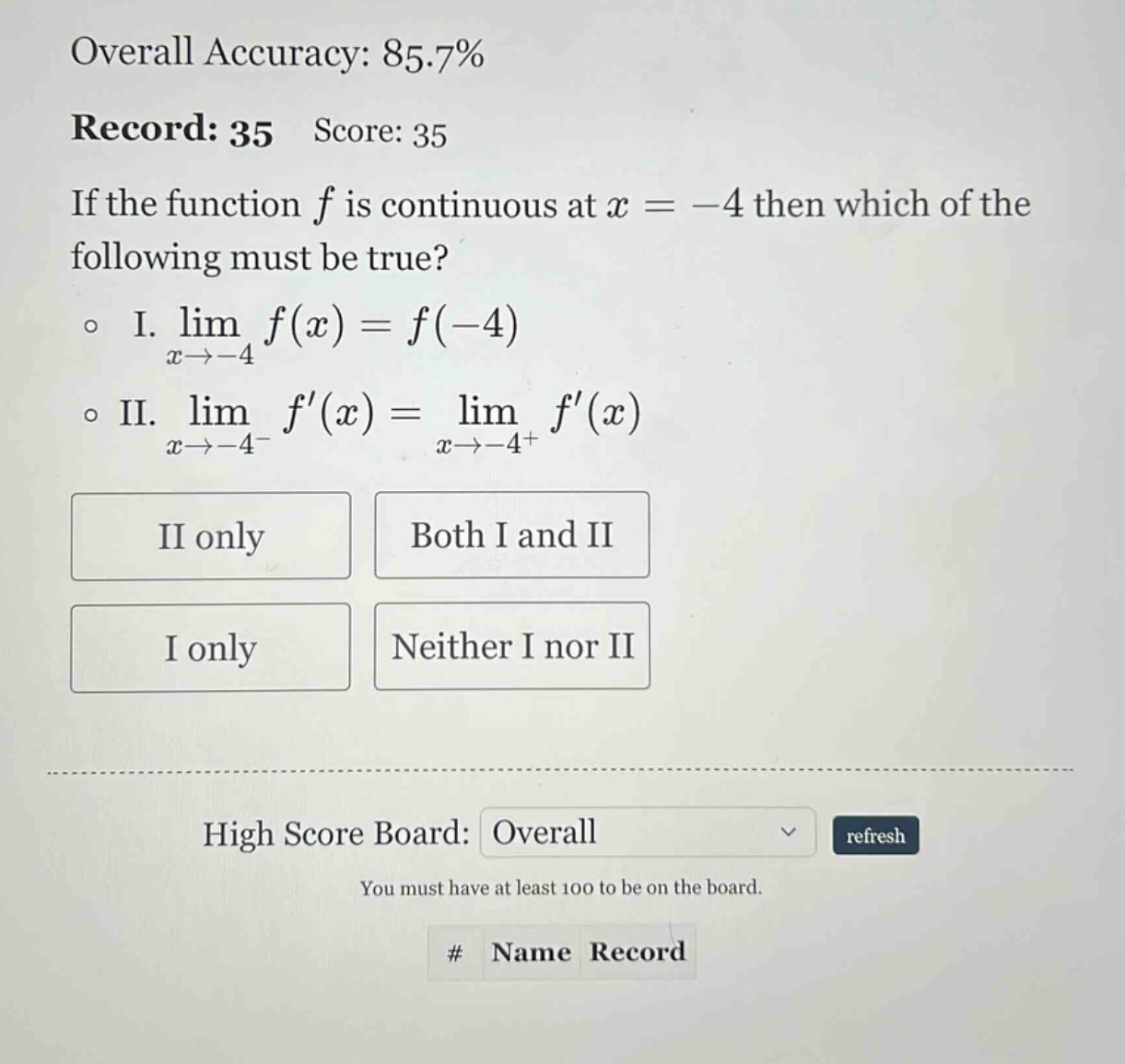
overall accuracy: 85.7% record: 35 score: 35 if the function f is continuous at x = -4 then which of the following must be true? i. lim(x→ - 4) f(x)=f(-4) ii. lim(x→ - 4⁻) f(x)=lim(x→ - 4⁺) f(x) ii only both i and ii i only neither i nor ii high score board: overall refresh you must have at least 100 to be on the board. # name record
Answer
Explanation:
Step1: Recall continuity definition
By the definition of continuity of a function $y = f(x)$ at $x = a$, we have $\lim_{x\rightarrow a}f(x)=f(a)$. Here $a=-4$, so $\lim_{x\rightarrow - 4}f(x)=f(-4)$ must be true for $f(x)$ to be continuous at $x = - 4$.
Step2: Analyze the second - statement
The equality $\lim_{x\rightarrow - 4^{-}}f'(x)=\lim_{x\rightarrow - 4^{+}}f'(x)$ is the condition for the function $f(x)$ to be differentiable at $x=-4$. Continuity of a function at a point does not imply differentiability at that point. A function can be continuous but not differentiable (e.g., $y = |x|$ at $x = 0$). So, this statement is not a must - have for continuity.
Answer:
C. I only