overall accuracy: 86% accuracy last 50: 86% record: 36 score: 36 if g(x) = k(x)/z(x), then g(x) =…
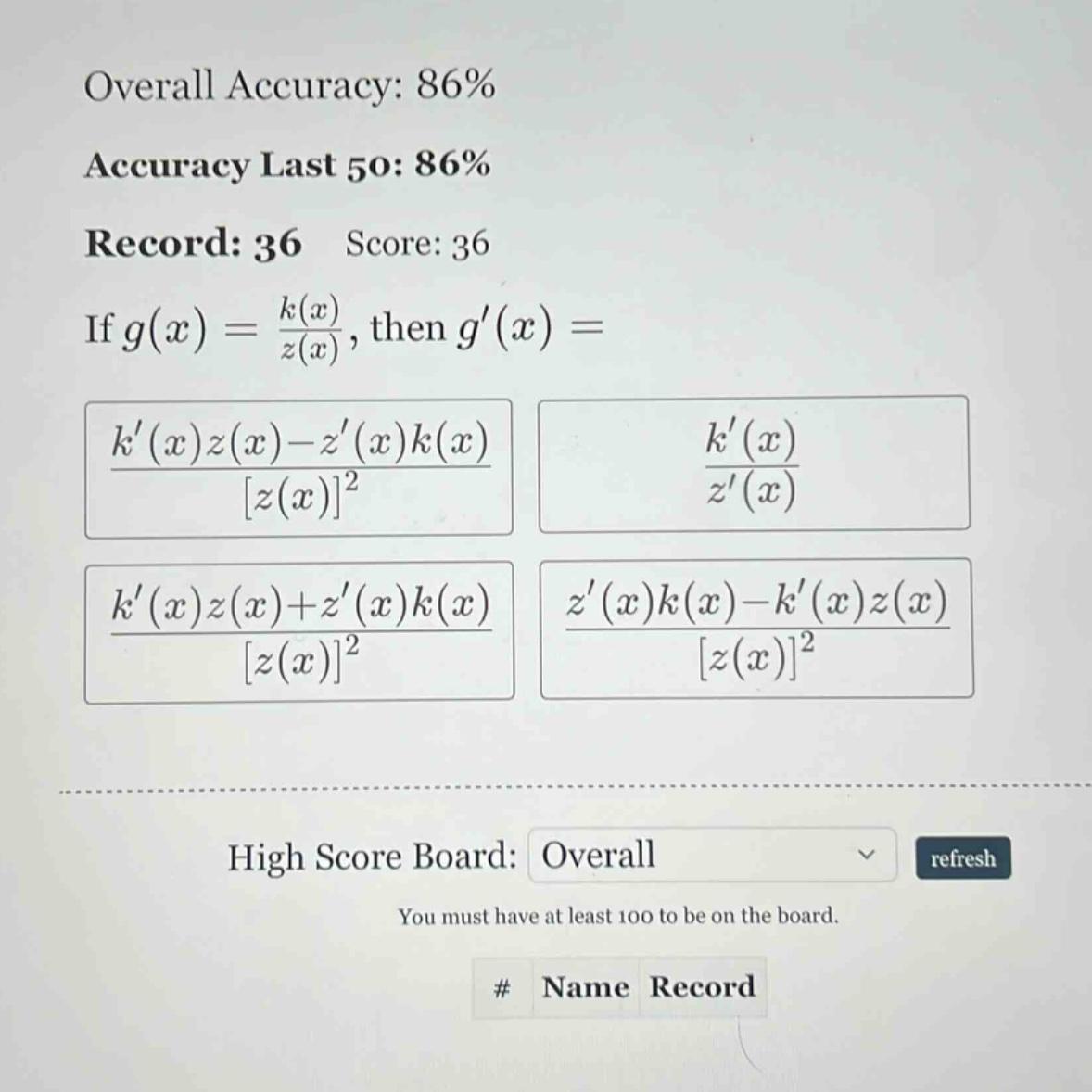
overall accuracy: 86% accuracy last 50: 86% record: 36 score: 36 if g(x) = k(x)/z(x), then g(x) = k(x)z(x)-z(x)k(x)/z(x)^2 k(x)/z(x) k(x)z(x)+z(x)k(x)/z(x)^2 z(x)k(x)-k(x)z(x)/z(x)^2 high score board: overall refresh you must have at least 100 to be on the board. # name record
Answer
Explanation:
Step1: Recall quotient - rule
The quotient - rule for differentiation states that if (g(x)=\frac{k(x)}{z(x)}), where (k(x)) and (z(x)) are differentiable functions and (z(x)\neq0), then (g^{\prime}(x)=\frac{k^{\prime}(x)z(x)-z^{\prime}(x)k(x)}{[z(x)]^{2}}).
Answer:
(\frac{k^{\prime}(x)z(x)-z^{\prime}(x)k(x)}{[z(x)]^{2}})