overall accuracy: 86.5% accuracy last 50: 86% record: 38 score: 38 ∫e^(-x/5)dx = 5e^(-x/5)+c e^(-x/5)+c…
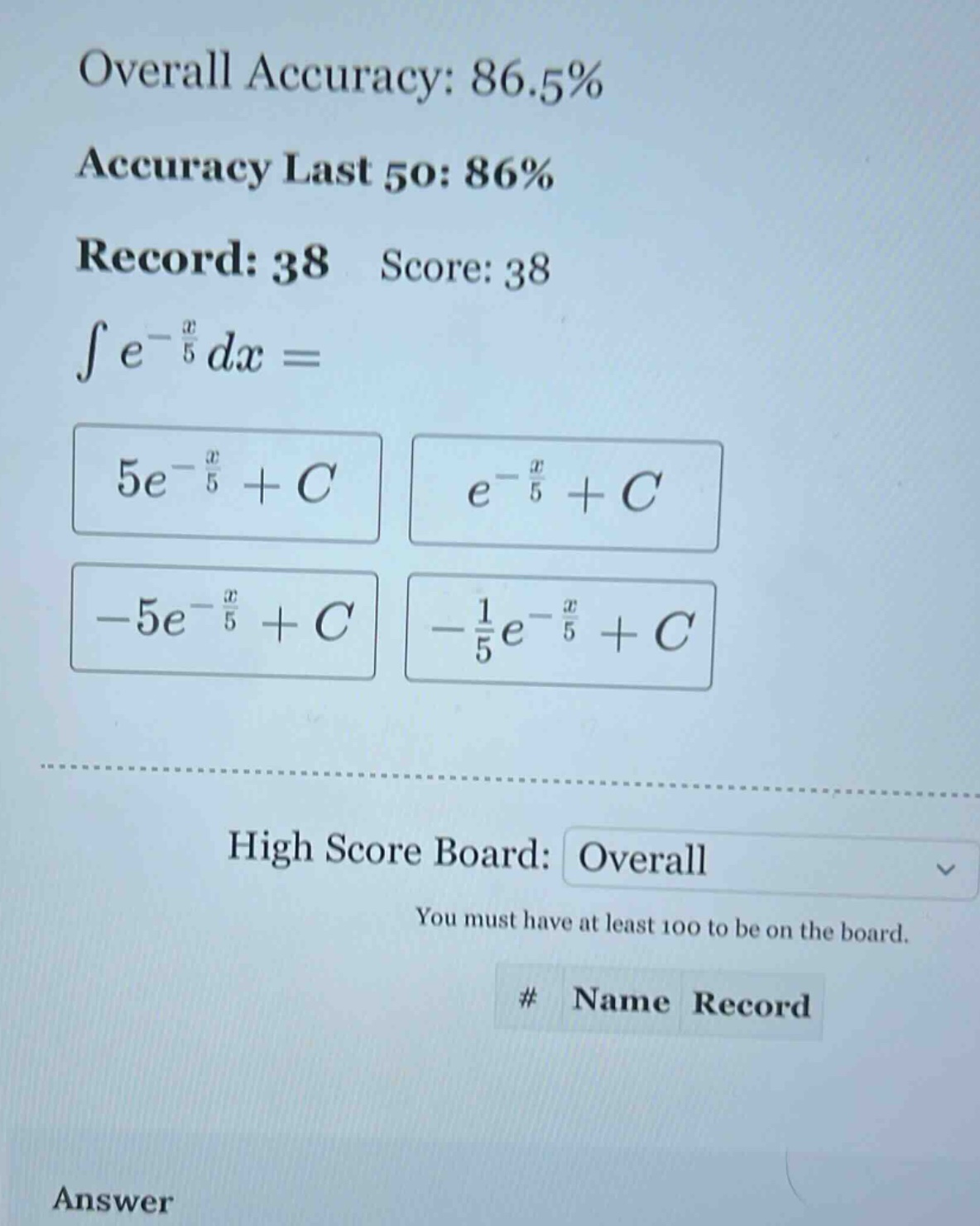
overall accuracy: 86.5% accuracy last 50: 86% record: 38 score: 38 ∫e^(-x/5)dx = 5e^(-x/5)+c e^(-x/5)+c -5e^(-x/5)+c -1/5e^(-x/5)+c high score board: overall you must have at least 100 to be on the board. # name record answer
Answer
Explanation:
Step1: Use substitution method
Let $u =-\frac{x}{5}$, then $du=-\frac{1}{5}dx$, and $dx=- 5du$.
Step2: Substitute into integral
$\int e^{-\frac{x}{5}}dx=\int e^{u}\cdot(-5du)=-5\int e^{u}du$.
Step3: Integrate $e^{u}$
Since $\int e^{u}du = e^{u}+C$, then $-5\int e^{u}du=-5e^{u}+C$.
Step4: Substitute back $u$
Substitute $u =-\frac{x}{5}$ back, we get $-5e^{-\frac{x}{5}}+C$.
Answer:
$-5e^{-\frac{x}{5}}+C$