overall accuracy: 86.8% accuracy last 5pc 86% record: 39 score: 39 what would be a step in solving the…
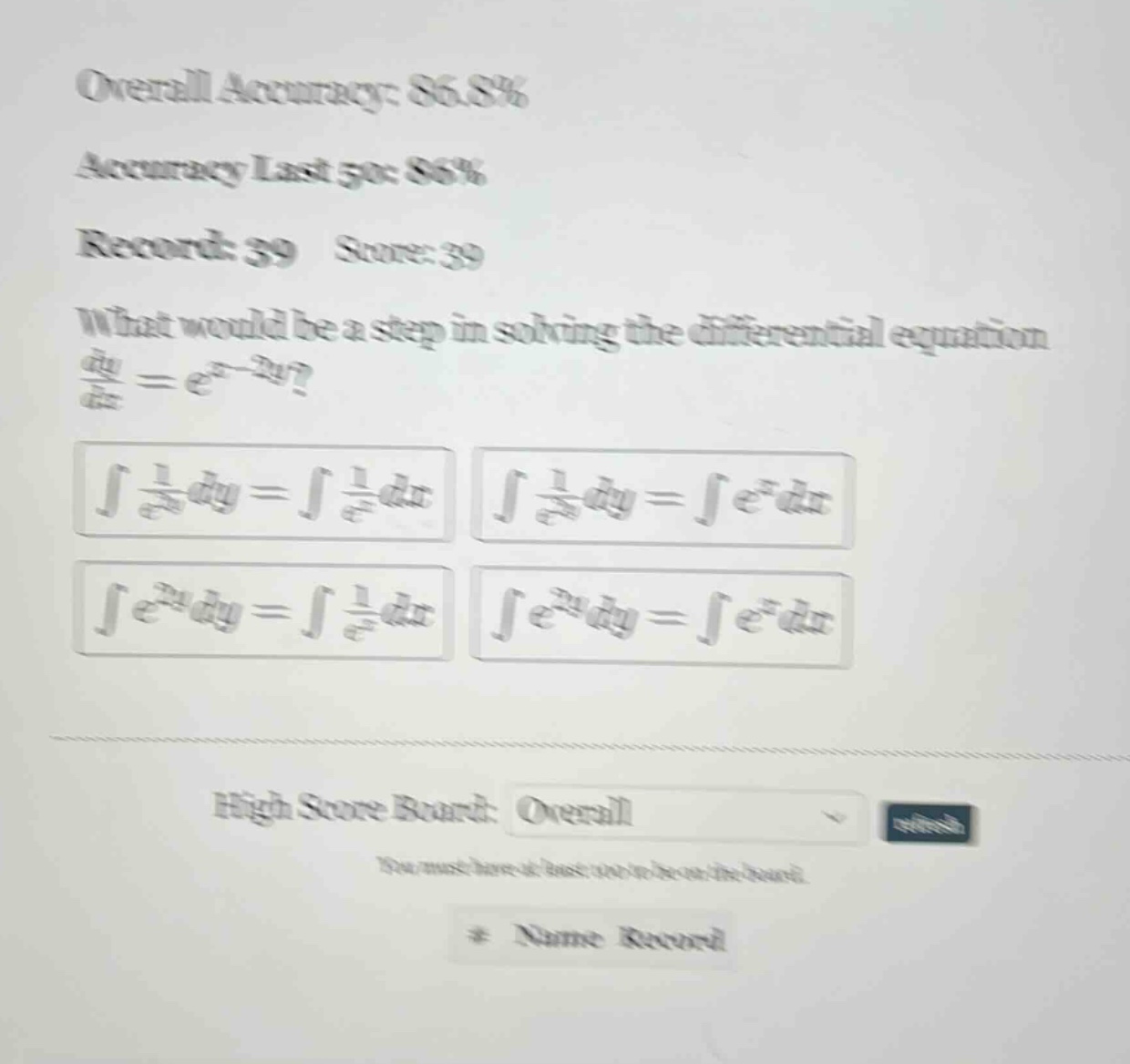
overall accuracy: 86.8% accuracy last 5pc 86% record: 39 score: 39 what would be a step in solving the differential equation dy/dx = e^(x - 2y)? ∫(1/e^(2y))dy = ∫(1/e^x)dx ∫(1/e^(2y))dy = ∫e^x dx ∫e^(2y)dy = ∫(1/e^x)dx ∫e^(2y)dy = ∫e^x dx high score board: overall you must have at least one best the board. * name record
Answer
Explanation:
Step1: Use separation of variables
Given $\frac{dy}{dx}=e^{x - 2y}$, we know that $e^{x - 2y}=e^{x}\cdot e^{- 2y}$. So we can rewrite the differential - equation as $\frac{dy}{dx}=e^{x}\cdot e^{-2y}$. Then, separate the variables: $\frac{dy}{e^{-2y}} = e^{x}dx$, which is equivalent to $e^{2y}dy=e^{x}dx$.
Answer:
$\int e^{2y}dy=\int e^{x}dx$