overall accuracy: 88.1% record: 32 score: 32 if ∫₁³ f(x)dx = -4, and ∫₁⁶ f(x)dx = -3, then ∫₃⁶ f(x)dx equals…
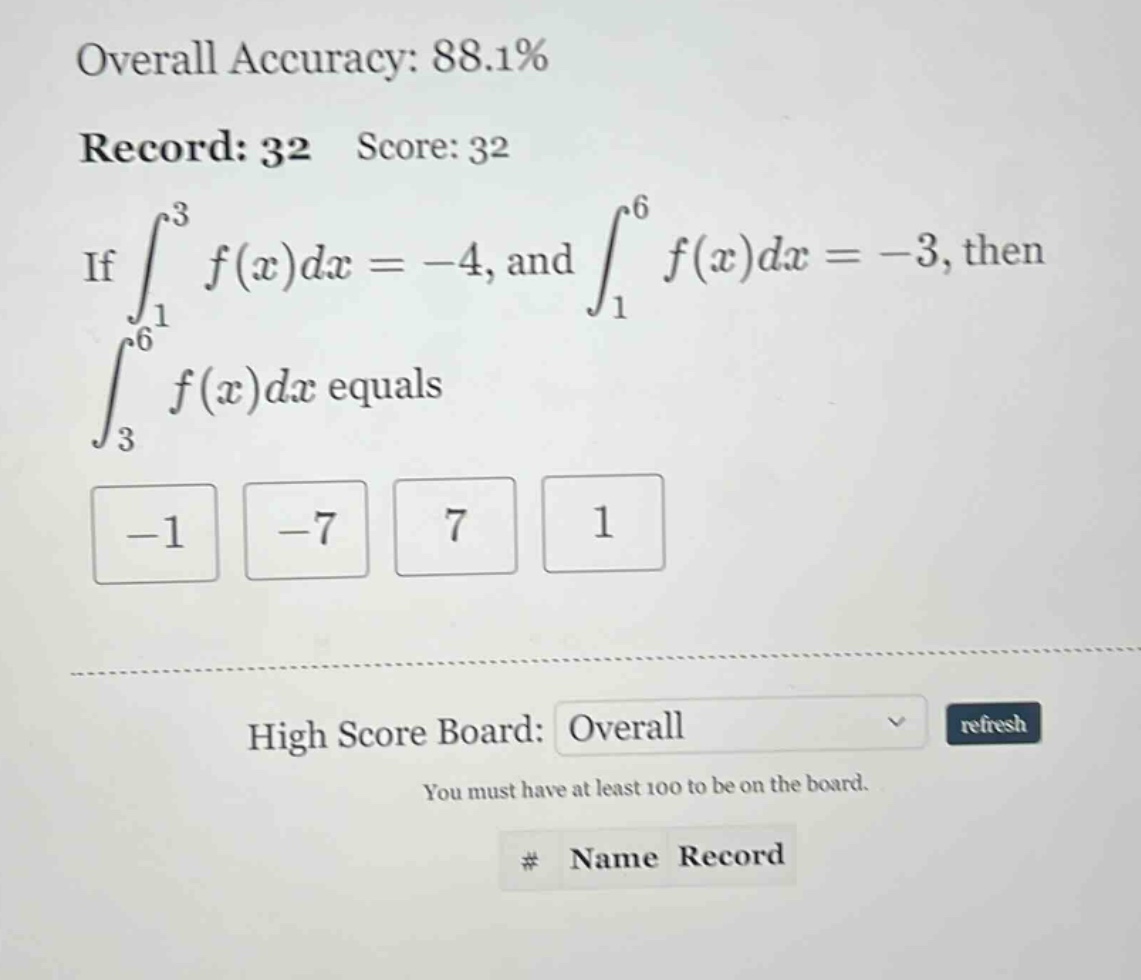
overall accuracy: 88.1% record: 32 score: 32 if ∫₁³ f(x)dx = -4, and ∫₁⁶ f(x)dx = -3, then ∫₃⁶ f(x)dx equals -1 -7 7 1 high score board: overall refresh you must have at least 100 to be on the board. # name record
Answer
Explanation:
Step1: Use integral property
We know that $\int_{a}^{c}f(x)dx=\int_{a}^{b}f(x)dx+\int_{b}^{c}f(x)dx$. So, $\int_{1}^{6}f(x)dx=\int_{1}^{3}f(x)dx+\int_{3}^{6}f(x)dx$.
Step2: Rearrange to find $\int_{3}^{6}f(x)dx$
We are given $\int_{1}^{3}f(x)dx = - 4$ and $\int_{1}^{6}f(x)dx=-3$. Then $\int_{3}^{6}f(x)dx=\int_{1}^{6}f(x)dx-\int_{1}^{3}f(x)dx$.
Step3: Substitute values
Substitute $\int_{1}^{3}f(x)dx=-4$ and $\int_{1}^{6}f(x)dx = - 3$ into the above - formula: $\int_{3}^{6}f(x)dx=-3-(-4)$.
Step4: Simplify
$-3-(-4)=-3 + 4=1$.
Answer:
1