the parent cosecant function is shifted 2 units down, and its period is changed to 6π. which of the…
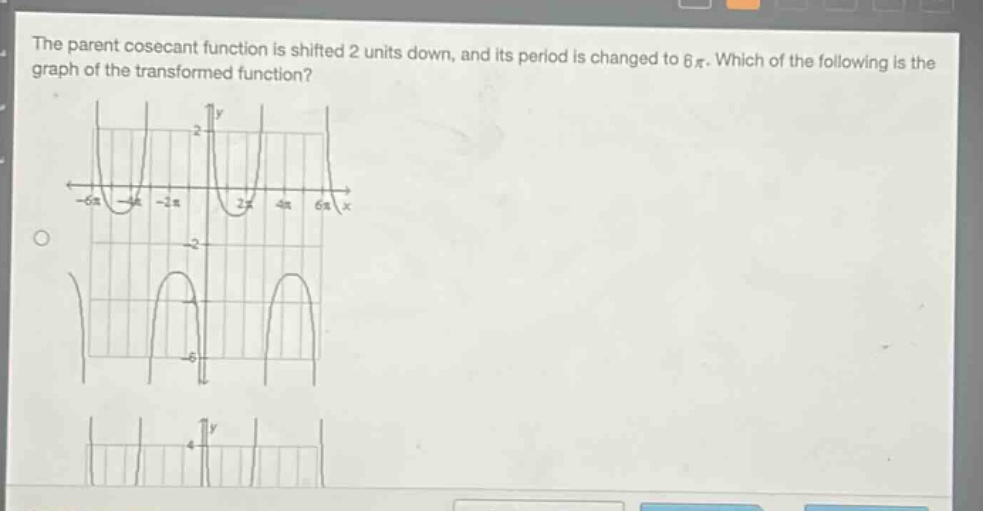
the parent cosecant function is shifted 2 units down, and its period is changed to 6π. which of the following is the graph of the transformed function?
Answer
Explanation:
Step1: Recall parent cosecant function
The parent cosecant function is $y = \csc(x)$ with a period of $2\pi$.
Step2: Determine the transformation for period
The general form of a periodic - function transformation for period is $y=\csc(bx)$. The period $T$ of $y = \csc(bx)$ is given by $T=\frac{2\pi}{|b|}$. Given $T = 6\pi$, we solve $\frac{2\pi}{|b|}=6\pi$. Cross - multiplying gives $2\pi=6\pi|b|$, so $|b|=\frac{1}{3}$.
Step3: Determine the vertical shift
The function is shifted 2 units down, so the transformation is of the form $y=\csc(\frac{1}{3}x)-2$. The key features of $y = \csc(x)$ are vertical asymptotes at $x = k\pi,k\in\mathbb{Z}$, and for $y=\csc(\frac{1}{3}x)-2$, the vertical asymptotes are at $\frac{1}{3}x=k\pi$, or $x = 3k\pi,k\in\mathbb{Z}$. Also, the minimum and maximum values of $y=\csc(x)$ are $y = 1$ and $y=-1$ respectively, and for $y=\csc(\frac{1}{3}x)-2$, the minimum and maximum values are $y=-1$ and $y = - 3$ respectively. We need to look for a graph with vertical asymptotes at $x = 3k\pi,k\in\mathbb{Z}$ and values ranging from $y=-3$ to $y=-1$ and is shifted 2 units down from the parent cosecant - function graph.
Since no options are provided in text format, the steps above outline how to identify the correct graph among the given choices. If we assume we are looking for the equation of the function, the answer is $y=\csc(\frac{1}{3}x)-2$.