the parent secant function is shifted 2 units down, and its period is changed to π. which of the following…
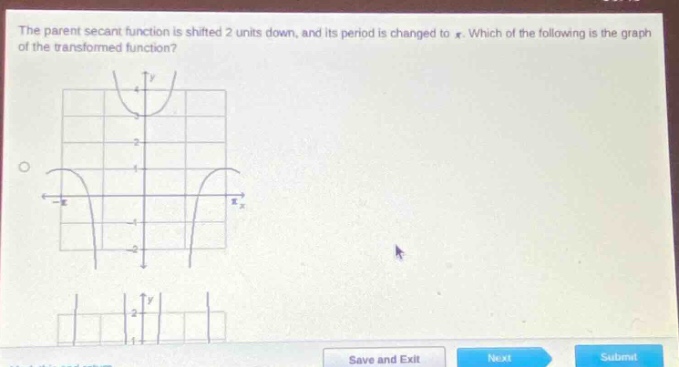
the parent secant function is shifted 2 units down, and its period is changed to π. which of the following is the graph of the transformed function?
Answer
Explanation:
Step1: Recall secant - function transformation rules
The general form of a secant - function is (y = A\sec(Bx - C)+D). The period of the secant function (y=\sec(x)) is (2\pi). The period of the transformed function (y = \sec(Bx)) is given by (T=\frac{2\pi}{|B|}). We are given that the period (T = \pi). So, (\pi=\frac{2\pi}{|B|}), which implies (|B| = 2). Also, the function is shifted 2 units down, so (D=-2). The parent - function (y = \sec(x)) is transformed to (y=\sec(2x)-2).
Step2: Analyze key points
The parent function (y = \sec(x)) has vertical asymptotes at (x=(2n + 1)\frac{\pi}{2},n\in\mathbb{Z}). For the function (y=\sec(2x)), the vertical asymptotes are found by setting (2x=(2n + 1)\frac{\pi}{2}), or (x=(2n + 1)\frac{\pi}{4},n\in\mathbb{Z}). When (x = 0), (y=\sec(0)-2=1 - 2=-1).
Step3: Match with the graph
We look for a graph that has a period of (\pi), vertical asymptotes at (x=(2n + 1)\frac{\pi}{4},n\in\mathbb{Z}), and a (y) - value of (-1) at (x = 0).
Since the question does not provide the full set of graph options, we cannot give a specific final - answer graph. But the key characteristics of the graph of (y=\sec(2x)-2) are:
- Period (\pi).
- Vertical asymptotes at (x=\frac{\pi}{4},\frac{3\pi}{4},\frac{5\pi}{4},\cdots)
- (y) - intercept at ((0, - 1)) and it is shifted 2 units down from the parent secant function.
If we assume we are choosing from a set of graphs with these characteristics, we would pick the graph that satisfies the above - mentioned properties.
If we had to give a general form of the answer based on the above analysis:
Answer:
The graph of (y = \sec(2x)-2) has a period of (\pi), vertical asymptotes at (x=(2n + 1)\frac{\pi}{4},n\in\mathbb{Z}), and a (y) - intercept of (-1) and is shifted 2 units down from the parent secant function (y=\sec(x)).