part 10 of 10\nsummarize the pertinent information obtained by applying the graphing strategy and sketch the…
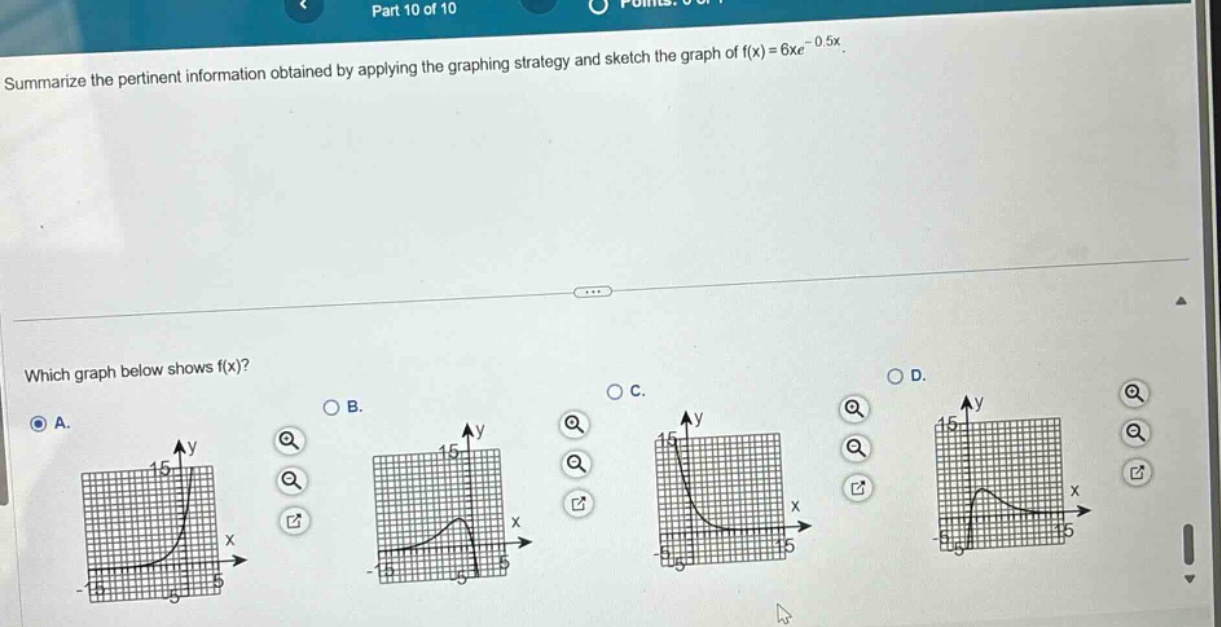
part 10 of 10\nsummarize the pertinent information obtained by applying the graphing strategy and sketch the graph of f(x)=6xe^(-0.5x).\nwhich graph below shows f(x)?\na.\nb.\nc.\nd.
Answer
Explanation:
Step1: Find the derivative of (f(x))
Use the product - rule ((uv)^\prime = u^\prime v+uv^\prime), where (u = 6x) and (v=e^{-0.5x}). (u^\prime=6) and (v^\prime=- 0.5e^{-0.5x}). Then (f^\prime(x)=6e^{-0.5x}-3xe^{-0.5x}=e^{-0.5x}(6 - 3x)).
Step2: Find the critical points
Set (f^\prime(x)=0). Since (e^{-0.5x}\gt0) for all real (x), we solve (6 - 3x = 0), which gives (x = 2).
Step3: Analyze the sign of the derivative
When (x\lt2), (f^\prime(x)=e^{-0.5x}(6 - 3x)\gt0), so (f(x)) is increasing. When (x\gt2), (f^\prime(x)=e^{-0.5x}(6 - 3x)\lt0), so (f(x)) is decreasing. So (x = 2) is a local maximum.
Step4: Find the (y) - value at the local maximum
(f(2)=6\times2\times e^{-0.5\times2}=12e^{-1}\approx4.42).
Step5: Analyze the end - behavior
As (x\to-\infty), (6x\to-\infty) and (e^{-0.5x}\to\infty), so (y = f(x)\to-\infty). As (x\to\infty), the exponential decay (e^{-0.5x}) dominates, and (y = f(x)\to0).
Answer:
D