part 11 of 11 points: 0 of 4 analyze the function for domain, range, continuity, increasing or decreasing…
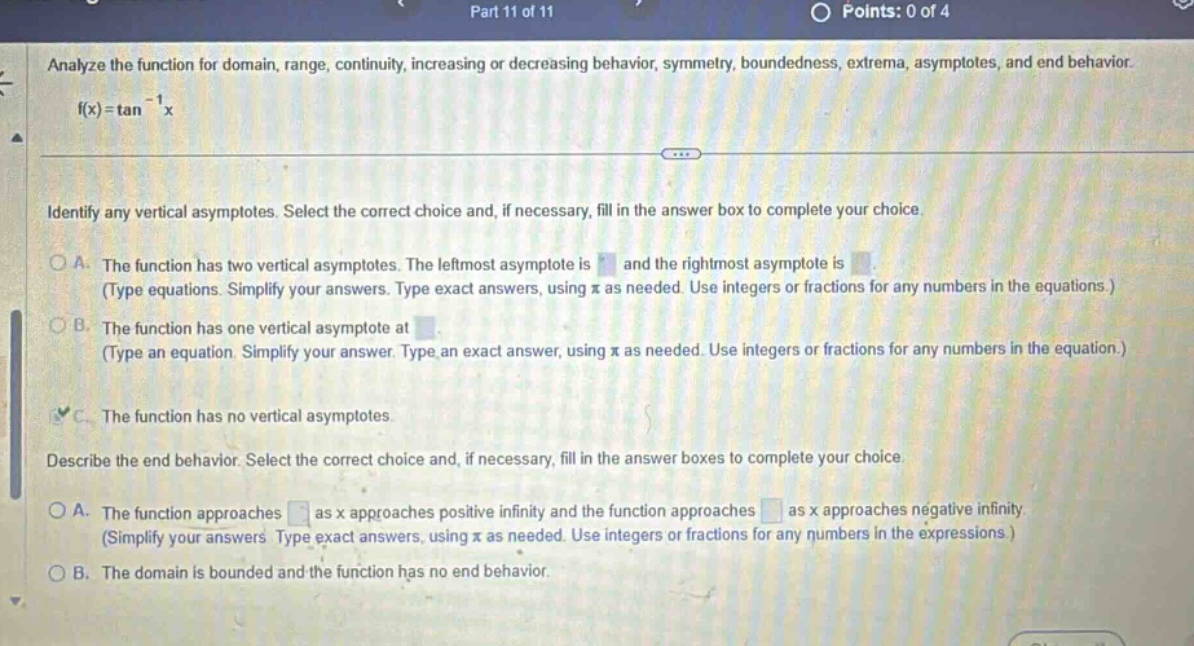
part 11 of 11 points: 0 of 4 analyze the function for domain, range, continuity, increasing or decreasing behavior, symmetry, boundedness, extrema, asymptotes, and end behavior. f(x)=tan⁻¹x identify any vertical asymptotes. select the correct choice and, if necessary, fill in the answer box to complete your choice. a. the function has two vertical asymptotes. the left - most asymptote is and the right - most asymptote is (type equations. simplify your answers. type exact answers, using π as needed. use integers or fractions for any numbers in the equations.) b. the function has one vertical asymptote at. (type an equation. simplify your answer. type an exact answer, using π as needed. use integers or fractions for any numbers in the equation.) c. the function has no vertical asymptotes. describe the end behavior. select the correct choice and, if necessary, fill in the answer boxes to complete your choice. a. the function approaches as x approaches positive infinity and the function approaches as x approaches negative infinity (simplify your answers. type exact answers, using π as needed. use integers or fractions for any numbers in the expressions.) b. the domain is bounded and the function has no end behavior.
Answer
Answer:
- C. The function has no vertical asymptotes.
- A. The function approaches $\frac{\pi}{2}$ as $x$ approaches positive infinity and the function approaches $-\frac{\pi}{2}$ as $x$ approaches negative infinity.
Explanation:
Step1: Recall the properties of $y = \tan^{- 1}x$
The inverse - tangent function $y=\tan^{-1}x$ is defined for all real - valued $x$. The domain of $y = \tan^{-1}x$ is $(-\infty,\infty)$. Since the function is defined for all real $x$, there are no values of $x$ for which the function is undefined in the real - number system, so there are no vertical asymptotes.
Step2: Analyze end - behavior
We know that $\lim_{x\rightarrow+\infty}\tan^{-1}x=\frac{\pi}{2}$ and $\lim_{x\rightarrow-\infty}\tan^{-1}x =-\frac{\pi}{2}$. As $x$ gets larger and larger in the positive direction, the value of $y = \tan^{-1}x$ approaches $\frac{\pi}{2}$, and as $x$ gets larger and larger in the negative direction, the value of $y=\tan^{-1}x$ approaches $-\frac{\pi}{2}$.