part 7 of 7 completed: 10 of 13 | my score: 8.48/13 pts (65.26%) save the graph to the right is a function…
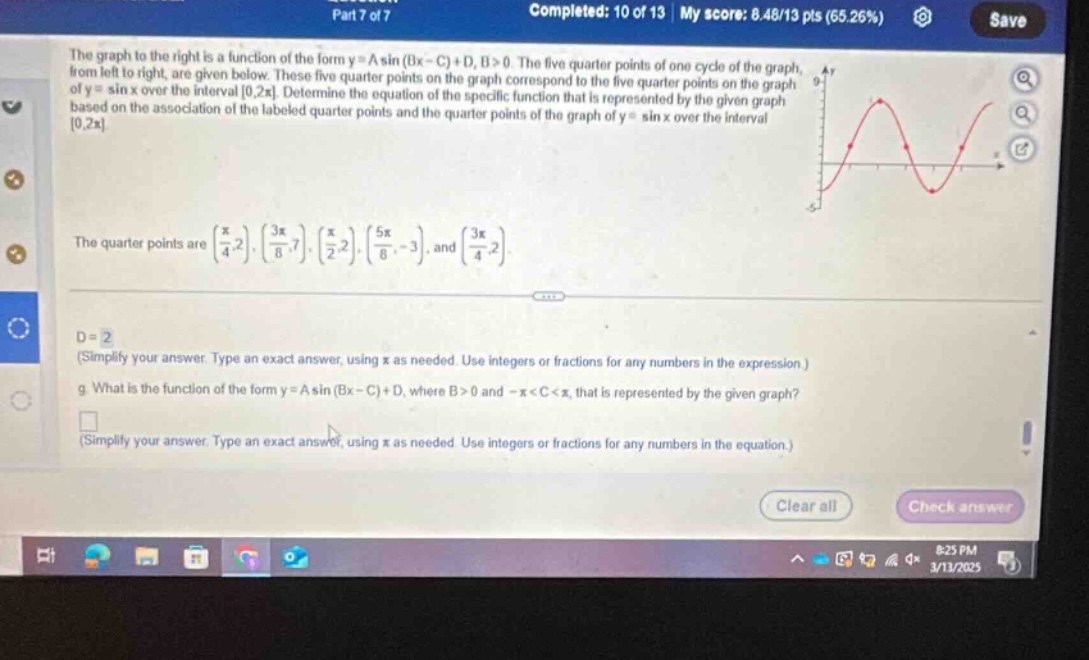
part 7 of 7 completed: 10 of 13 | my score: 8.48/13 pts (65.26%) save the graph to the right is a function of the form y = a sin (bx - c)+d, b>0. the five quarter - points of one cycle of the graph, from left to right, are given below. these five quarter - points on the graph correspond to the five quarter - points on the graph of y = sin x over the interval 0,2π. determine the equation of the specific function that is represented by the given graph based on the association of the labeled quarter - points and the quarter - points of the graph of y = sin x over the interval 0,2π. the quarter points are (π/4,2), (3π/8,7), (π/2,2), (5π/8, - 3), and (3π/4,2). d = 2 (simplify your answer. type an exact answer, using π as needed. use integers or fractions for any numbers in the expression.) g. what is the function of the form y = a sin (bx - c)+d, where b>0 and -π<c<π, that is represented by the given graph? (simplify your answer. type an exact answer, using π as needed. use integers or fractions for any numbers in the equation.) clear all check answer 8:25 pm 3/11/2025
Answer
Explanation:
Step1: Find the amplitude A
The mid - line is (y = D=2). The maximum value is (y = 7) and the minimum value is (y=-3). The amplitude (A=\frac{\text{max}-\text{min}}{2}=\frac{7 - (- 3)}{2}=\frac{10}{2}=5).
Step2: Find the period P and B
The distance between two consecutive quarter - points gives information about the period. The period (P) of a sine function is related to the horizontal distance between two corresponding quarter - points. The horizontal distance between two consecutive quarter - points: (\frac{3\pi}{4}-\frac{\pi}{4}=\frac{\pi}{2}). The period (P = 2\pi) for (y = \sin x). For the function (y = A\sin(Bx - C)+D), the period (P=\frac{2\pi}{B}). Since the horizontal distance between two consecutive quarter - points of our function is the same as that of (y=\sin x) in terms of proportion, and the period of (y=\sin x) is (2\pi), and the period of our function is also (2\pi) (because the pattern of quarter - points is the same as for (y = \sin x) over one cycle). So, if (P=\frac{2\pi}{B}=2\pi), then (B = 1).
Step3: Find the phase - shift C
The general form of the sine function is (y=A\sin(Bx - C)+D). We know that (y = \sin x) has a zero - crossing at (x = 0). For our function, when (x=\frac{\pi}{4}), (y = 2) (on the mid - line). The function (y = A\sin(Bx - C)+D) with (A = 5), (B = 1), (D = 2) becomes (y=5\sin(x - C)+2). Substituting (x=\frac{\pi}{4}) and (y = 2) into (y=5\sin(x - C)+2), we get (2=5\sin(\frac{\pi}{4}-C)+2), which simplifies to (\sin(\frac{\pi}{4}-C)=0). So, (\frac{\pi}{4}-C = k\pi), (k\in\mathbb{Z}). Since (-\pi<C<\pi), when (k = 0), (C=\frac{\pi}{4}).
Answer:
(y = 5\sin(x-\frac{\pi}{4})+2)