part a: estimate the years when the number of wild horses is increasing by larger and larger amounts…
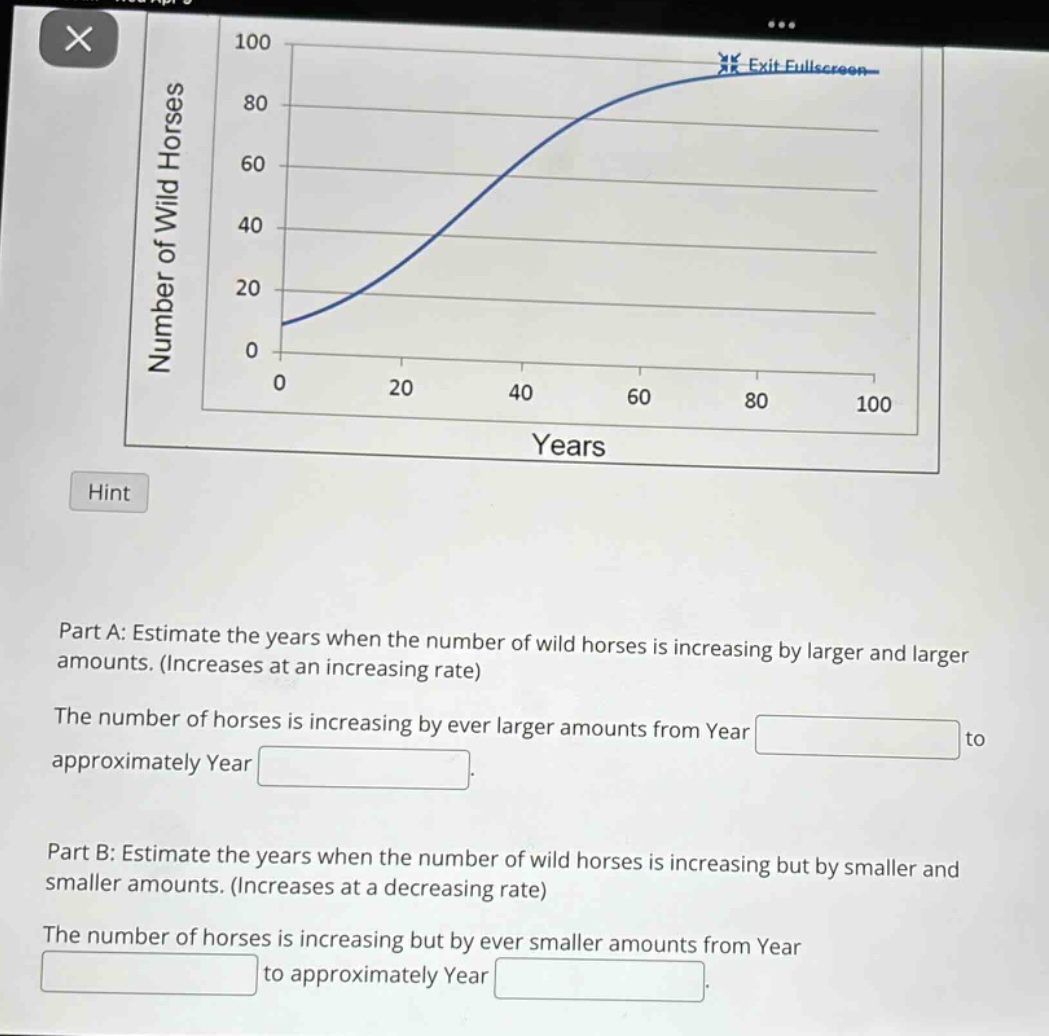
part a: estimate the years when the number of wild horses is increasing by larger and larger amounts. (increases at an increasing rate)\nthe number of horses is increasing by ever larger amounts from year blank to approximately year blank.\npart b: estimate the years when the number of wild horses is increasing but by smaller and smaller amounts. (increases at a decreasing rate)\nthe number of horses is increasing but by ever smaller amounts from year blank to approximately year blank.
Answer
Explanation:
Step1: Understand increasing - rate concept
The rate of increase of a function is related to its slope. When the function is increasing at an increasing rate, the slope is getting steeper.
Step2: Analyze the graph for increasing - at - increasing rate
Looking at the graph, the slope is getting steeper from approximately Year 0 to Year 40.
Step3: Understand decreasing - rate concept
When the function is increasing at a decreasing rate, the slope is getting less steep while still being positive.
Step4: Analyze the graph for increasing - at - decreasing rate
The slope is getting less steep (but still positive) from approximately Year 40 to Year 80.
Answer:
Part A: 0, 40 Part B: 40, 80