part 2 of 3 - finding the phase shift\nthere are two ways to find the phase shift.\none is to factor out the…
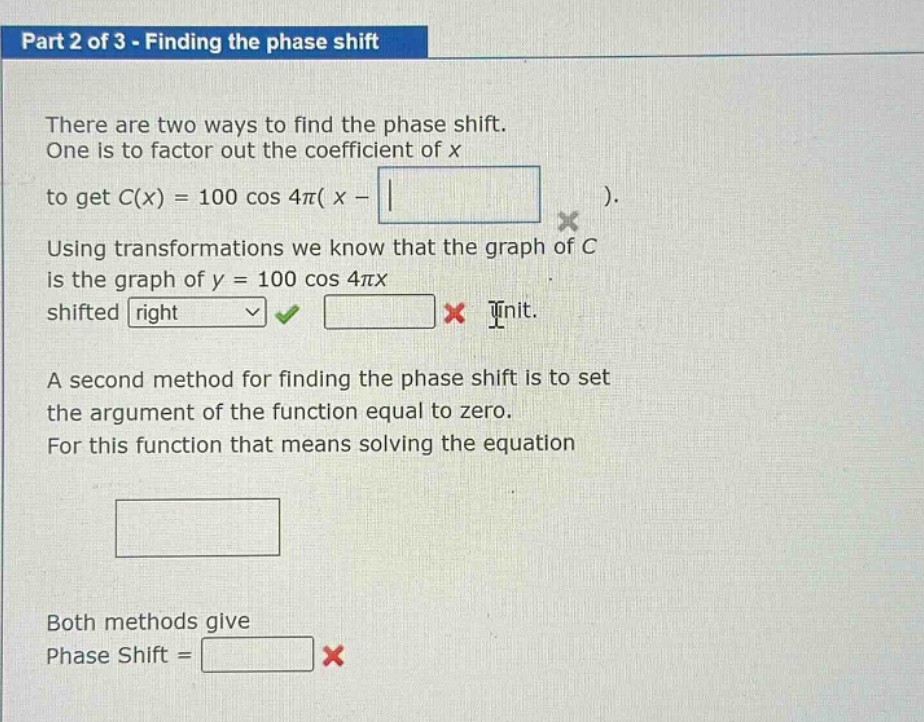
part 2 of 3 - finding the phase shift\nthere are two ways to find the phase shift.\none is to factor out the coefficient of x\nto get c(x) = 100 cos 4π( x - \n).\nusing transformations we know that the graph of c\nis the graph of y = 100 cos 4πx\nshifted right \ninit.\na second method for finding the phase shift is to set\nthe argument of the function equal to zero.\nfor this function that means solving the equation\n\nboth methods give\nphase shift =\n
Answer
Explanation:
Step1: Rewrite the cosine - function in standard form
The general form of a cosine function is $y = A\cos(B(x - h))+k$, where $h$ is the phase - shift. Given $C(x)=100\cos(4\pi(x - h))$. We want to rewrite $C(x)$ in this form. For the function $y = 100\cos(4\pi x)$, to get $C(x)=100\cos(4\pi(x - h))$, we compare the two functions.
Step2: Use the zero - argument method
Set the argument of the cosine function $4\pi(x - h)=0$. For the function $y = 100\cos(4\pi x)$, if we rewrite it as $y = 100\cos(4\pi(x - 0))$, and for $C(x)=100\cos(4\pi(x - h))$, when we set the argument equal to zero: $4\pi(x - h)=0$. Solving for $x$ gives $x = h$. In the standard form of a cosine function $y = A\cos(B(x - h))$, the phase - shift is $h$. For the function $C(x)=100\cos(4\pi(x - 0))$, the phase - shift is $0$.
Answer:
0