part 1 of 3 the function f(x) = sin(4ln x) is a composition, and so we must use the chain rule d/dxg(h(x)) =…
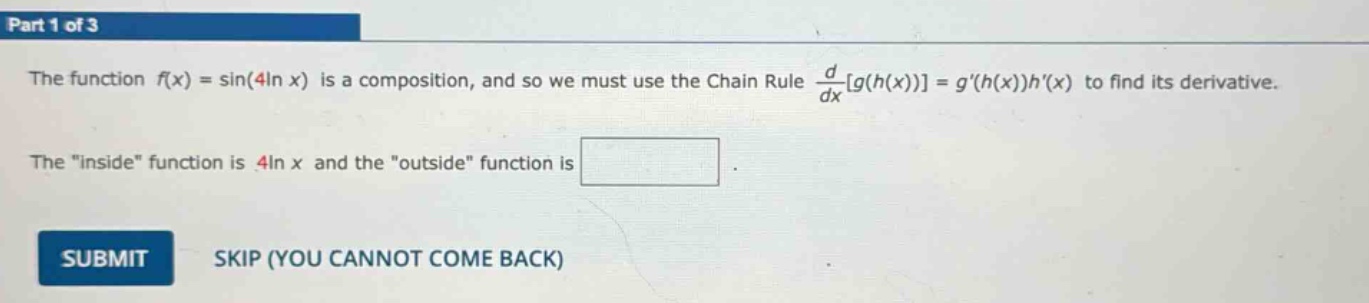
part 1 of 3 the function f(x) = sin(4ln x) is a composition, and so we must use the chain rule d/dxg(h(x)) = g(h(x))h(x) to find its derivative. the \inside\ function is 4ln x and the \outside\ function is . submit skip (you cannot come back)
Answer
Explanation:
Step1: Identify composition structure
The function $y = f(x)=\sin(4\ln x)$ is of the form $y = g(h(x))$. Here, if we let $h(x)=4\ln x$ (the inside - function), then the outside - function $g(u)$ is such that when $u = h(x)$, $y = g(u)$. Since $y=\sin(4\ln x)$ and $u = 4\ln x$, the outside - function $g(u)=\sin(u)$.
Answer:
$\sin(u)$ (where $u = 4\ln x$) or simply $\sin$ (as the function form of the outer - layer operation)