part iii section 11.3: 16, 20, 30, 38, 72, 76. a. use the definition of a taylor/maclaurin series to find…
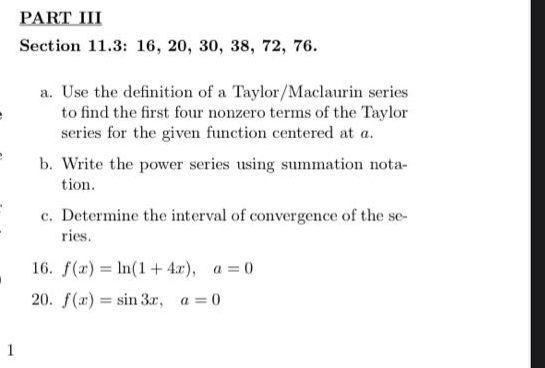
part iii section 11.3: 16, 20, 30, 38, 72, 76. a. use the definition of a taylor/maclaurin series to find the first four nonzero terms of the taylor series for the given function centered at a. b. write the power series using summation notation. c. determine the interval of convergence of the series. 16. f(x)=ln(1 + 4x), a = 0 20. f(x)=sin 3x, a = 0
Answer
Explanation:
Step1: Recall Taylor - Maclaurin series formula
The Maclaurin series of a function (f(x)) is given by (f(x)=\sum_{n = 0}^{\infty}\frac{f^{(n)}(0)}{n!}x^{n}=f(0)+f^{\prime}(0)x+\frac{f^{\prime\prime}(0)}{2!}x^{2}+\frac{f^{(3)}(0)}{3!}x^{3}+\cdots)
For (f(x)=\ln(1 + 4x)), (a = 0)
Step2: Find the first - few derivatives and their values at (x = 0)
- (f(x)=\ln(1 + 4x)), (f(0)=\ln(1+4\times0)=0)
- (f^{\prime}(x)=\frac{4}{1 + 4x}), (f^{\prime}(0)=\frac{4}{1+4\times0}=4)
- (f^{\prime\prime}(x)=-\frac{4^{2}}{(1 + 4x)^{2}}), (f^{\prime\prime}(0)=-4^{2})
- (f^{(3)}(x)=\frac{2\times4^{3}}{(1 + 4x)^{3}}), (f^{(3)}(0)=2\times4^{3})
Step3: Write the first four non - zero terms
The first four non - zero terms of the Maclaurin series are: [f(x)=0 + 4x-\frac{4^{2}}{2!}x^{2}+\frac{2\times4^{3}}{3!}x^{3}=4x-8x^{2}+\frac{32}{3}x^{3}]
Step4: Write the power series using summation notation
We know that (f^{(n)}(x)=(-1)^{n - 1}\frac{(n - 1)!4^{n}}{(1 + 4x)^{n}}), (f^{(n)}(0)=(-1)^{n - 1}(n - 1)!4^{n}) The power series is (\sum_{n = 1}^{\infty}\frac{(-1)^{n - 1}(n - 1)!4^{n}}{n!}x^{n}=\sum_{n = 1}^{\infty}\frac{(-1)^{n - 1}4^{n}}{n}x^{n})
Step5: Determine the interval of convergence
Use the ratio test. Let (a_{n}=\frac{(-1)^{n - 1}4^{n}}{n}x^{n}) [L=\lim_{n\rightarrow\infty}\left|\frac{a_{n + 1}}{a_{n}}\right|=\lim_{n\rightarrow\infty}\left|\frac{\frac{(-1)^{n}4^{n+1}}{n + 1}x^{n+1}}{\frac{(-1)^{n - 1}4^{n}}{n}x^{n}}\right|=\lim_{n\rightarrow\infty}\left|\frac{(-1)^{n}4^{n+1}n x^{n+1}}{(-1)^{n - 1}4^{n}(n + 1)x^{n}}\right|=\lim_{n\rightarrow\infty}\left|\frac{-4nx}{n + 1}\right| = 4|x|] For convergence, (L<1), so (4|x|<1), (|x|<\frac{1}{4}) When (x=\frac{1}{4}), the series becomes (\sum_{n = 1}^{\infty}\frac{(-1)^{n - 1}4^{n}}{n}(\frac{1}{4})^{n}=\sum_{n = 1}^{\infty}\frac{(-1)^{n - 1}}{n}), which is a convergent alternating harmonic series. When (x=-\frac{1}{4}), the series becomes (\sum_{n = 1}^{\infty}\frac{(-1)^{n - 1}4^{n}}{n}(-\frac{1}{4})^{n}=\sum_{n = 1}^{\infty}\frac{-1}{n}), which is a divergent harmonic series. The interval of convergence is ((-\frac{1}{4},\frac{1}{4}])
For (f(x)=\sin(3x)), (a = 0)
Step1: Recall the derivatives of (\sin t)
The derivatives of (y = \sin t) are: (y^{\prime}=\cos t), (y^{\prime\prime}=-\sin t), (y^{(3)}=-\cos t), (y^{(4)}=\sin t) and the cycle repeats. Let (t = 3x)
Step2: Find the first - few derivatives and their values at (x = 0)
- (f(x)=\sin(3x)), (f(0)=\sin(0)=0)
- (f^{\prime}(x)=3\cos(3x)), (f^{\prime}(0)=3)
- (f^{\prime\prime}(x)=-3^{2}\sin(3x)), (f^{\prime\prime}(0)=0)
- (f^{(3)}(x)=-3^{3}\cos(3x)), (f^{(3)}(0)=-3^{3})
- (f^{(4)}(x)=3^{4}\sin(3x)), (f^{(4)}(0)=0)
- (f^{(5)}(x)=3^{5}\cos(3x)), (f^{(5)}(0)=3^{5})
Step3: Write the first four non - zero terms
The first four non - zero terms of the Maclaurin series are: [f(x)=0 + 3x+0-\frac{3^{3}}{3!}x^{3}+0+\frac{3^{5}}{5!}x^{5}=3x-\frac{9}{2}x^{3}+\frac{81}{40}x^{5}]
Step4: Write the power series using summation notation
The general formula for the Maclaurin series of (\sin(3x)) is (\sum_{n = 0}^{\infty}\frac{(-1)^{n}(3x)^{2n + 1}}{(2n+1)!})
Step5: Determine the interval of convergence
Use the ratio test. Let (a_{n}=\frac{(-1)^{n}(3x)^{2n + 1}}{(2n+1)!}) [L=\lim_{n\rightarrow\infty}\left|\frac{a_{n + 1}}{a_{n}}\right|=\lim_{n\rightarrow\infty}\left|\frac{\frac{(-1)^{n+1}(3x)^{2(n + 1)+1}}{(2(n + 1)+1)!}}{\frac{(-1)^{n}(3x)^{2n + 1}}{(2n+1)!}}\right|=\lim_{n\rightarrow\infty}\left|\frac{(-1)^{n+1}(3x)^{2n+3}(2n + 1)!}{(-1)^{n}(3x)^{2n + 1}(2n+3)!}\right|=\lim_{n\rightarrow\infty}\left|\frac{(3x)^{2}}{(2n + 2)(2n+3)}\right| = 0] Since (L = 0<1) for all (x\in(-\infty,\infty)), the interval of convergence is ((-\infty,\infty))
Answer:
For (f(x)=\ln(1 + 4x)):
- First four non - zero terms: (4x-8x^{2}+\frac{32}{3}x^{3})
- Power series: (\sum_{n = 1}^{\infty}\frac{(-1)^{n - 1}4^{n}}{n}x^{n})
- Interval of convergence: ((-\frac{1}{4},\frac{1}{4}])
For (f(x)=\sin(3x)):
- First four non - zero terms: (3x-\frac{9}{2}x^{3}+\frac{81}{40}x^{5})
- Power series: (\sum_{n = 0}^{\infty}\frac{(-1)^{n}(3x)^{2n + 1}}{(2n+1)!})
- Interval of convergence: ((-\infty,\infty))