part a\nwhat is the phase shift of the graph of $y = -\\sin(x + \\frac{\\pi}{4})+2$?\na. $\\frac{\\pi}{4}$…
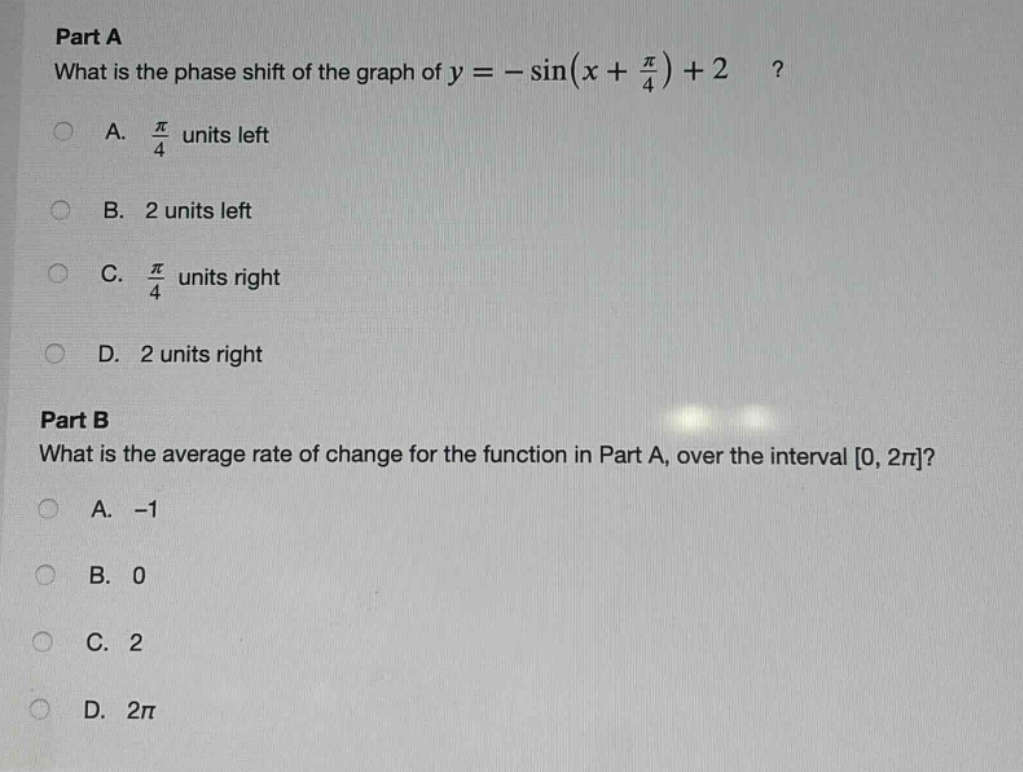
part a\nwhat is the phase shift of the graph of $y = -\\sin(x + \\frac{\\pi}{4})+2$?\na. $\\frac{\\pi}{4}$ units left\nb. 2 units left\nc. $\\frac{\\pi}{4}$ units right\nd. 2 units right\npart b\nwhat is the average rate of change for the function in part a, over the interval $0, 2\\pi$?\na. -1\nb. 0\nc. 2\nd. $2\\pi$
Answer
Explanation:
Step1: Recall phase - shift formula
For the sine function $y = A\sin(Bx - C)+D$, the phase - shift is given by $\frac{C}{B}$. In the function $y =-\sin(x+\frac{\pi}{4}) + 2$, we can rewrite it as $y=-\sin(x-(-\frac{\pi}{4}))+2$, where $A=- 1$, $B = 1$, $C=-\frac{\pi}{4}$, $D = 2$. The phase - shift is $\frac{-\frac{\pi}{4}}{1}=-\frac{\pi}{4}$. A negative phase - shift means a shift to the left. So the phase - shift is $\frac{\pi}{4}$ units left.
Step2: Recall average rate of change formula
The average rate of change of a function $y = f(x)$ over the interval $[a,b]$ is $\frac{f(b)-f(a)}{b - a}$. For $y =-\sin(x+\frac{\pi}{4})+2$ with $a = 0$ and $b = 2\pi$: First, find $f(0)$: $f(0)=-\sin(0+\frac{\pi}{4})+2=-\frac{\sqrt{2}}{2}+2$. Then, find $f(2\pi)$: $f(2\pi)=-\sin(2\pi+\frac{\pi}{4})+2=-\frac{\sqrt{2}}{2}+2$. Now, calculate the average rate of change: $\frac{f(2\pi)-f(0)}{2\pi - 0}=\frac{(-\frac{\sqrt{2}}{2}+2)-(-\frac{\sqrt{2}}{2}+2)}{2\pi}=0$.
Answer:
Part A: A. $\frac{\pi}{4}$ units left Part B: B. 0