part i: show all work for full credit. evaluate the definite int leave all answers in exact form. 1…
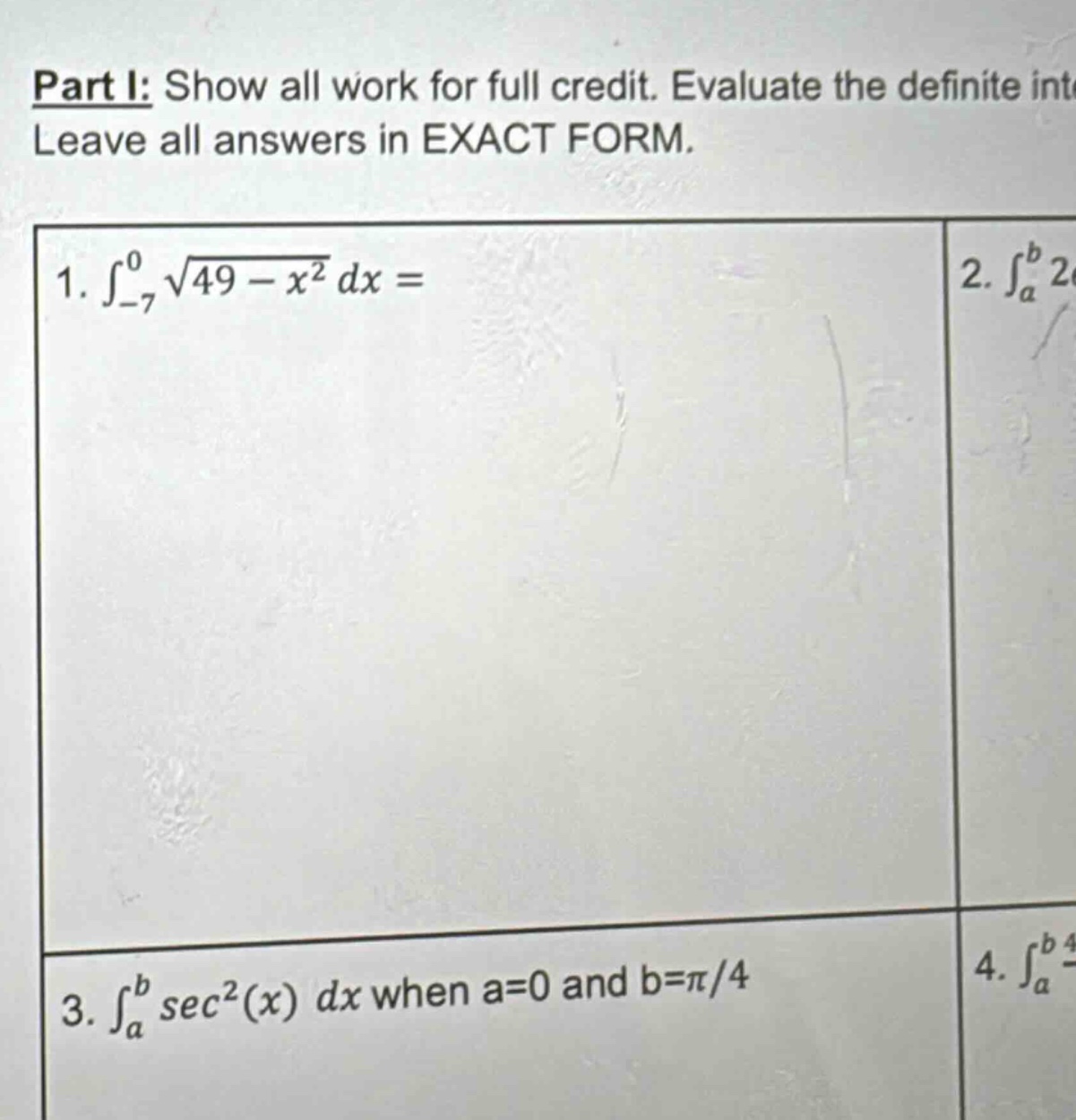
part i: show all work for full credit. evaluate the definite int leave all answers in exact form. 1. ∫−7049−x2 dx = 2. ∫ab 2 3. ∫absec2(x) dx when a = 0 and b = π/4 4. ∫ab 4
Answer
Answer:
- $\frac{49\pi}{4}$
- $1$
Explanation:
Step1: For $\int_{-7}^{0}\sqrt{49 - x^{2}}dx$, use trig - substitution
Let $x = 7\sin\theta$, then $dx=7\cos\theta d\theta$. When $x=-7$, $\theta =-\frac{\pi}{2}$; when $x = 0$, $\theta=0$. The integral becomes $\int_{-\frac{\pi}{2}}^{0}\sqrt{49 - 49\sin^{2}\theta}\cdot7\cos\theta d\theta=\int_{-\frac{\pi}{2}}^{0}7\cos\theta\cdot7\cos\theta d\theta = 49\int_{-\frac{\pi}{2}}^{0}\cos^{2}\theta d\theta$. Since $\cos^{2}\theta=\frac{1 + \cos(2\theta)}{2}$, we have $49\int_{-\frac{\pi}{2}}^{0}\frac{1+\cos(2\theta)}{2}d\theta$.
Step2: Integrate term - by - term
$49\left[\frac{1}{2}\theta+\frac{1}{4}\sin(2\theta)\right]_{-\frac{\pi}{2}}^{0}=49\left(0 - \left(-\frac{\pi}{4}+0\right)\right)=\frac{49\pi}{4}$.
Step3: For $\int_{a}^{b}\sec^{2}(x)dx$ with $a = 0$ and $b=\frac{\pi}{4}$
Recall the antiderivative of $\sec^{2}(x)$ is $\tan(x)$.
Step4: Apply the fundamental theorem of calculus
$\int_{0}^{\frac{\pi}{4}}\sec^{2}(x)dx=\left[\tan(x)\right]_{0}^{\frac{\pi}{4}}=\tan\left(\frac{\pi}{4}\right)-\tan(0)=1 - 0=1$.