part 5 of 5 write the domain and range of the function using interval notation. then analyze the intercepts…
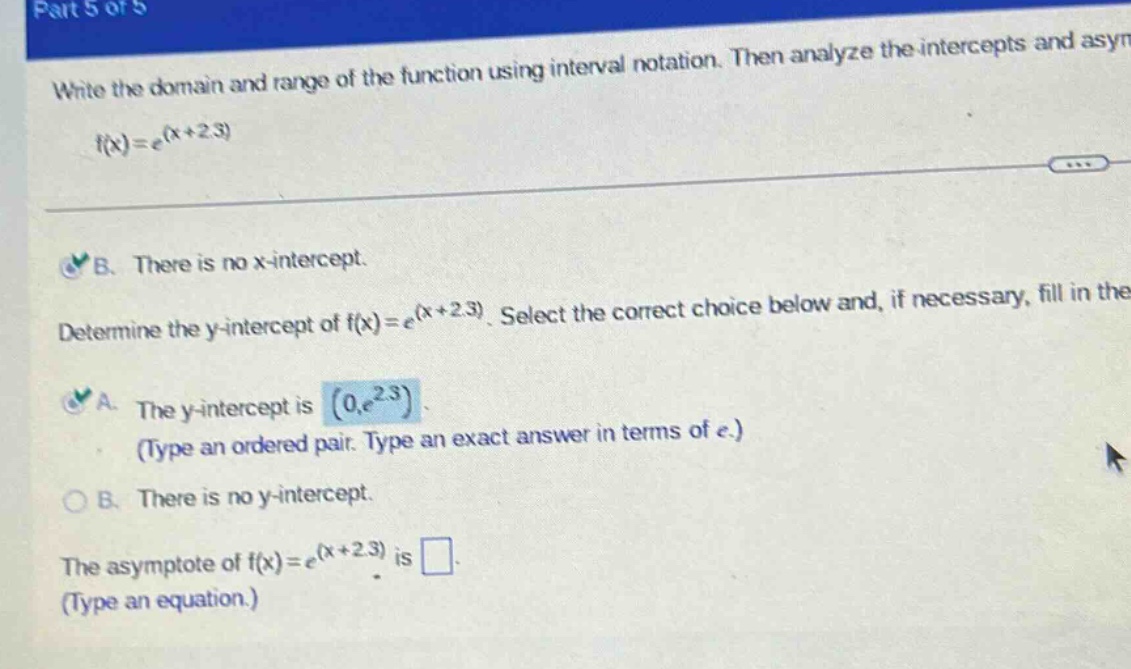
part 5 of 5 write the domain and range of the function using interval notation. then analyze the intercepts and asym f(x)=e^(x + 2.3) b. there is no x - intercept. determine the y - intercept of f(x)=e^(x + 2.3). select the correct choice below and, if necessary, fill in the a. the y - intercept is (0,e^2.3) (type an ordered pair. type an exact answer in terms of e.) b. there is no y - intercept. the asymptote of f(x)=e^(x + 2.3) is (type an equation.)
Answer
Explanation:
Step1: Find the domain
The exponential - function $y = e^{u}$ is defined for all real values of $u$. Here $u=x + 2.3$, and $x\in(-\infty,\infty)$. So the domain of $f(x)=e^{(x + 2.3)}$ is $(-\infty,\infty)$.
Step2: Find the range
The exponential function $y = e^{u}$ has a range of $(0,\infty)$. Since $u=x + 2.3$ and $e^{(x + 2.3)}>0$ for all $x\in R$, the range of $f(x)$ is $(0,\infty)$.
Step3: Find the asymptote
As $x\to-\infty$, $u=x + 2.3\to-\infty$, and $\lim_{x\to-\infty}e^{(x + 2.3)} = 0$. So the horizontal asymptote is $y = 0$.
Answer:
Domain: $(-\infty,\infty)$ Range: $(0,\infty)$ Asymptote: $y = 0$