a particle moves according to a law of motion s = f(t)=t³ - 9t² + 15t, t≥0, where t is measured in seconds…
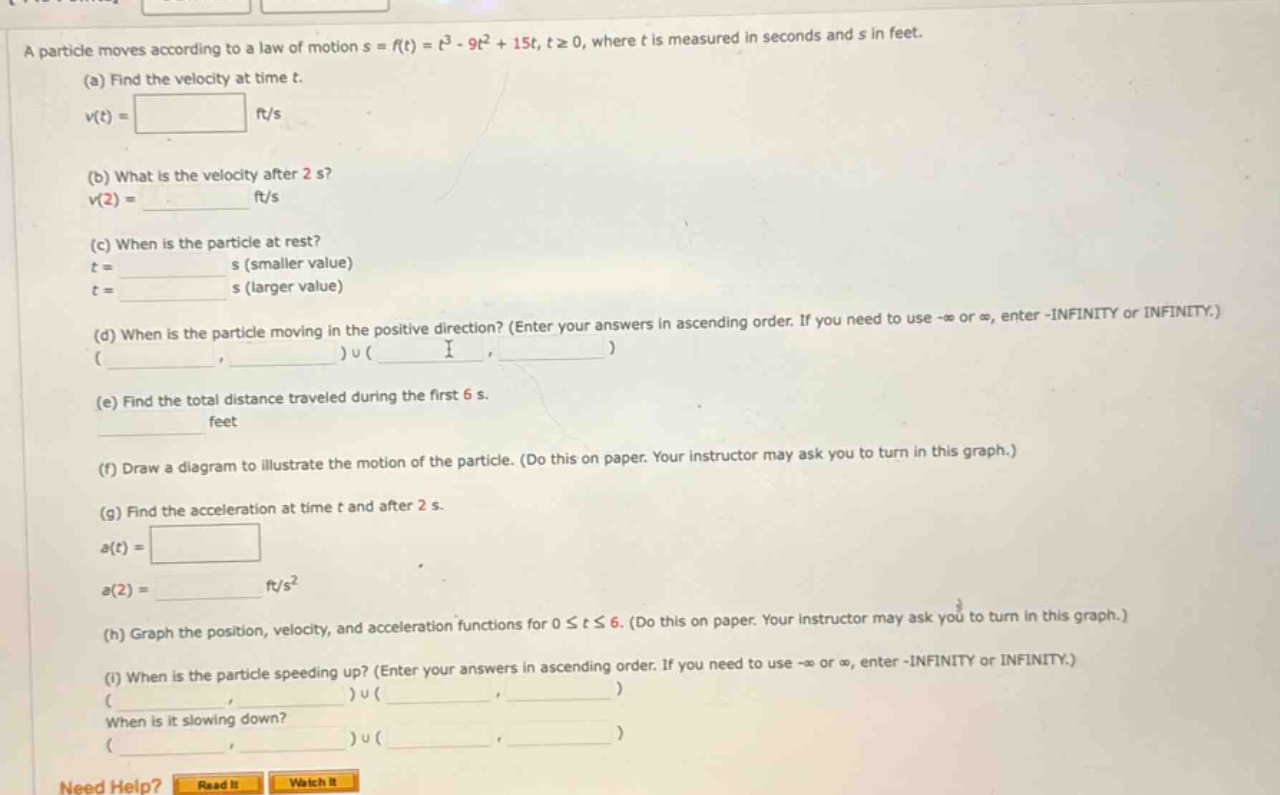
a particle moves according to a law of motion s = f(t)=t³ - 9t² + 15t, t≥0, where t is measured in seconds and s in feet. (a) find the velocity at time t. v(t)= ft/s (b) what is the velocity after 2 s? v(2)= ft/s (c) when is the particle at rest? t = s (smaller value) t = s (larger value) (d) when is the particle moving in the positive direction? (enter your answers in ascending order. if you need to use -∞ or ∞, enter -infinity or infinity.) ( )u( ) (e) find the total distance traveled during the first 6 s. feet (f) draw a diagram to illustrate the motion of the particle. (do this on paper. your instructor may ask you to turn in this graph.) (g) find the acceleration at time t and after 2 s. a(t)= a(2)= ft/s² (h) graph the position, velocity, and acceleration functions for 0≤t≤6. (do this on paper. your instructor may ask you to turn in this graph.) (i) when is the particle speeding up? (enter your answers in ascending order. if you need to use -∞ or ∞, enter -infinity or infinity.) ( )u( ) when is it slowing down? ( )u( )
Answer
Explanation:
Step1: Recall velocity - displacement relation
Velocity $v(t)$ is the derivative of displacement $s(t)$. Given $s(t)=t^{3}-9t^{2}+15t$, by the power - rule of differentiation $\frac{d}{dt}(t^{n}) = nt^{n - 1}$, we have $v(t)=\frac{d}{dt}(t^{3}-9t^{2}+15t)=3t^{2}-18t + 15$.
Step2: Find velocity at $t = 2$
Substitute $t = 2$ into $v(t)$. $v(2)=3(2)^{2}-18(2)+15=3\times4-36 + 15=12-36 + 15=-9$ ft/s.
Step3: Find when particle is at rest
The particle is at rest when $v(t)=0$. So, set $3t^{2}-18t + 15 = 0$. Divide through by 3: $t^{2}-6t + 5=0$. Factor the quadratic equation: $(t - 1)(t - 5)=0$. Solving for $t$, we get $t = 1$ s and $t = 5$ s.
Step4: Find when particle moves in positive direction
The particle moves in the positive direction when $v(t)>0$. Since $v(t)=3t^{2}-18t + 15=3(t^{2}-6t + 5)=3(t - 1)(t - 5)$, we consider the intervals determined by $t = 1$ and $t = 5$. Testing intervals $[0,1)$, $(1,5)$ and $(5,\infty)$:
- For $t\in[0,1)$, let $t = 0.5$, then $v(0.5)=3(0.5 - 1)(0.5 - 5)=3\times(-0.5)\times(-4.5)>0$.
- For $t\in(1,5)$, let $t = 2$, then $v(2)=3(2 - 1)(2 - 5)=3\times1\times(-3)<0$.
- For $t\in(5,\infty)$, let $t = 6$, then $v(6)=3(6 - 1)(6 - 5)=3\times5\times1>0$. So, the particle moves in the positive direction on the intervals $[0,1)\cup(5,\infty)$.
Step5: Find total distance traveled in first 6 s
The total distance $D$ is given by $D=\int_{0}^{6}|v(t)|dt$. Since $v(t)=3(t - 1)(t - 5)$, we split the integral based on the sign - changes of $v(t)$ at $t = 1$ and $t = 5$. $D=\int_{0}^{1}(3t^{2}-18t + 15)dt-\int_{1}^{5}(3t^{2}-18t + 15)dt+\int_{5}^{6}(3t^{2}-18t + 15)dt$. $\int(3t^{2}-18t + 15)dt=t^{3}-9t^{2}+15t+C$. $\int_{0}^{1}(3t^{2}-18t + 15)dt=(1^{3}-9\times1^{2}+15\times1)-(0)=7$. $\int_{1}^{5}(3t^{2}-18t + 15)dt=(5^{3}-9\times5^{2}+15\times5)-(1^{3}-9\times1^{2}+15\times1)=(125-225 + 75)-7=-32$. $\int_{5}^{6}(3t^{2}-18t + 15)dt=(6^{3}-9\times6^{2}+15\times6)-(5^{3}-9\times5^{2}+15\times5)=(216-324+90)-(125 - 225+75)=7$. $D = 7+32 + 7=46$ feet.
Step6: Recall acceleration - velocity relation
Acceleration $a(t)$ is the derivative of velocity $v(t)$. Since $v(t)=3t^{2}-18t + 15$, then $a(t)=\frac{d}{dt}(3t^{2}-18t + 15)=6t-18$.
Step7: Find acceleration at $t = 2$
Substitute $t = 2$ into $a(t)$. $a(2)=6\times2-18=-6$ ft/s².
Step8: Determine when particle is speeding up/slowing down
The particle is speeding up when $v(t)$ and $a(t)$ have the same sign, and slowing down when they have opposite signs. $a(t)=6t - 18$, $v(t)=3(t - 1)(t - 5)$. $a(t)=0$ when $t = 3$.
- For $t\in(0,1)$, $v(t)>0$ and $a(t)=6t-18<0$, so the particle is slowing down.
- For $t\in(1,3)$, $v(t)<0$ and $a(t)<0$, so the particle is speeding up.
- For $t\in(3,5)$, $v(t)<0$ and $a(t)>0$, so the particle is slowing down.
- For $t\in(5,\infty)$, $v(t)>0$ and $a(t)>0$, so the particle is speeding up. The particle is speeding up on the intervals $(1,3)\cup(5,\infty)$ and slowing down on the intervals $(0,1)\cup(3,5)$.
Answer:
(a) $v(t)=3t^{2}-18t + 15$ (b) $v(2)=-9$ (c) $t = 1$, $t = 5$ (d) $0$, $1$, $5$, $\infty$ (e) $46$ (g) $a(t)=6t-18$, $a(2)=-6$ (i) $1$, $3$, $5$, $\infty$ (j) $0$, $1$, $3$, $5$