1. a particle moves along the x - axis so that at any time t≥0, its velocity is given by v(t)=3 +…
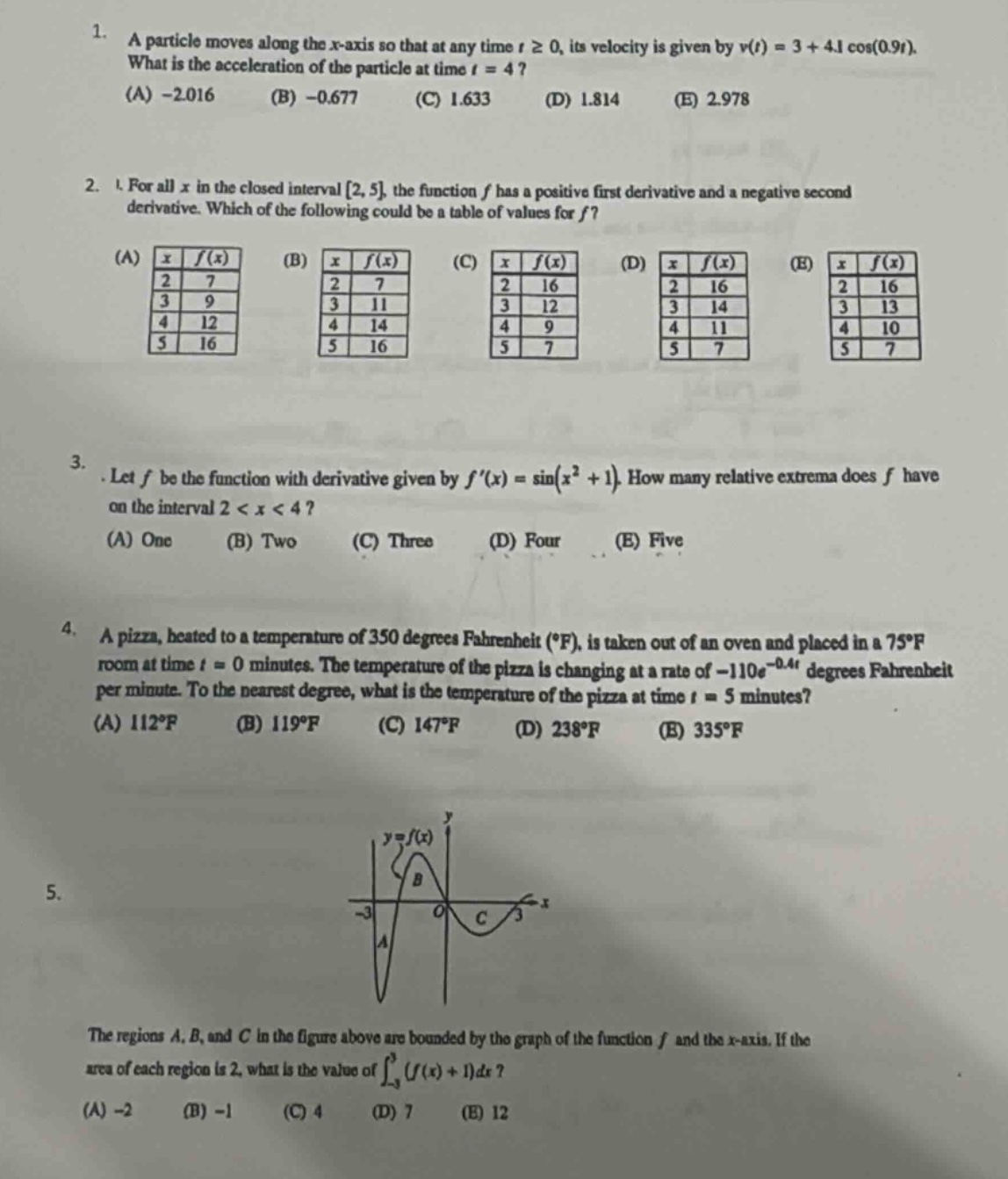
1. a particle moves along the x - axis so that at any time t≥0, its velocity is given by v(t)=3 + 4.1cos(0.9t). what is the acceleration of the particle at time t = 4? (a) - 2.016 (b) - 0.677 (c) 1.633 (d) 1.814 (e) 2.978\n2. for all x in the closed interval 2, 5, the function f has a positive first derivative and a negative second derivative. which of the following could be a table of values for f? (a) x f(x) 2 7 3 9 4 12 5 16 (b) x f(x) 2 7 3 11 4 14 5 16 (c) x f(x) 2 16 3 12 4 9 5 7 (d) x f(x) 2 16 3 14 4 11 5 7 (e) x f(x) 2 16 3 13 4 10 5 7\n3. let f be the function with derivative given by f(x)=sin(x² + 1). how many relative extrema does f have on the interval 2 < x < 4? (a) one (b) two (c) three (d) four (e) five\n4. a pizza, heated to a temperature of 350 degrees fahrenheit (°f), is taken out of an oven and placed in a 75°f room at time t = 0 minutes. the temperature of the pizza is changing at a rate of - 110e^(-0.4t) degrees fahrenheit per minute. to the nearest degree, what is the temperature of the pizza at time t = 5 minutes? (a) 112°f (b) 119°f (c) 147°f (d) 238°f (e) 335°f\n5. the regions a, b, and c in the figure above are bounded by the graph of the function f and the x - axis. if the area of each region is 2, what is the value of ∫-3,3(f(x)+1)dx? (a) - 2 (b) - 1 (c) 4 (d) 7 (e) 12
Answer
Explanation:
Step1: Recall the relationship between velocity and acceleration
Acceleration $a(t)$ is the derivative of velocity $v(t)$. Given $v(t)=3 + 4.1\cos(0.9t)$, by the chain - rule, $a(t)=v^\prime(t)=-4.1\times0.9\sin(0.9t)=- 3.69\sin(0.9t)$.
Step2: Evaluate the acceleration at $t = 4$
Substitute $t = 4$ into $a(t)$: $a(4)=-3.69\sin(0.9\times4)=-3.69\sin(3.6)$. Using a calculator, $\sin(3.6)\approx0.546$, so $a(4)=-3.69\times0.546\approx - 2.016$.
Answer:
A. -2.016
Explanation:
Step1: Analyze the properties of the function
A positive first - derivative means the function is increasing, and a negative second - derivative means the function is concave down. For an increasing function, $f(x_2)>f(x_1)$ when $x_2>x_1$. For a concave - down function, the rate of increase is decreasing. In option (A), the differences between consecutive $y$ - values are $9 - 7=2$, $12 - 9 = 3$, $16 - 12 = 4$, which means the function is increasing at an increasing rate (concave up). In option (B), the differences are $11 - 7 = 4$, $14 - 11 = 3$, $16 - 14 = 2$, which means the function is increasing at a decreasing rate (concave down). In options (C), (D), and (E), the function is decreasing.
Answer:
B.
| $x$ | $f(x)$ |
|---|---|
| 2 | 7 |
| 3 | 11 |
| 4 | 14 |
| 5 | 16 |
Explanation:
Step1: Recall the condition for relative extrema
A function $y = f(x)$ has a relative extremum at a point $c$ in its domain if $f^\prime(c)=0$ and $f^\prime(x)$ changes sign at $x = c$. We need to find the number of solutions of $f^\prime(x)=\sin(x^{2}+1)=0$ in the interval $2\lt x\lt4$. Let $u=x^{2}+1$. When $x = 2$, $u=2^{2}+1 = 5$; when $x = 4$, $u=4^{2}+1=17$. We know that $\sin(u)=0$ when $u = k\pi,k\in\mathbb{Z}$. In the interval $[5,17]$, $\sin(u)=0$ when $u=\pi\approx3.14$ (not in our range), $2\pi\approx6.28$, $3\pi\approx9.42$, $4\pi\approx12.56$, $5\pi\approx15.7$. So there are three values of $u$ in $[5,17]$ for which $\sin(u)=0$, and thus three values of $x$ in $(2,4)$ for which $f^\prime(x)=0$.
Answer:
C. Three
Explanation:
Step1: Set up the integral for the temperature change
The rate of change of temperature is $T^\prime(t)=-110e^{-0.4t}$. The temperature function $T(t)$ can be found by integrating $T^\prime(t)$: $T(t)=T(0)+\int_{0}^{t}T^\prime(s)ds$. We know $T(0) = 350$ and $T^\prime(s)=-110e^{-0.4s}$. Then $\int_{0}^{t}-110e^{-0.4s}ds=-110\int_{0}^{t}e^{-0.4s}ds$. Let $u=-0.4s$, $du=-0.4ds$. When $s = 0$, $u = 0$; when $s=t$, $u=-0.4t$. So $\int_{0}^{t}e^{-0.4s}ds=\frac{1}{-0.4}[e^{-0.4s}]_{0}^{t}=-\frac{1}{0.4}(e^{-0.4t}-1)$. Then $T(t)=350 - 110\times\frac{1}{-0.4}(e^{-0.4t}-1)=350 + 275(e^{-0.4t}-1)$. When $t = 5$, $T(5)=350+275(e^{-0.4\times5}-1)=350+275(e^{-2}-1)$. Since $e^{-2}\approx0.135$, $T(5)=350+275(0.135 - 1)=350+275\times(-0.865)=350-237.875\approx112$.
Answer:
A. $112^{\circ}F$
Explanation:
Step1: Use the property of definite integrals
We know that $\int_{-3}^{3}(f(x)+1)dx=\int_{-3}^{3}f(x)dx+\int_{-3}^{3}1dx$. The integral $\int_{-3}^{3}f(x)dx$ is the net - signed area between the graph of $y = f(x)$ and the $x$ - axis. The area of region $A$ is negative (below the $x$ - axis), and the areas of regions $B$ and $C$ are positive. Since the area of each region is 2, $\int_{-3}^{3}f(x)dx=-2 + 2-2=-2$. Also, $\int_{-3}^{3}1dx=x|{-3}^{3}=3-(-3)=6$. Then $\int{-3}^{3}(f(x)+1)dx=-2 + 6=4$.
Answer:
C. 4