a particle moves along the x - axis so that its position at time 0 ≤ t ≤ 18 is given by x(t), whose graph is…
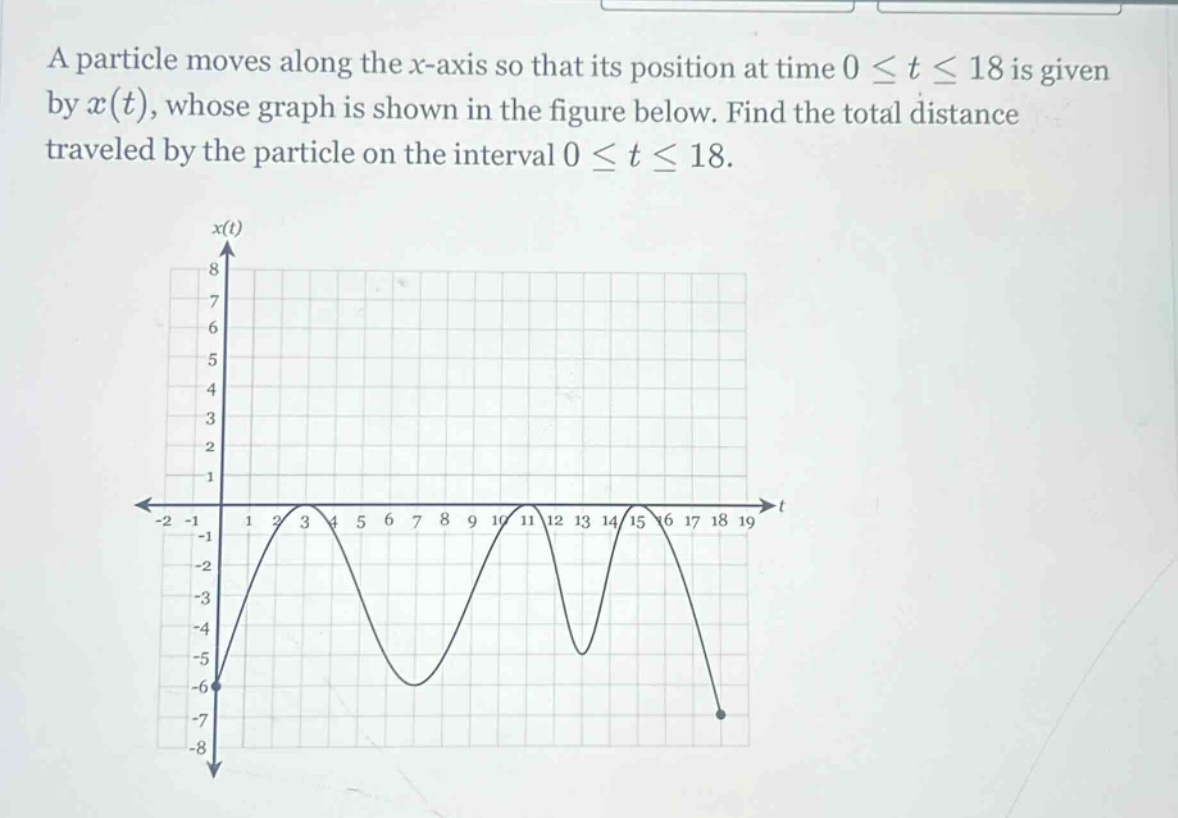
a particle moves along the x - axis so that its position at time 0 ≤ t ≤ 18 is given by x(t), whose graph is shown in the figure below. find the total distance traveled by the particle on the interval 0 ≤ t ≤ 18.
Answer
Explanation:
Step1: Identify intervals of motion
The particle moves in segments. We need to find the change in position in each segment where the direction doesn't change.
Step2: Calculate distance for first - segment (0 to 3)
From (t = 0) to (t=3), (x(0)= - 6) and (x(3)=0). The distance (d_1=\vert x(3)-x(0)\vert=\vert0 - (-6)\vert = 6).
Step3: Calculate distance for second - segment (3 to 6)
From (t = 3) to (t = 6), (x(3)=0) and (x(6)= - 6). The distance (d_2=\vert x(6)-x(3)\vert=\vert-6 - 0\vert = 6).
Step4: Calculate distance for third - segment (6 to 9)
From (t = 6) to (t = 9), (x(6)= - 6) and (x(9)=0). The distance (d_3=\vert x(9)-x(6)\vert=\vert0-(-6)\vert = 6).
Step5: Calculate distance for fourth - segment (9 to 12)
From (t = 9) to (t = 12), (x(9)=0) and (x(12)= - 6). The distance (d_4=\vert x(12)-x(9)\vert=\vert-6 - 0\vert = 6).
Step6: Calculate distance for fifth - segment (12 to 15)
From (t = 12) to (t = 15), (x(12)= - 6) and (x(15)=0). The distance (d_5=\vert x(15)-x(12)\vert=\vert0-(-6)\vert = 6).
Step7: Calculate distance for sixth - segment (15 to 18)
From (t = 15) to (t = 18), (x(15)=0) and (x(18)= - 7). The distance (d_6=\vert x(18)-x(15)\vert=\vert-7 - 0\vert = 7).
Step8: Sum up distances
The total distance (D=d_1 + d_2+d_3+d_4+d_5+d_6=6 + 6+6+6+6+7=37).
Answer:
37