2. particle q moves along the x - axis so that its velocity at any time t is given by v_q(t)=1…
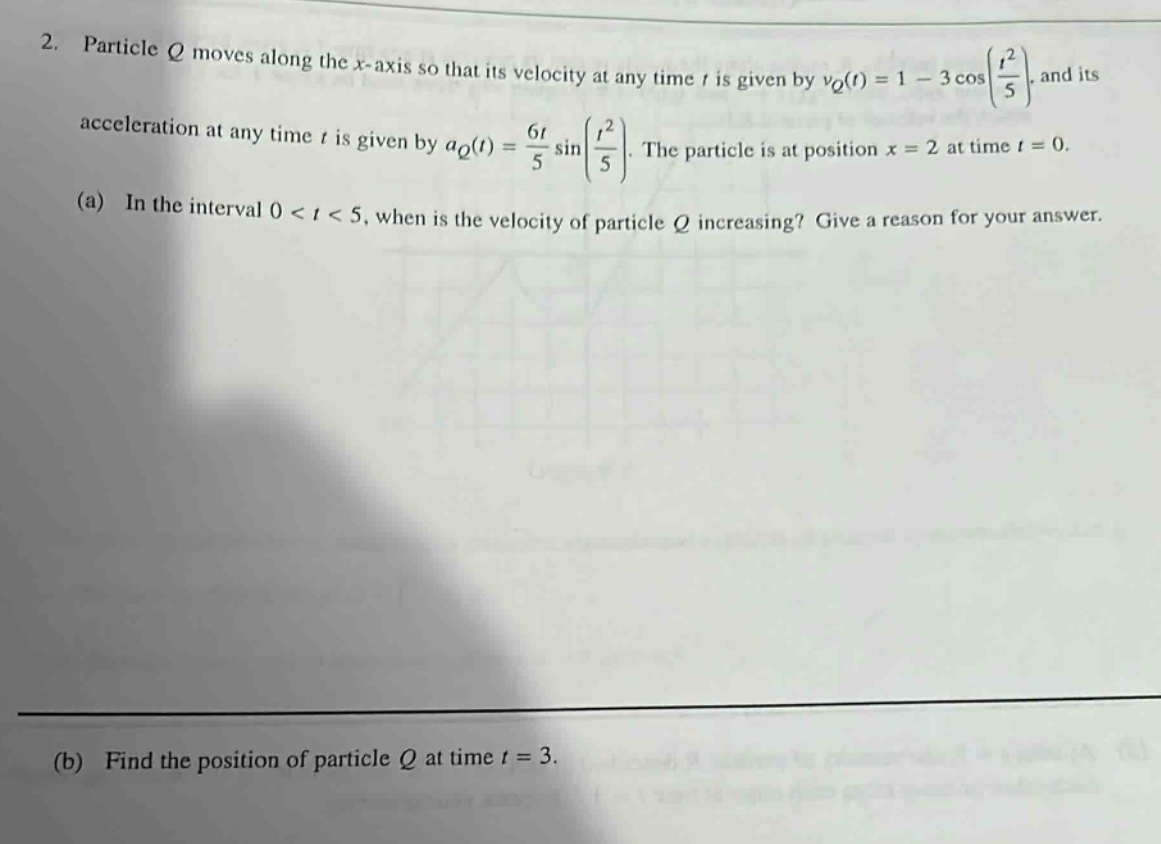
2. particle q moves along the x - axis so that its velocity at any time t is given by v_q(t)=1 - 3cos(t^2/5), and its acceleration at any time t is given by a_q(t)=6t/5 sin(t^2/5). the particle is at position x = 2 at time t = 0. (a) in the interval 0 < t < 5, when is the velocity of particle q increasing? give a reason for your answer. (b) find the position of particle q at time t = 3.
Answer
Explanation:
Step1: Recall the relationship between velocity and acceleration
The velocity $v(t)$ of a particle is increasing when its acceleration $a(t)>0$. We are given $a_Q(t)=\frac{6t}{5}\sin(\frac{t^{2}}{5})$ and the interval $0 < t<5$. Since $t>0$ in the interval $(0,5)$, we only need to consider when $\sin(\frac{t^{2}}{5})>0$.
Step2: Solve the inequality for $\sin(\frac{t^{2}}{5})>0$
Let $u = \frac{t^{2}}{5}$. We know that $\sin(u)>0$ when $2k\pi<u<(2k + 1)\pi,k = 0,1,2,\cdots$. For $k = 0$, $0<\frac{t^{2}}{5}<\pi$, so $0<t<\sqrt{5\pi}\approx 3.96$. Since we are in the interval $0 < t<5$, the velocity of particle $Q$ is increasing when $0 < t<\sqrt{5\pi}$.
Step3: Recall the position - velocity relationship for part (b)
The position function $x(t)$ of a particle is related to the velocity function $v(t)$ by $x(t)-x(0)=\int_{0}^{t}v(s)ds$. We know that $x(0) = 2$ and $v_Q(t)=1 - 3\cos(\frac{t^{2}}{5})$. So $x(t)=2+\int_{0}^{t}(1 - 3\cos(\frac{s^{2}}{5}))ds$.
Step4: Evaluate the integral for $t = 3$
$x(3)=2+\int_{0}^{3}(1 - 3\cos(\frac{s^{2}}{5}))ds=2+\left[s-3\int_{0}^{3}\cos(\frac{s^{2}}{5})ds\right]$. We use a calculator to evaluate $\int_{0}^{3}\cos(\frac{s^{2}}{5})ds$. Let $u=\frac{s^{2}}{5}$, then $du=\frac{2s}{5}ds$. $\int_{0}^{3}\cos(\frac{s^{2}}{5})ds$ can be evaluated numerically. Using a calculator, $\int_{0}^{3}\cos(\frac{s^{2}}{5})ds\approx 2.30$. $x(3)=2+(3-3\times2.30)=2 + 3-6.9=-1.9$
Answer:
(a) The velocity of particle $Q$ is increasing for $0 < t<\sqrt{5\pi}$ because the velocity of a particle is increasing when its acceleration $a(t)>0$, and for $a_Q(t)=\frac{6t}{5}\sin(\frac{t^{2}}{5})$ with $t\in(0,5)$, $a_Q(t)>0$ when $\sin(\frac{t^{2}}{5})>0$. (b) $x(3)\approx - 1.9$