a particle moves along the curve y = -2x² - 4x - 9 in such a way that as it moves, dx/dt = 8 units/minute…
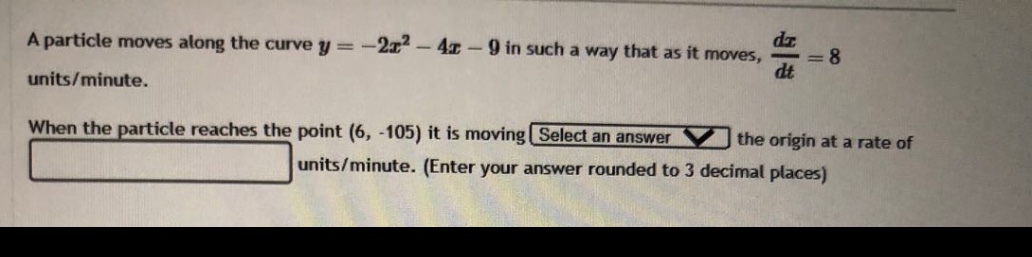
a particle moves along the curve y = -2x² - 4x - 9 in such a way that as it moves, dx/dt = 8 units/minute. when the particle reaches the point (6, -105) it is moving select an answer the origin at a rate of units/minute. (enter your answer rounded to 3 decimal places)
Answer
Explanation:
Step1: Differentiate the curve equation with respect to $t$
Using the chain - rule, if $y=-2x^{2}-4x - 9$, then $\frac{dy}{dt}=(-4x - 4)\frac{dx}{dt}$. Given $\frac{dx}{dt}=8$, so $\frac{dy}{dt}=(-4x - 4)\times8=-32x-32$.
Step2: Find $\frac{dy}{dt}$ at $x = 6$
Substitute $x = 6$ into the equation for $\frac{dy}{dt}$: $\frac{dy}{dt}=-32\times6-32=-192 - 32=-224$.
Step3: Find the rate of change of the distance from the origin
The distance $s$ from the origin to the point $(x,y)$ is $s=\sqrt{x^{2}+y^{2}}$. Differentiating both sides with respect to $t$ using the chain - rule gives $\frac{ds}{dt}=\frac{x\frac{dx}{dt}+y\frac{dy}{dt}}{\sqrt{x^{2}+y^{2}}}$. When $x = 6$ and $y=-105$, $\frac{dx}{dt}=8$ and $\frac{dy}{dt}=-224$. Substitute these values into the formula for $\frac{ds}{dt}$: [ \begin{align*} \frac{ds}{dt}&=\frac{6\times8+( - 105)\times(-224)}{\sqrt{6^{2}+(-105)^{2}}}\ &=\frac{48 + 105\times224}{\sqrt{36 + 11025}}\ &=\frac{48+23520}{\sqrt{11061}}\ &=\frac{23568}{\sqrt{11061}}\ &\approx\frac{23568}{105.171}\ &\approx224.094 \end{align*} ]
Answer:
$224.094$