a particle moves on the circle x² + y² = 100 in the xy - plane for time t ≥ 0. at the time when the particle…
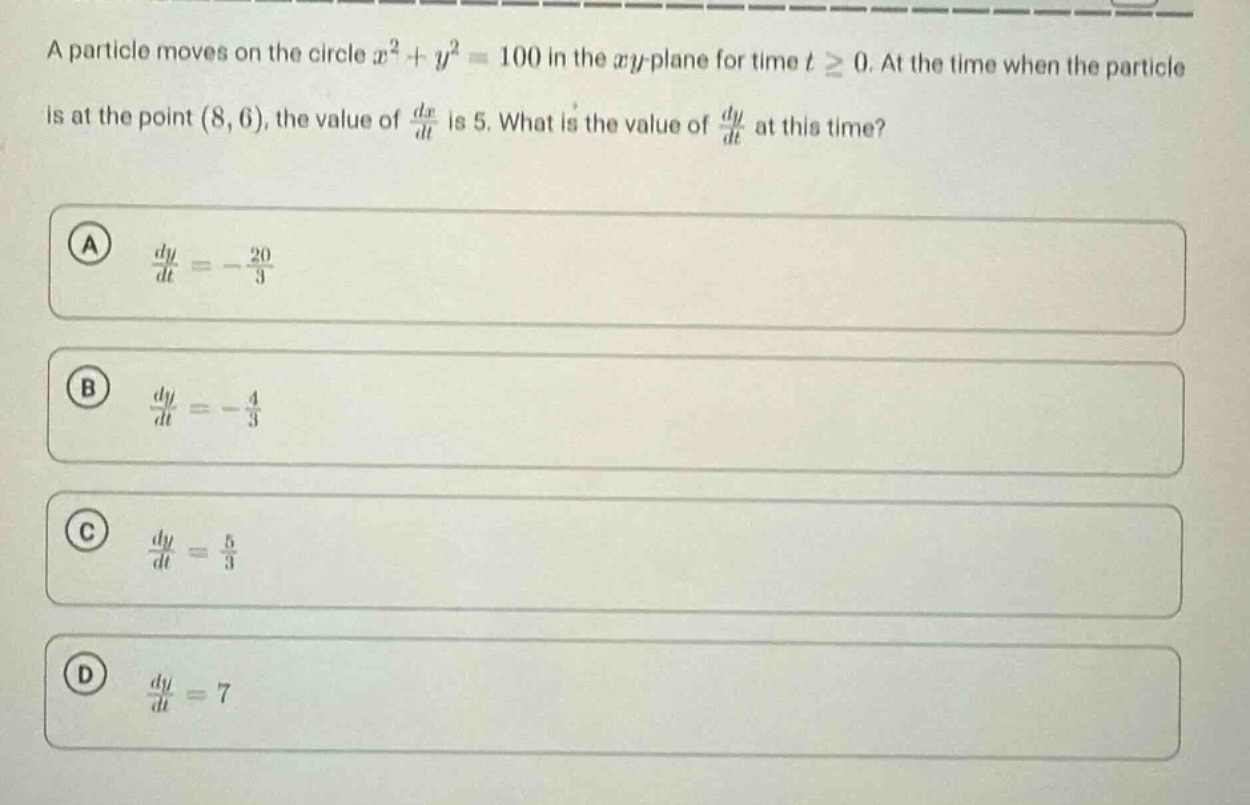
a particle moves on the circle x² + y² = 100 in the xy - plane for time t ≥ 0. at the time when the particle is at the point (8, 6), the value of dx/dt is 5. what is the value of dy/dt at this time? a dy/dt = -20/3 b dy/dt = -4/3 c dy/dt = 5/3 d dy/dt = 7
Answer
Explanation:
Step1: Differentiate the circle equation
Differentiate $x^{2}+y^{2}=100$ with respect to $t$ using the chain - rule. We get $2x\frac{dx}{dt}+2y\frac{dy}{dt}=0$.
Step2: Simplify the differentiated equation
Divide the entire equation $2x\frac{dx}{dt}+2y\frac{dy}{dt}=0$ by 2, resulting in $x\frac{dx}{dt}+y\frac{dy}{dt}=0$.
Step3: Substitute given values
We know that $x = 8$, $y = 6$, and $\frac{dx}{dt}=5$. Substitute these values into $x\frac{dx}{dt}+y\frac{dy}{dt}=0$. So, $8\times5+6\times\frac{dy}{dt}=0$.
Step4: Solve for $\frac{dy}{dt}$
First, simplify the left - hand side: $40 + 6\frac{dy}{dt}=0$. Then, subtract 40 from both sides: $6\frac{dy}{dt}=-40$. Finally, divide both sides by 6: $\frac{dy}{dt}=-\frac{40}{6}=-\frac{20}{3}$.
Answer:
A. $\frac{dy}{dt}=-\frac{20}{3}$