a particle travels along the x - axis such that its velocity is given by v(t)=t^1.2 - 4sin(2t - 5). the…
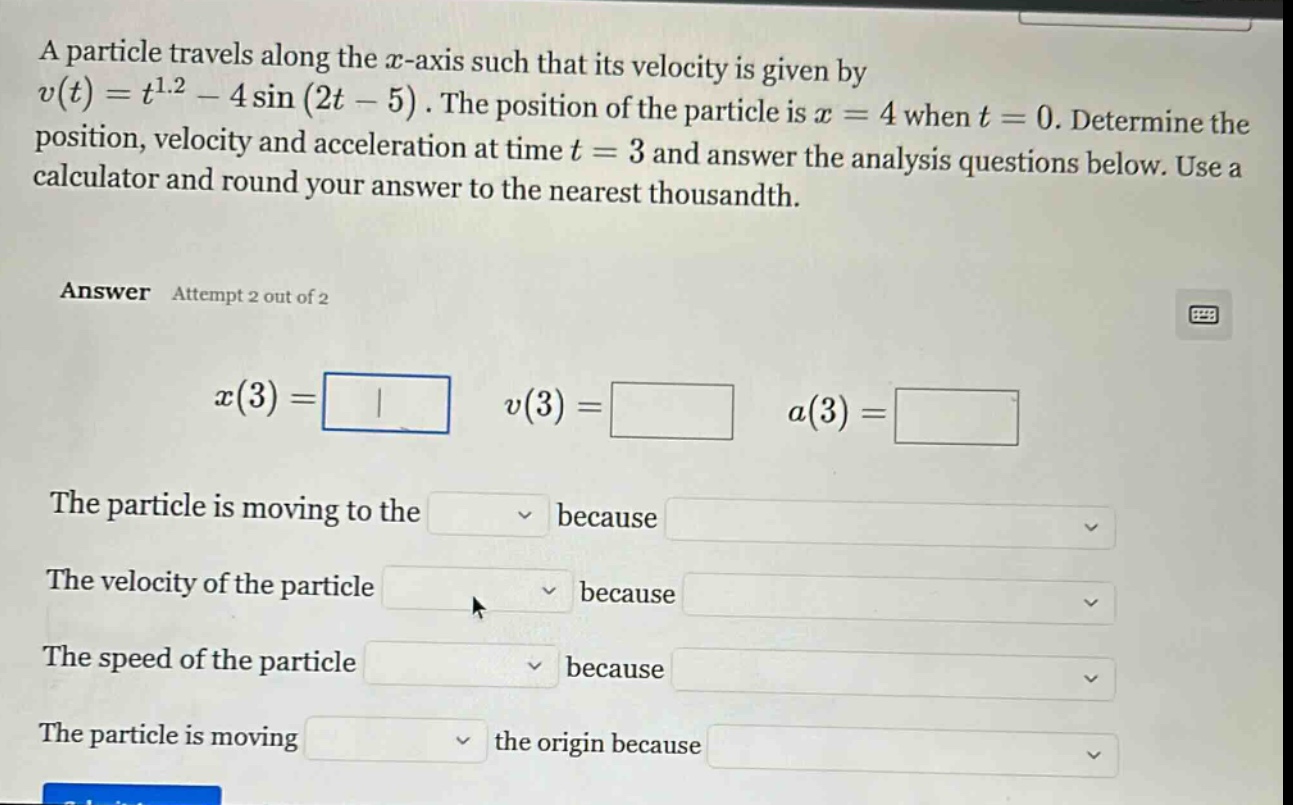
a particle travels along the x - axis such that its velocity is given by v(t)=t^1.2 - 4sin(2t - 5). the position of the particle is x = 4 when t = 0. determine the position, velocity and acceleration at time t = 3 and answer the analysis questions below. use a calculator and round your answer to the nearest thousandth. answer attempt 2 out of 2 x(3)= v(3)= a(3)= the particle is moving to the because the velocity of the particle because the speed of the particle because the particle is moving the origin because
Answer
Explanation:
Step1: Recall the relationship between position, velocity and acceleration
Position $x(t)$ is the antiderivative of velocity $v(t)$, and acceleration $a(t)$ is the derivative of velocity $v(t)$. Given $v(t)=t^{1.2}-4\sin(2t - 5)$ and $x(0)=4$. First, find $x(t)$ by integrating $v(t)$: $x(t)=\int(t^{1.2}-4\sin(2t - 5))dt$. Using the power - rule $\int t^n dt=\frac{t^{n + 1}}{n+1}+C$ and $\int\sin(u)du=-\cos(u)+C$ (where $u = 2t-5$ and $du=2dt$), we have $x(t)=\frac{t^{2.2}}{2.2}+2\cos(2t - 5)+C$. Substitute $t = 0$ and $x(0)=4$: $4=\frac{0^{2.2}}{2.2}+2\cos(- 5)+C$. Since $\cos(-5)=\cos(5)\approx0.284$, then $C=4 - 2\cos(5)\approx4-2\times0.284 = 3.432$. So $x(t)=\frac{t^{2.2}}{2.2}+2\cos(2t - 5)+3.432$.
Step2: Find $x(3)$
Substitute $t = 3$ into $x(t)$: $x(3)=\frac{3^{2.2}}{2.2}+2\cos(2\times3 - 5)+3.432=\frac{3^{2.2}}{2.2}+2\cos(1)+3.432$. Calculate $3^{2.2}\approx11.212$, $\frac{3^{2.2}}{2.2}\approx5.096$, $\cos(1)\approx0.540$. Then $x(3)\approx5.096+2\times0.540 + 3.432=5.096 + 1.08+3.432 = 9.608$.
Step3: Find $v(3)$
Substitute $t = 3$ into $v(t)$: $v(3)=3^{1.2}-4\sin(2\times3 - 5)=3^{1.2}-4\sin(1)$. Calculate $3^{1.2}\approx3.737$, $\sin(1)\approx0.841$. Then $v(3)\approx3.737-4\times0.841=3.737 - 3.364=0.373$.
Step4: Find the acceleration function $a(t)$
Differentiate $v(t)$ with respect to $t$. Using the power - rule $\frac{d}{dt}(t^n)=nt^{n - 1}$ and $\frac{d}{dt}(\sin(u))=\cos(u)\cdot\frac{du}{dt}$ (where $u = 2t-5$ and $\frac{du}{dt}=2$), we get $a(t)=1.2t^{0.2}-4\times2\cos(2t - 5)=1.2t^{0.2}-8\cos(2t - 5)$.
Step5: Find $a(3)$
Substitute $t = 3$ into $a(t)$: $a(3)=1.2\times3^{0.2}-8\cos(2\times3 - 5)=1.2\times3^{0.2}-8\cos(1)$. Calculate $3^{0.2}\approx1.246$, then $a(3)=1.2\times1.246-8\times0.540=1.495 - 4.32=-2.825$.
For the analysis questions:
- The particle is moving to the right because $v(3)=0.373>0$.
- The velocity of the particle is decreasing because $a(3)=-2.825<0$.
- The speed of the particle is decreasing because the velocity and acceleration have opposite signs ($v(3)>0$ and $a(3)<0$).
- The particle is moving away from the origin because $x(3)=9.608>0$ and $v(3)>0$.
Answer:
$x(3)=9.608$ $v(3)=0.373$ $a(3)=-2.825$ The particle is moving to the right because $v(3)>0$ The velocity of the particle is decreasing because $a(3)<0$ The speed of the particle is decreasing because $v(3)$ and $a(3)$ have opposite signs The particle is moving away from the origin because $x(3)>0$ and $v(3)>0$