in a particular city, taxicabs charge passengers $3.80 for entering a cab and then $0.50 for each one…
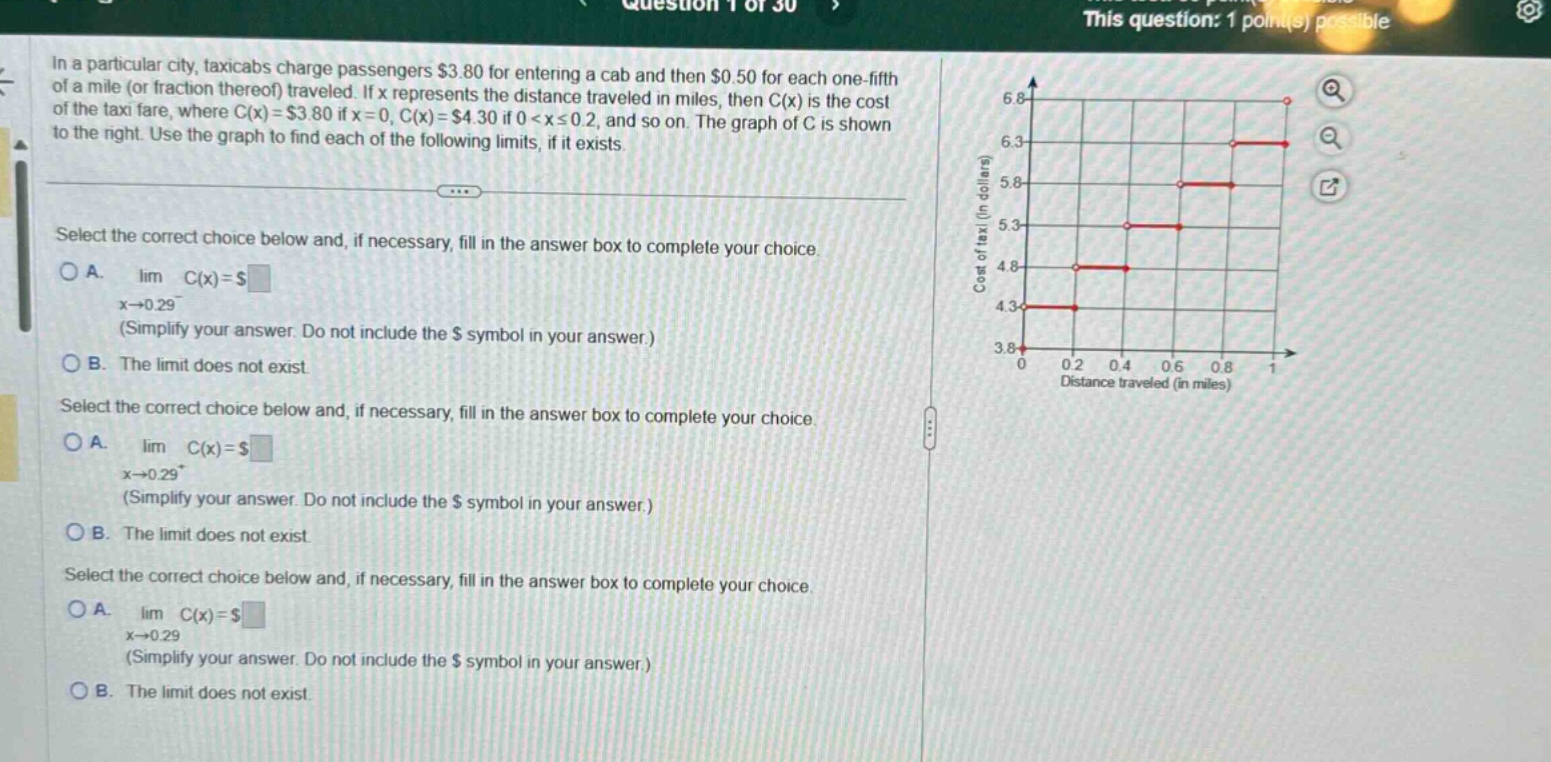
in a particular city, taxicabs charge passengers $3.80 for entering a cab and then $0.50 for each one - fifth of a mile (or fraction thereof) traveled. if x represents the distance traveled in miles, then c(x) is the cost of the taxi fare, where c(x) = $3.80 if x = 0, c(x) = $4.30 if 0 < x ≤ 0.2, and so on. the graph of c is shown to the right. use the graph to find each of the following limits, if it exists. select the correct choice below and, if necessary, fill in the answer box to complete your choice. a. lim c(x) = $ x→0.29⁻ (simplify your answer. do not include the $ symbol in your answer.) b. the limit does not exist. select the correct choice below and, if necessary, fill in the answer box to complete your choice. a. lim c(x) = $ x→0.29⁺ (simplify your answer. do not include the $ symbol in your answer.) b. the limit does not exist. select the correct choice below and, if necessary, fill in the answer box to complete your choice. a. lim c(x) = $ x→0.29 (simplify your answer. do not include the $ symbol in your answer.) b. the limit does not exist.
Answer
Explanation:
Step1: Analyze left - hand limit
As $x\to0.29^{-}$, we look at the values of $C(x)$ as $x$ approaches $0.29$ from the left - hand side. From the graph, when $x$ is approaching $0.29$ from the left, the cost $C(x)$ is $4.8$.
Step2: Analyze right - hand limit
As $x\to0.29^{+}$, we look at the values of $C(x)$ as $x$ approaches $0.29$ from the right - hand side. From the graph, when $x$ is approaching $0.29$ from the right, the cost $C(x)$ is $5.3$.
Step3: Determine overall limit
Since $\lim_{x\to0.29^{-}}C(x)=4.8$ and $\lim_{x\to0.29^{+}}C(x)=5.3$, and $\lim_{x\to0.29^{-}}C(x)\neq\lim_{x\to0.29^{+}}C(x)$, the two - sided limit $\lim_{x\to0.29}C(x)$ does not exist.
For $\lim_{x\to0.29^{-}}C(x)$:
Answer:
4.8
For $\lim_{x\to0.29^{+}}C(x)$:
Answer:
5.3
For $\lim_{x\to0.29}C(x)$:
Answer:
B. The limit does not exist.