a passenger is riding a ferris wheel. the graph shows the height, in feet, of the passenger as a function of…
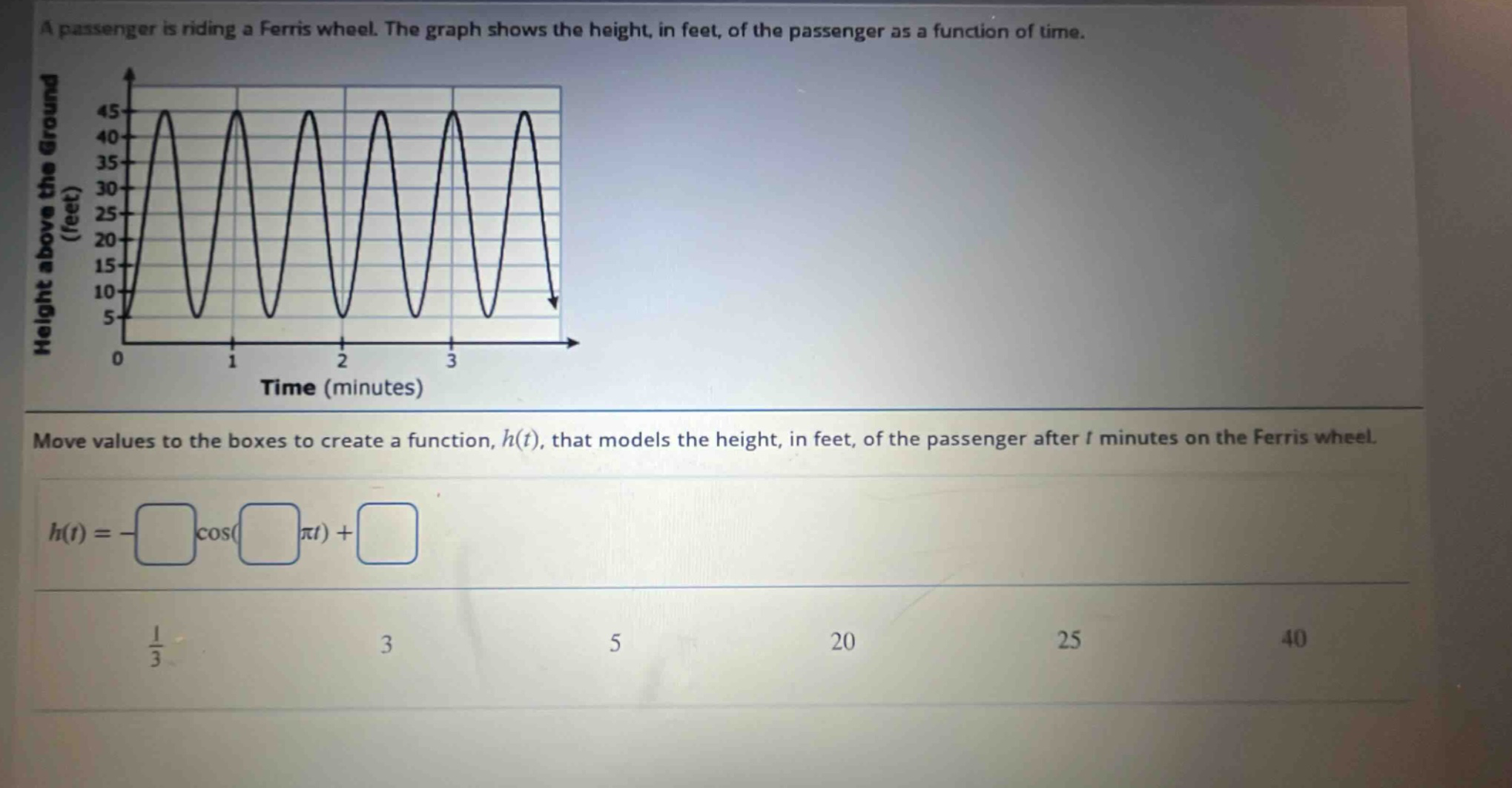
a passenger is riding a ferris wheel. the graph shows the height, in feet, of the passenger as a function of time. move values to the boxes to create a function, $h(t)$, that models the height, in feet, of the passenger after $t$ minutes on the ferris wheel. $h(t)=-squarecos(squarepi t)+square$ $\frac{1}{3}$ 3 5 20 25 40
Answer
Explanation:
Step1: Determine the amplitude
The amplitude $A$ of a cosine - type function $y = A\cos(Bx - C)+D$ is half of the vertical distance between the maximum and minimum values. The maximum height is $45$ feet and the minimum height is $5$ feet. So, $A=\frac{45 - 5}{2}=\frac{40}{2}=20$.
Step2: Determine the period
The period $T$ of the function is the time it takes for one complete cycle. From the graph, the period $T=\frac{2}{3}$ minutes. The formula for the period of a cosine function $y = \cos(Bx)$ is $T=\frac{2\pi}{B}$. Since $T = \frac{2}{3}$, we have $\frac{2}{3}=\frac{2\pi}{B}$, and solving for $B$ gives $B = 3\pi$.
Step3: Determine the vertical shift
The vertical shift $D$ is the mid - value between the maximum and minimum values. So, $D=\frac{45 + 5}{2}=25$.
Answer:
$h(t)=- 20\cos(3\pi t)+25$