a pendulum is swinging next to a wall. the distance from the bob of the swinging pendulum to the wall varies…
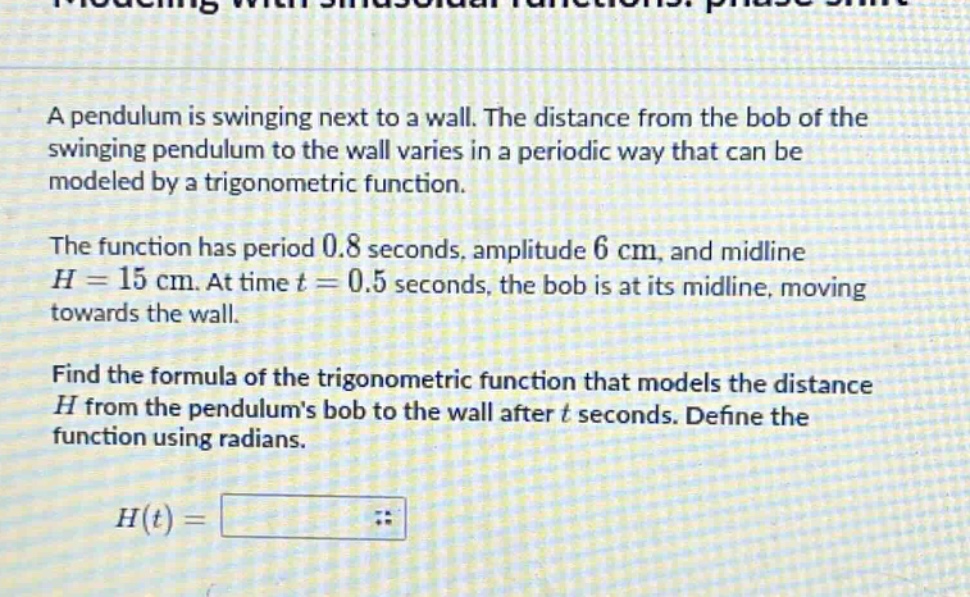
a pendulum is swinging next to a wall. the distance from the bob of the swinging pendulum to the wall varies in a periodic way that can be modeled by a trigonometric function.\nthe function has period 0.8 seconds, amplitude 6 cm, and midline (h = 15) cm. at time (t = 0.5) seconds, the bob is at its midline, moving towards the wall.\nfind the formula of the trigonometric function that models the distance (h) from the pendulums bob to the wall after (t) seconds. define the function using radians.\n\n(h(t)=)
Answer
Explanation:
Step1: Determine the general form
The general form of a periodic trig - function is $H(t)=A\sin(B(t - C))+D$ or $H(t)=A\cos(B(t - C))+D$. The mid - line gives $D$, the amplitude gives $A$, and the period is used to find $B$. Given amplitude $A = 6$, mid - line $D=15$, and period $T = 0.8$. Since $T=\frac{2\pi}{B}$, then $B=\frac{2\pi}{T}=\frac{2\pi}{0.8}=\frac{5\pi}{2}$.
Step2: Choose the function type and find the phase - shift
We know that at $t = 0.5$ seconds, the bob is at its mid - line, moving towards the wall. A cosine function $y = A\cos(B(t - C))+D$ starts at its maximum or minimum value. A sine function $y=A\sin(B(t - C))+D$ starts at the mid - line. Let's use the sine function $H(t)=A\sin(B(t - C))+D$. Substitute $A = 6$, $B=\frac{5\pi}{2}$, $D = 15$ into it: $H(t)=6\sin(\frac{5\pi}{2}(t - C))+15$. When $t = 0.5$, $H(0.5)=15$, so $15=6\sin(\frac{5\pi}{2}(0.5 - C))+15$. Then $\sin(\frac{5\pi}{2}(0.5 - C))=0$. We want the bob to be moving towards the wall at $t = 0.5$. For $y=\sin x$, when $x = 0$, the function is increasing. So $\frac{5\pi}{2}(0.5 - C)=0$, which gives $C = 0.5$.
Answer:
$H(t)=6\sin\left(\frac{5\pi}{2}(t - 0.5)\right)+15$