people enter a line for an escalator at a rate modeled by the function r given by r(t) = {44(100/t)^3(1…
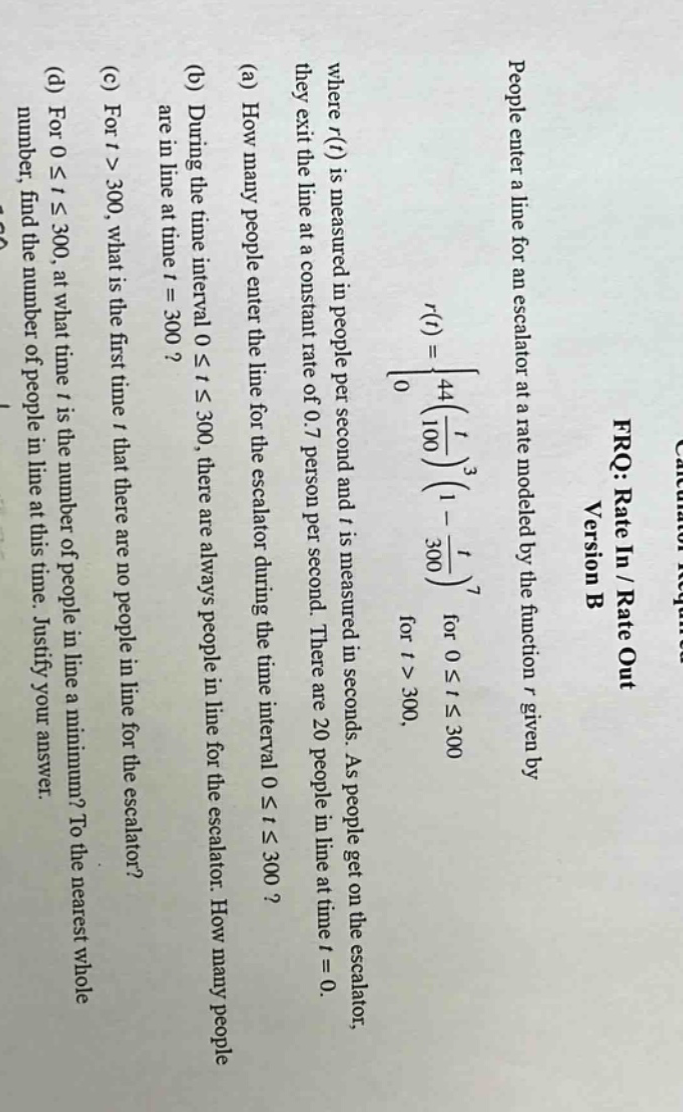
people enter a line for an escalator at a rate modeled by the function r given by r(t) = {44(100/t)^3(1 - t/300)^7 for 0 ≤ t ≤ 300, 0 for t > 300} where r(t) is measured in people per second and t is measured in seconds. as people get on the escalator, they exit the line at a constant rate of 0.7 person per second. there are 20 people in line at time t = 0. (a) how many people enter the line for the escalator during the time interval 0 ≤ t ≤ 300? (b) during the time interval 0 ≤ t ≤ 300, there are always people in line for the escalator. how many people are in line at time t = 300? (c) for t > 300, what is the first time t that there are no people in line for the escalator? (d) for 0 ≤ t ≤ 300, at what time t is the number of people in line a minimum? to the nearest whole number, find the number of people in line at this time. justify your answer.
Answer
Explanation:
Step1: Calculate people entering in 0 ≤ t ≤ 300
The rate of people entering the line for 0 ≤ t ≤ 300 is given by $r(t)=44\left(\frac{t}{100}\right)^3\left(1 - \frac{t}{300}\right)^7$. To find the number of people entering the line in the interval 0 ≤ t ≤ 300, we use the definite - integral $\int_{0}^{300}r(t)dt$. Let $u=\frac{t}{100}$, then $t = 100u$ and $dt=100du$. When $t = 0$, $u = 0$; when $t = 300$, $u = 3$.
[
\begin{align*}
\int_{0}^{300}44\left(\frac{t}{100}\right)^3\left(1-\frac{t}{300}\right)^7dt&=44\times100\int_{0}^{3}u^3\left(1 - \frac{100u}{300}\right)^7du\
&=4400\int_{0}^{3}u^3\left(1-\frac{u}{3}\right)^7du
\end{align*}
]
Using a calculator or software for definite - integral (such as a TI - 84 Plus: fnInt(44*(x/100)^3*(1 - x/300)^7,x,0,300)), we get $\int_{0}^{300}r(t)dt = 330$. There are 20 people in line at $t = 0$. So the number of people who enter the line in 0 ≤ t ≤ 300 is 330.
Step2: Find number of people in line at t = 300
The number of people who exit the line in the interval 0 ≤ t ≤ 300 at a constant rate of 0.7 person per second is $0.7\times300=210$. The initial number of people in line is 20, and the number of people who enter is 330. So the number of people in line at $t = 300$ is $20 + 330-210=140$.
Step3: Analyze for t > 300
For $t>300$, $r(t) = 0$. The number of people exiting the line continues at a rate of 0.7 person per second. Let $N(t)$ be the number of people in line at time $t$. For $t>300$, $N(t)=140-0.7(t - 300)$. Set $N(t)=0$ to find when there are no people in line: [ \begin{align*} 140-0.7(t - 300)&=0\ 140-0.7t+210&=0\ -0.7t&=-350\ t& = 500 \end{align*} ]
Step4: Find the minimum number of people in line
We know that for 0 ≤ t ≤ 300, we can analyze the derivative of the net - change function (the difference between the number of people entering and exiting) to find local minima. But we can also just consider the values at the endpoints and critical points. The number of people in line at $t = 0$ is 20. The number of people in line at $t = 300$ is 140. For $t>300$, $N(t)$ is a linear function $N(t)=140-0.7(t - 300)$ which is a decreasing function. The minimum number of people in line occurs at $t = 0$ and is 20.
Answer:
(a) 330 (b) 140 (c) 500 (d) 20