perform a first derivative test on the function $f(x)=sqrt{x}ln7x;(0,infty)$. a. locate the critical points…
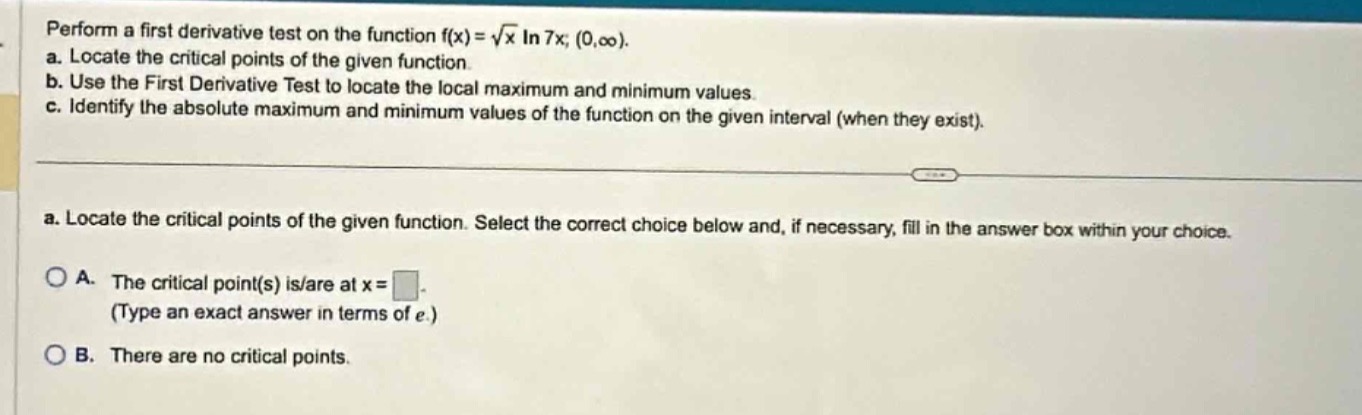
perform a first derivative test on the function $f(x)=sqrt{x}ln7x;(0,infty)$. a. locate the critical points of the given function. b. use the first derivative test to locate the local maximum and minimum values. c. identify the absolute maximum and minimum values of the function on the given interval (when they exist). a. locate the critical points of the given function. select the correct choice below and, if necessary, fill in the answer box within your choice. a. the critical point(s) is/are at $x = square$. (type an exact answer in terms of $e$.) b. there are no critical points.
Answer
Explanation:
Step1: Find the derivative of $f(x)$
Use the product - rule $(uv)^\prime = u^\prime v+uv^\prime$, where $u = \sqrt{x}=x^{\frac{1}{2}}$ and $v=\ln(7x)$. $u^\prime=\frac{1}{2}x^{-\frac{1}{2}}$ and $v^\prime=\frac{1}{x}$. So $f^\prime(x)=\frac{1}{2}x^{-\frac{1}{2}}\ln(7x)+x^{\frac{1}{2}}\cdot\frac{1}{x}=\frac{\ln(7x)}{2\sqrt{x}}+\frac{1}{\sqrt{x}}=\frac{\ln(7x) + 2}{2\sqrt{x}}$.
Step2: Locate the critical points
Set $f^\prime(x) = 0$. Since the denominator $2\sqrt{x}\gt0$ for $x\in(0,\infty)$, we set the numerator equal to 0. $\ln(7x)+2 = 0$. $\ln(7x)=-2$. Exponentiate both sides using the property $e^{\ln a}=a$. So $7x = e^{-2}$, and $x=\frac{e^{-2}}{7}$.
Answer:
A. The critical point(s) is/are at $x = \frac{1}{7e^{2}}$