1. perform the integration. show all necessary solutions.\na. $int(8t^{2}+\frac{sin t+cos t}{sin t - cos…
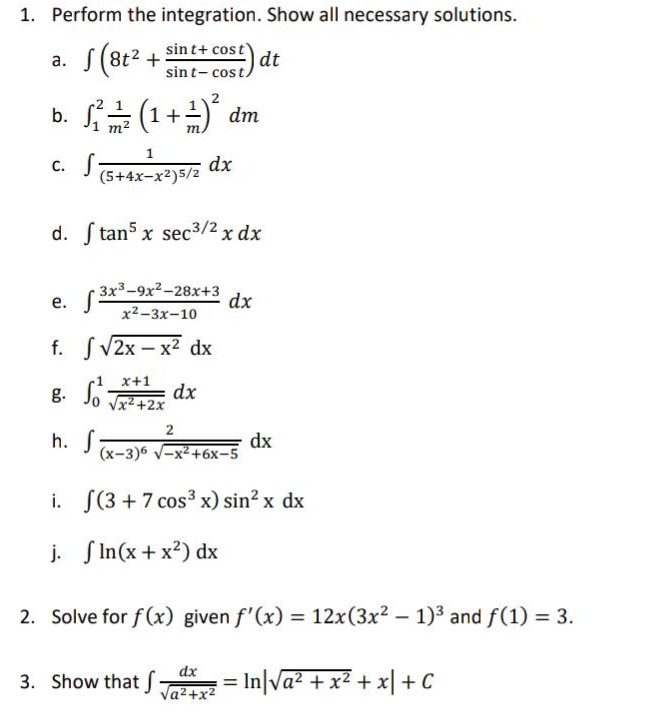
1. perform the integration. show all necessary solutions.\na. $int(8t^{2}+\frac{sin t+cos t}{sin t - cos t})dt$\nb. $int_{1}^{2}\frac{1}{m^{2}}(1 + \frac{1}{m})^{2}dm$\nc. $int\frac{1}{(5 + 4x - x^{2})^{5/2}}dx$\nd. $int\tan^{5}xsec^{3/2}x dx$\ne. $int\frac{3x^{3}-9x^{2}-28x + 3}{x^{2}-3x - 10}dx$\nf. $intsqrt{2x - x^{2}}dx$\ng. $int_{0}^{1}\frac{x + 1}{sqrt{x^{2}+2x}}dx$\nh. $int\frac{2}{(x - 3)^{6}sqrt{-x^{2}+6x - 5}}dx$\ni. $int(3 + 7cos^{3}x)sin^{2}x dx$\nj. $intln(x + x^{2})dx$\n2. solve for $f(x)$ given $f(x)=12x(3x^{2}-1)^{3}$ and $f(1)=3$.\n3. show that $int\frac{dx}{sqrt{a^{2}+x^{2}}}=ln|sqrt{a^{2}+x^{2}}+x|+c$
Answer
Explanation:
a. $\int(8t^{2}+\frac{\sin t+\cos t}{\sin t - \cos t})dt$
Step1: Split the integral
By the sum - rule of integration $\int(f(x)+g(x))dx=\int f(x)dx+\int g(x)dx$, we have $\int 8t^{2}dt+\int\frac{\sin t+\cos t}{\sin t - \cos t}dt$. For $\int 8t^{2}dt$, using the power - rule $\int t^{n}dt=\frac{t^{n + 1}}{n+1}+C$ ($n\neq - 1$), we get $8\times\frac{t^{3}}{3}=\frac{8t^{3}}{3}$. For $\int\frac{\sin t+\cos t}{\sin t - \cos t}dt$, let $u=\sin t-\cos t$, then $du = (\cos t+\sin t)dt$. So $\int\frac{\sin t+\cos t}{\sin t - \cos t}dt=\int\frac{du}{u}=\ln|u|=\ln|\sin t-\cos t|$. So $\int(8t^{2}+\frac{\sin t+\cos t}{\sin t - \cos t})dt=\frac{8t^{3}}{3}+\ln|\sin t - \cos t|+C$.
b. $\int_{1}^{2}\frac{1}{m^{2}}(1 + \frac{1}{m})^{2}dm$
Step1: Expand the integrand
Expand $(1+\frac{1}{m})^{2}=1+\frac{2}{m}+\frac{1}{m^{2}}$. Then $\frac{1}{m^{2}}(1 + \frac{1}{m})^{2}=\frac{1}{m^{2}}+\frac{2}{m^{3}}+\frac{1}{m^{4}}$.
Step2: Integrate term - by - term
$\int(\frac{1}{m^{2}}+\frac{2}{m^{3}}+\frac{1}{m^{4}})dm=\int m^{-2}dm + 2\int m^{-3}dm+\int m^{-4}dm$. Using the power - rule $\int x^{n}dx=\frac{x^{n + 1}}{n+1}+C$ ($n\neq - 1$), we have $-\frac{1}{m}-m^{-2}-\frac{1}{3}m^{-3}+C$.
Step3: Evaluate the definite integral
$[-\frac{1}{m}-\frac{1}{m^{2}}-\frac{1}{3m^{3}}]_{1}^{2}=(-\frac{1}{2}-\frac{1}{4}-\frac{1}{24})-(-1 - 1-\frac{1}{3})=\frac{41}{24}$.
c. $\int\frac{1}{(5 + 4x-x^{2})^{\frac{5}{2}}}dx$
Step1: Complete the square
$5 + 4x-x^{2}=-(x^{2}-4x - 5)=-(x - 2)^{2}+9$. Let $x-2 = 3\sin\theta$, then $dx=3\cos\theta d\theta$. $5 + 4x-x^{2}=9 - 9\sin^{2}\theta=9\cos^{2}\theta$.
Step2: Substitute and simplify
The integral becomes $\int\frac{3\cos\theta}{(9\cos^{2}\theta)^{\frac{5}{2}}}d\theta=\frac{1}{81}\int\frac{3\cos\theta}{\cos^{5}\theta}d\theta=\frac{1}{27}\int\sec^{4}\theta d\theta$. Since $\sec^{4}\theta=\sec^{2}\theta(1 + \tan^{2}\theta)$, let $u = \tan\theta$, $du=\sec^{2}\theta d\theta$. Then $\frac{1}{27}\int(1 + u^{2})du=\frac{1}{27}(u+\frac{u^{3}}{3})+C$. Substituting back $\theta=\arcsin(\frac{x - 2}{3})$ and $u=\tan\theta=\frac{x - 2}{\sqrt{9-(x - 2)^{2}}}$, we get the result.
d. $\int\tan^{5}x\sec^{\frac{3}{2}}x dx$
Step1: Rewrite $\tan^{5}x$
$\tan^{5}x\sec^{\frac{3}{2}}x=\tan^{4}x\sec^{\frac{1}{2}}x\tan x\sec x=(\sec^{2}x - 1)^{2}\sec^{\frac{1}{2}}x\tan x\sec x$. Let $u=\sec x$, then $du=\tan x\sec xdx$.
Step2: Expand and integrate
$(u^{2}-1)^{2}u^{\frac{1}{2}}=(u^{4}-2u^{2}+1)u^{\frac{1}{2}}=u^{\frac{9}{2}}-2u^{\frac{5}{2}}+u^{\frac{1}{2}}$. $\int(u^{\frac{9}{2}}-2u^{\frac{5}{2}}+u^{\frac{1}{2}})du=\frac{2}{11}u^{\frac{11}{2}}-\frac{4}{7}u^{\frac{7}{2}}+\frac{2}{3}u^{\frac{3}{2}}+C=\frac{2}{11}\sec^{\frac{11}{2}}x-\frac{4}{7}\sec^{\frac{7}{2}}x+\frac{2}{3}\sec^{\frac{3}{2}}x+C$.
e. $\int\frac{3x^{3}-9x^{2}-28x + 3}{x^{2}-3x - 10}dx$
Step1: Perform polynomial long - division
$3x^{3}-9x^{2}-28x + 3=(3x)(x^{2}-3x - 10)+2x + 3$. So $\int\frac{3x^{3}-9x^{2}-28x + 3}{x^{2}-3x - 10}dx=\int(3x+\frac{2x + 3}{x^{2}-3x - 10})dx$. Factor $x^{2}-3x - 10=(x - 5)(x+2)$. Use partial - fraction decomposition for $\frac{2x + 3}{(x - 5)(x + 2)}=\frac{A}{x - 5}+\frac{B}{x + 2}$. Solving for $A$ and $B$ gives $A=\frac{13}{7}$ and $B=\frac{1}{7}$. Then $\int(3x+\frac{13}{7(x - 5)}+\frac{1}{7(x + 2)})dx=\frac{3x^{2}}{2}+\frac{13}{7}\ln|x - 5|+\frac{1}{7}\ln|x + 2|+C$.
f. $\int\sqrt{2x - x^{2}}dx$
Step1: Complete the square
$2x - x^{2}=-(x^{2}-2x)=1-(x - 1)^{2}$. Let $x - 1=\sin\theta$, then $dx=\cos\theta d\theta$. $\sqrt{2x - x^{2}}=\sqrt{1-\sin^{2}\theta}=\cos\theta$.
Step2: Integrate
$\int\cos^{2}\theta d\theta=\int\frac{1+\cos(2\theta)}{2}d\theta=\frac{\theta}{2}+\frac{\sin(2\theta)}{4}+C=\frac{1}{2}\arcsin(x - 1)+\frac{(x - 1)\sqrt{2x - x^{2}}}{2}+C$.
g. $\int_{0}^{1}\frac{x + 1}{\sqrt{x^{2}+2x}}dx$
Step1: Let $u=x^{2}+2x$
Then $du=(2x + 2)dx = 2(x + 1)dx$. When $x = 0$, $u = 0$; when $x = 1$, $u=3$. The integral becomes $\frac{1}{2}\int_{0}^{3}u^{-\frac{1}{2}}du$.
Step2: Integrate and evaluate
$\frac{1}{2}\times2u^{\frac{1}{2}}\big|_{0}^{3}=\sqrt{3}$.
h. $\int\frac{2}{(x - 3)^{6}\sqrt{-x^{2}+6x - 5}}dx$
Step1: Complete the square
$-x^{2}+6x - 5=-(x^{2}-6x + 5)=-(x - 3)^{2}+4$. Let $u=x - 3$, then $du=dx$ and the integral becomes $\int\frac{2}{u^{6}\sqrt{4 - u^{2}}}du$. Let $u = 2\sin\theta$, $du=2\cos\theta d\theta$.
Step2: Simplify and integrate
After substitution and simplification, we can integrate the resulting trigonometric integral.
i. $\int(3 + 7\cos^{3}x)\sin^{2}x dx$
Step1: Expand the integrand
$(3 + 7\cos^{3}x)\sin^{2}x=3\sin^{2}x+7\cos^{3}x\sin^{2}x$. $\int 3\sin^{2}x dx=3\int\frac{1-\cos(2x)}{2}dx=\frac{3x}{2}-\frac{3\sin(2x)}{4}$. For $\int7\cos^{3}x\sin^{2}x dx$, let $u=\sin x$, then $du=\cos xdx$ and $\cos^{2}x = 1 - u^{2}$. The integral becomes $7\int(1 - u^{2})u^{2}du$.
Step2: Integrate term - by - term
$7\int(1 - u^{2})u^{2}du=7\int(u^{2}-u^{4})du=7(\frac{u^{3}}{3}-\frac{u^{5}}{5})+C=7(\frac{\sin^{3}x}{3}-\frac{\sin^{5}x}{5})+C$. So $\int(3 + 7\cos^{3}x)\sin^{2}x dx=\frac{3x}{2}-\frac{3\sin(2x)}{4}+\frac{7\sin^{3}x}{3}-\frac{7\sin^{5}x}{5}+C$.
j. $\int\ln(x + x^{2})dx$
Step1: Use integration by parts
Let $u=\ln(x + x^{2})$ and $dv=dx$. Then $du=\frac{1 + 2x}{x + x^{2}}dx$ and $v=x$. By the integration - by - parts formula $\int u dv=uv-\int v du$, we have $x\ln(x + x^{2})-\int\frac{x(1 + 2x)}{x + x^{2}}dx$. Simplify $\frac{x(1 + 2x)}{x + x^{2}}=\frac{2x^{2}+x}{x + x^{2}}=2-\frac{x}{x + x^{2}}=2-\frac{1}{1 + x}$.
Step2: Integrate the remaining integral
$\int(2-\frac{1}{1 + x})dx=2x-\ln|1 + x|+C$. So $\int\ln(x + x^{2})dx=x\ln(x + x^{2})-2x+\ln|1 + x|+C$.
2. Solve for $f(x)$ given $f^{\prime}(x)=12x(3x^{2}-1)^{3}$ and $f(1)=3$
Step1: Integrate $f^{\prime}(x)$
Let $u = 3x^{2}-1$, then $du = 6xdx$. So $\int12x(3x^{2}-1)^{3}dx = 2\int u^{3}du$. Using the power - rule $\int u^{n}du=\frac{u^{n+1}}{n + 1}+C$ ($n\neq - 1$), we get $2\times\frac{u^{4}}{4}=\frac{1}{2}(3x^{2}-1)^{4}+C$.
Step2: Use the initial condition
Since $f(1)=3$, substitute $x = 1$ into $f(x)=\frac{1}{2}(3x^{2}-1)^{4}+C$. $3=\frac{1}{2}(3\times1^{2}-1)^{4}+C$, $3=\frac{1}{2}\times16+C$, $C=-5$. So $f(x)=\frac{1}{2}(3x^{2}-1)^{4}-5$.
3. Show that $\int\frac{dx}{\sqrt{a^{2}+x^{2}}}=\ln|\sqrt{a^{2}+x^{2}}+x|+C$
Step1: Let $x=a\tan\theta$
Then $dx=a\sec^{2}\theta d\theta$ and $\sqrt{a^{2}+x^{2}}=a\sec\theta$. The integral $\int\frac{dx}{\sqrt{a^{2}+x^{2}}}=\int\frac{a\sec^{2}\theta}{a\sec\theta}d\theta=\int\sec\theta d\theta$.
Step2: Recall the integral of $\sec\theta$
$\int\sec\theta d\theta=\ln|\sec\theta+\tan\theta|+C$. Since $x = a\tan\theta$, $\tan\theta=\frac{x}{a}$ and $\sec\theta=\frac{\sqrt{a^{2}+x^{2}}}{a}$. $\ln|\sec\theta+\tan\theta|=\ln|\frac{\sqrt{a^{2}+x^{2}}}{a}+\frac{x}{a}|=\ln|\sqrt{a^{2}+x^{2}}+x|-\ln|a|$. Since $-\ln|a|$ is a constant, we have $\int\frac{dx}{\sqrt{a^{2}+x^{2}}}=\ln|\sqrt{a^{2}+x^{2}}+x|+C$.
Answer:
a. $\frac{8t^{3}}{3}+\ln|\sin t - \cos t|+C$ b. $\frac{41}{24}$ c. (Result after back - substitution as shown above) d. $\frac{2}{11}\sec^{\frac{11}{2}}x-\frac{4}{7}\sec^{\frac{7}{2}}x+\frac{2}{3}\sec^{\frac{3}{2}}x+C$ e. $\frac{3x^{2}}{2}+\frac{13}{7}\ln|x - 5|+\frac{1}{7}\ln|x + 2|+C$ f. $\frac{1}{2}\arcsin(x - 1)+\frac{(x - 1)\sqrt{2x - x^{2}}}{2}+C$ g. $\sqrt{3}$ h. (Result after back - substitution as shown above) i. $\frac{3x}{2}-\frac{3\sin(2x)}{4}+\frac{7\sin^{3}x}{3}-\frac{7\sin^{5}x}{5}+C$ j. $x\ln(x + x^{2})-2x+\ln|1 + x|+C$ 2. $f(x)=\frac{1}{2}(3x^{2}-1)^{4}-5$ 3. Shown as above.