what are the period, phase shift, and vertical shift of y = csc3(x + 4) + 6?\nperiod: $\frac{pi}{3}$; phase…
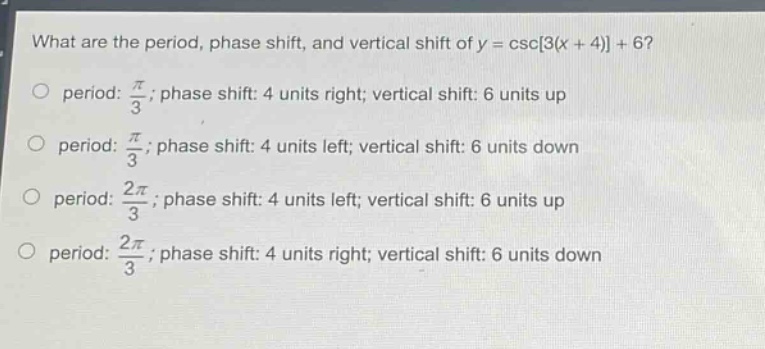
what are the period, phase shift, and vertical shift of y = csc3(x + 4) + 6?\nperiod: $\frac{pi}{3}$; phase shift: 4 units right; vertical shift: 6 units up\nperiod: $\frac{pi}{3}$; phase shift: 4 units left; vertical shift: 6 units down\nperiod: $\frac{2pi}{3}$; phase shift: 4 units left; vertical shift: 6 units up\nperiod: $\frac{2pi}{3}$; phase shift: 4 units right; vertical shift: 6 units down
Answer
Explanation:
Step1: Recall the general form of cosecant function
The general form of the cosecant function is $y = A\csc(B(x - C))+D$. For the function $y=\csc[3(x + 4)]+6$, we have $A = 1$, $B=3$, $C=- 4$, $D = 6$.
Step2: Calculate the period
The period of the cosecant function $y = A\csc(B(x - C))+D$ is given by $T=\frac{2\pi}{|B|}$. Since $B = 3$, then $T=\frac{2\pi}{3}$.
Step3: Determine the phase - shift
The phase - shift is given by the value of $C$. Here $C=-4$, which means a shift of 4 units to the left (because when $C<0$, the shift is to the left).
Step4: Determine the vertical shift
The vertical shift is given by the value of $D$. Since $D = 6$, the vertical shift is 6 units up.
Answer:
period: $\frac{2\pi}{3}$; phase shift: 4 units left; vertical shift: 6 units up