8.6 phase shift of sinusoidal functions (part 1)\npractice\ngraph each of the following functions.\n1…
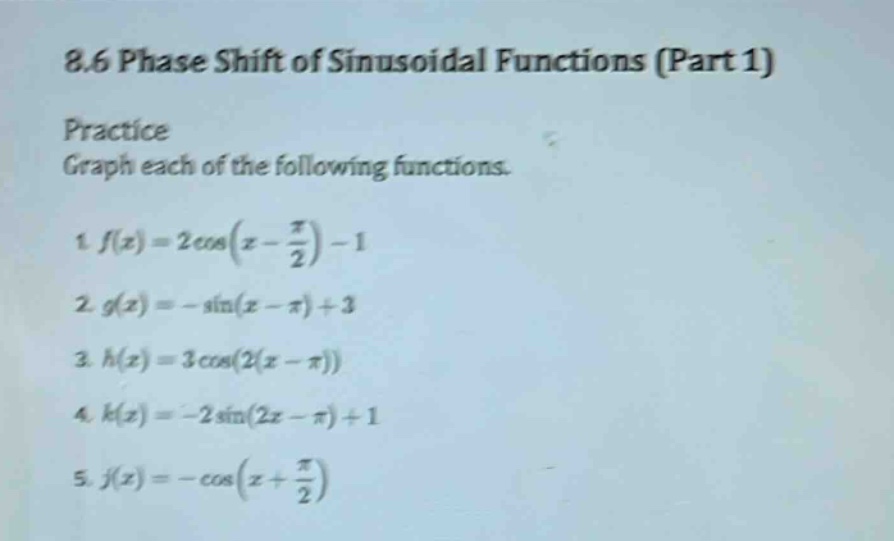
8.6 phase shift of sinusoidal functions (part 1)\npractice\ngraph each of the following functions.\n1. f(x)=2cos(x - π/2)-1\n2. g(x)= -sin(x - π)+3\n3. h(x)=3cos(2(x - π))\n4. k(x)= -2sin(2x - π)+1\n5. j(x)= -cos(x + π/2)
Answer
Explanation:
Step1: Recall general form of sinusoidal function
The general form of a sinusoidal function is $y = A\sin(B(x - C))+D$ or $y = A\cos(B(x - C))+D$, where $|A|$ is the amplitude, $\frac{2\pi}{|B|}$ is the period, $C$ is the phase - shift and $D$ is the vertical shift.
Step2: Analyze $f(x)=2\cos(x-\frac{\pi}{2}) - 1$
- Amplitude $|A| = 2$.
- Period $T=\frac{2\pi}{|B|}=\frac{2\pi}{1}=2\pi$.
- Phase - shift $C=\frac{\pi}{2}$ (right - shift).
- Vertical shift $D=-1$. Start with the graph of $y = \cos(x)$, stretch it vertically by a factor of 2, shift it $\frac{\pi}{2}$ units to the right and 1 unit down.
Step3: Analyze $g(x)=-\sin(x - \pi)+3$
- Amplitude $|A| = 1$.
- Period $T=\frac{2\pi}{|B|}=\frac{2\pi}{1}=2\pi$.
- Phase - shift $C = \pi$ (right - shift).
- Vertical shift $D = 3$. Start with the graph of $y=\sin(x)$, reflect it about the $x$ - axis, shift it $\pi$ units to the right and 3 units up.
Step4: Analyze $h(x)=3\cos(2(x-\pi))$
- Amplitude $|A| = 3$.
- Period $T=\frac{2\pi}{|B|}=\frac{2\pi}{2}=\pi$.
- Phase - shift $C=\pi$ (right - shift). Start with the graph of $y = \cos(x)$, stretch it vertically by a factor of 3, compress it horizontally by a factor of 2 and shift it $\pi$ units to the right.
Step5: Analyze $k(x)=-2\sin(2(x-\frac{\pi}{2})) + 1$
- Amplitude $|A| = 2$.
- Period $T=\frac{2\pi}{|B|}=\frac{2\pi}{2}=\pi$.
- Phase - shift $C=\frac{\pi}{2}$ (right - shift).
- Vertical shift $D = 1$. Start with the graph of $y=\sin(x)$, reflect it about the $x$ - axis, stretch it vertically by a factor of 2, compress it horizontally by a factor of 2, shift it $\frac{\pi}{2}$ units to the right and 1 unit up.
Step6: Analyze $j(x)=-\cos(x+\frac{\pi}{2})$
- Amplitude $|A| = 1$.
- Period $T=\frac{2\pi}{|B|}=\frac{2\pi}{1}=2\pi$.
- Phase - shift $C=-\frac{\pi}{2}$ (left - shift). Start with the graph of $y = \cos(x)$, reflect it about the $x$ - axis and shift it $\frac{\pi}{2}$ units to the left.
To graph these functions accurately, you can make a table of values for $x$ and the corresponding $y$ values for each function in their respective periods and then plot the points and connect them with a smooth curve.
Since this is just a practice of graphing and no specific question about a particular value is asked, the main task is to understand the transformations and graph them.
Answer:
Graphs of the functions are obtained by applying amplitude, period, phase - shift and vertical - shift transformations as described above.