phase shifts quick check\nuse the table to answer the question.\nthis table shows values of the sine…
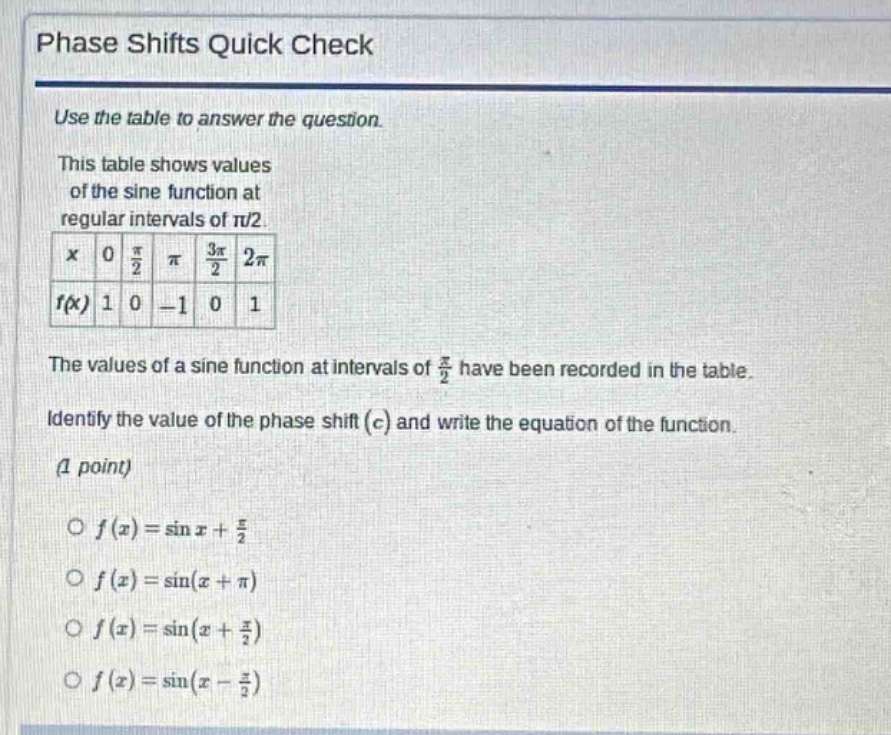
phase shifts quick check\nuse the table to answer the question.\nthis table shows values of the sine function at regular intervals of π/2\nx 0 π/2 π 3π/2 2π\nf(x) 1 0 -1 0 1\nthe values of a sine function at intervals of π/2 have been recorded in the table.\nidentify the value of the phase shift (c) and write the equation of the function.\n(1 point)\no f(x)=sin x + π/2\no f(x)=sin(x + π)\no f(x)=sin(x + π/2)\no f(x)=sin(x - π/2)
Answer
Explanation:
Step1: Analizar la función seno estándar
La función seno estándar es $y = \sin(x)$. La función dada en la tabla tiene un valor de $f(0)=1$. Para la función $y = \sin(x)$, $y(0) = 0$. La función $y=\sin(x + c)$ representa una traslación horizontal (fase - shift).
Step2: Encontrar el valor de c
Sabemos que $\sin\left(\frac{\pi}{2}\right)=1$. Si $x + c=\frac{\pi}{2}$ y $x = 0$, entonces $c=\frac{\pi}{2}$. La ecuación de la función con una fase - shift $c$ es $y=\sin(x + c)$. Sustituyendo $c=\frac{\pi}{2}$, obtenemos $y=\sin\left(x+\frac{\pi}{2}\right)$.
Answer:
$f(x)=\sin\left(x+\frac{\pi}{2}\right)$