4. picture to the right is the graph of the derivative, $f(x)$, of a function. what is the area under the…
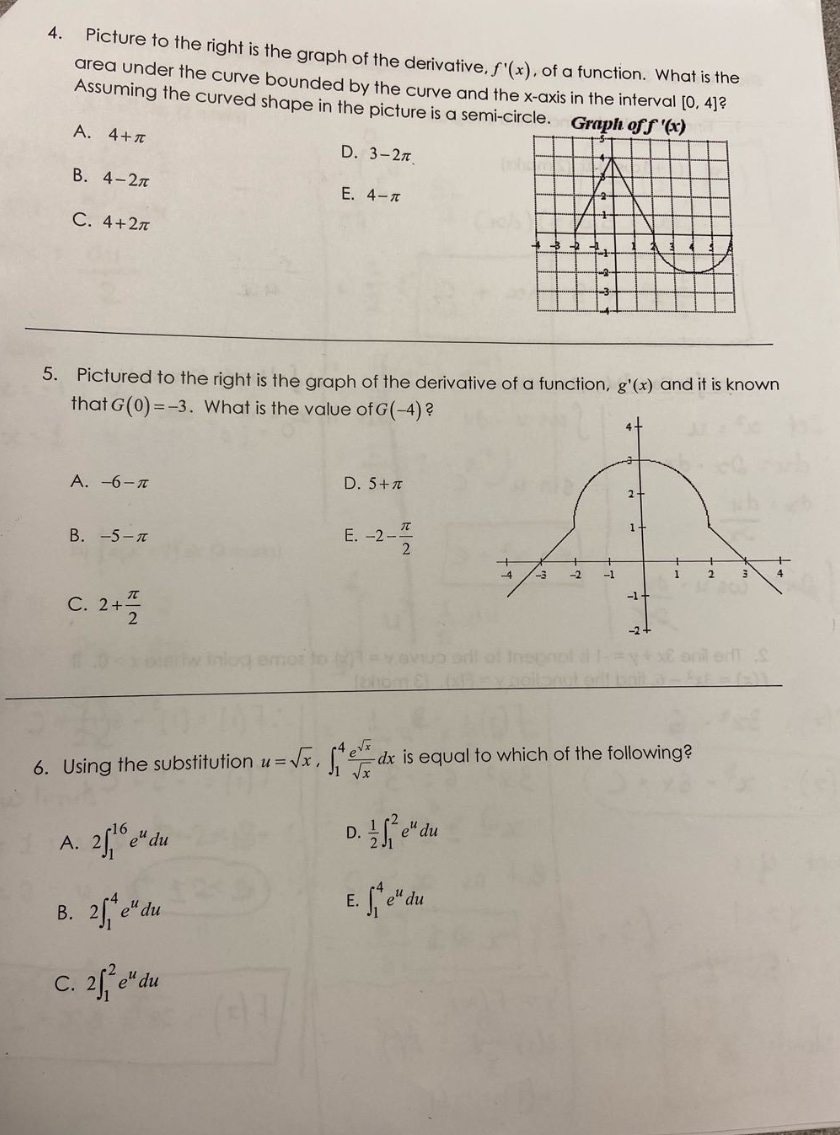
4. picture to the right is the graph of the derivative, $f(x)$, of a function. what is the area under the curve bounded by the curve and the x - axis in the interval $0,4$? assuming the curved shape in the picture is a semi - circle. a. $4 + \\pi$ b. $4-2\\pi$ c. $4 + 2\\pi$ d. $3-2\\pi$ e. $4-\\pi$ 5. pictured to the right is the graph of the derivative of a function, $g(x)$ and it is known that $g(0)=-3$. what is the value of $g(-4)$? a. $-6-\\pi$ b. $-5-\\pi$ c. $2+\\frac{\\pi}{2}$ d. $5 + \\pi$ e. $-2-\\frac{\\pi}{2}$ 6. using the substitution $u = \\sqrt{x}$, $\\int_{1}^{4}\\frac{e^{\\sqrt{x}}}{\\sqrt{x}}dx$ is equal to which of the following? a. $2\\int_{1}^{16}e^{u}du$ b. $2\\int_{1}^{4}e^{u}du$ c. $2\\int_{1}^{2}e^{u}du$ d. $\\frac{1}{2}\\int_{1}^{2}e^{u}du$ e. $\\int_{1}^{4}e^{u}du$
Answer
4.
Explanation:
Step1: Split the area into parts
The area from (x = 0) to (x=2) is a triangle and from (x = 2) to (x = 4) is a semi - circle. For the triangle from (x=0) to (x = 2): The base of the triangle (b = 2) and the height (h=4). The area of a triangle (A_{triangle}=\frac{1}{2}\times b\times h). So (A_{triangle}=\frac{1}{2}\times2\times4 = 4). For the semi - circle from (x = 2) to (x=4): The radius of the semi - circle (r = 1). The area of a semi - circle (A_{semicircle}=\frac{1}{2}\pi r^{2}), so (A_{semicircle}=\frac{1}{2}\pi\times1^{2}=\frac{\pi}{2}). But since the semi - circle is below the (x) - axis, its signed area is (-\frac{\pi}{2}\times2=-\pi) (the factor of 2 comes from the diameter being 2). The total area (A=4-\pi).
Answer:
E. (4 - \pi)
5.
Explanation:
Step1: Use the fundamental theorem of calculus
We know that (G(x)-G(0)=\int_{0}^{x}g^{\prime}(t)dt). We want to find (G(- 4)), so (G(-4)-G(0)=\int_{0}^{-4}g^{\prime}(x)dx). The integral (\int_{0}^{-4}g^{\prime}(x)dx) is the negative of the integral (\int_{-4}^{0}g^{\prime}(x)dx). The area under the curve (y = g^{\prime}(x)) from (x=-4) to (x = 0) consists of a semi - circle and a rectangle. The semi - circle has radius (r = 1) and its area (A_{semicircle}=\frac{1}{2}\pi r^{2}=\frac{\pi}{2}). The rectangle has base (b = 1) and height (h = 1), so its area (A_{rectangle}=1\times1 = 1). The total area from (x=-4) to (x = 0) is (1+\frac{\pi}{2}). Then (\int_{0}^{-4}g^{\prime}(x)dx=-(1 + \frac{\pi}{2})). Since (G(0)=-3), then (G(-4)=G(0)+\int_{0}^{-4}g^{\prime}(x)dx=-3-(1+\frac{\pi}{2})=-4-\frac{\pi}{2}=- 6-\pi) (after combining terms).
Answer:
A. (-6-\pi)
6.
Explanation:
Step1: Find (du) and change of limits
If (u = \sqrt{x}), then (du=\frac{1}{2\sqrt{x}}dx), or (2du=\frac{1}{\sqrt{x}}dx). When (x = 1), (u=\sqrt{1}=1). When (x = 4), (u=\sqrt{4}=2). The integral (\int_{1}^{4}\frac{e^{\sqrt{x}}}{\sqrt{x}}dx) with the substitution (u = \sqrt{x}) becomes (\int_{1}^{2}2e^{u}du=2\int_{1}^{2}e^{u}du).
Answer:
C. (2\int_{1}^{2}e^{u}du)