on a piece of paper, graph (f(x)=2cdot(0.5)^x). then determine which answer choice matches the graph you drew.
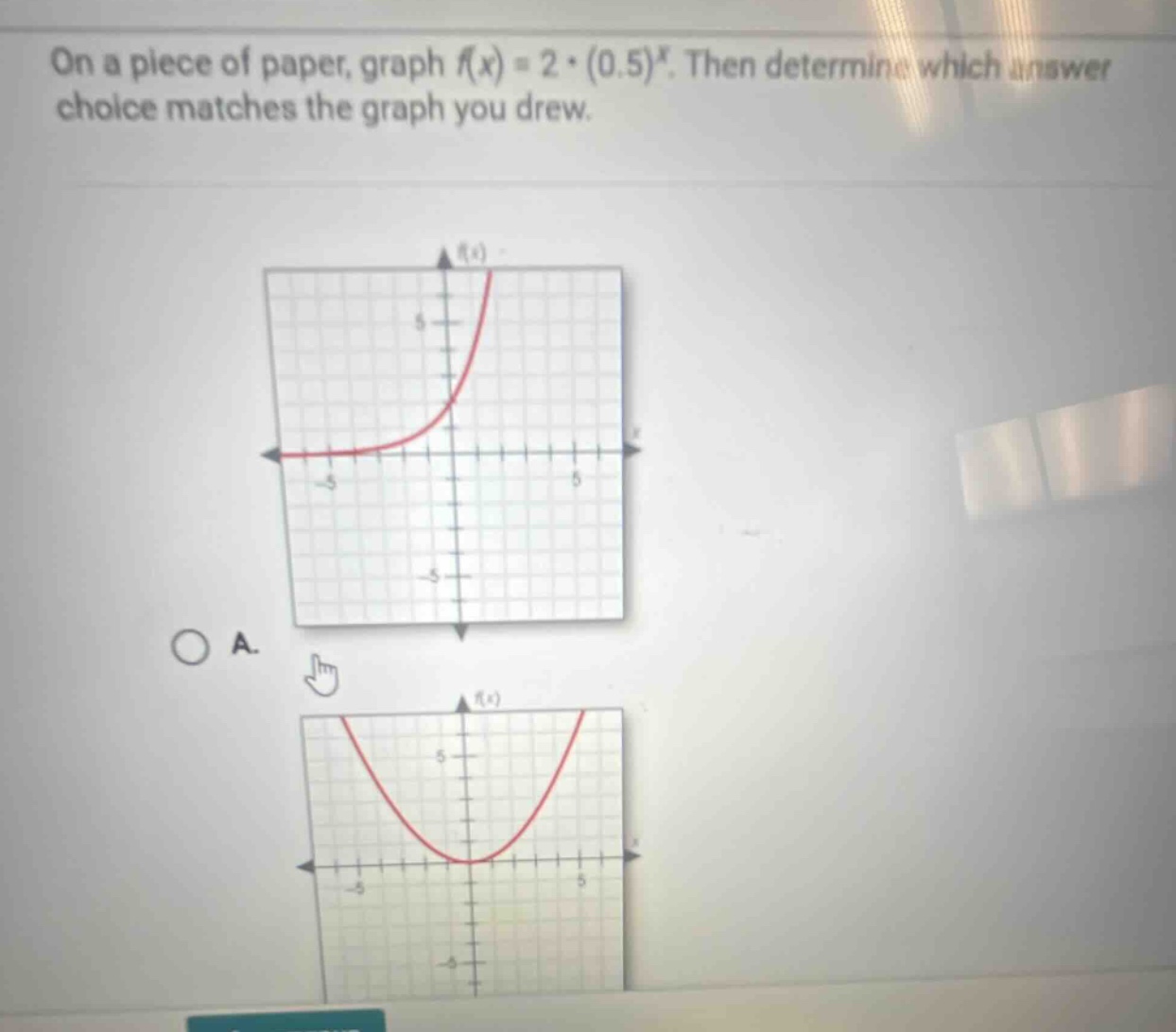
on a piece of paper, graph (f(x)=2cdot(0.5)^x). then determine which answer choice matches the graph you drew.
Answer
Explanation:
Step1: Identify the function type
The function $f(x)=2\cdot(0.5)^x$ is an exponential function of the form $y = ab^x$, where $a = 2$ and $b=0.5$. Since $0 < b<1$, the function is a decaying - exponential function.
Step2: Find the y - intercept
When $x = 0$, $f(0)=2\cdot(0.5)^0=2\cdot1 = 2$. So the y - intercept is at the point $(0,2)$.
Step3: Analyze the end - behavior
As $x\rightarrow+\infty$, $f(x)=2\cdot(0.5)^x\rightarrow0$ because $0.5<1$. As $x\rightarrow-\infty$, $f(x)=2\cdot(0.5)^x\rightarrow+\infty$.
Answer:
The graph of $y = 2\cdot(0.5)^x$ is a decaying exponential function that passes through the point $(0,2)$ and approaches the x - axis as $x$ goes to positive infinity. Without seeing all the options, we know it should be a curve that starts at $(0,2)$ and goes down as $x$ increases.