plot the point $(-5,240^{circ})$. then determine what is not an equivalent point, and find the rectangular…
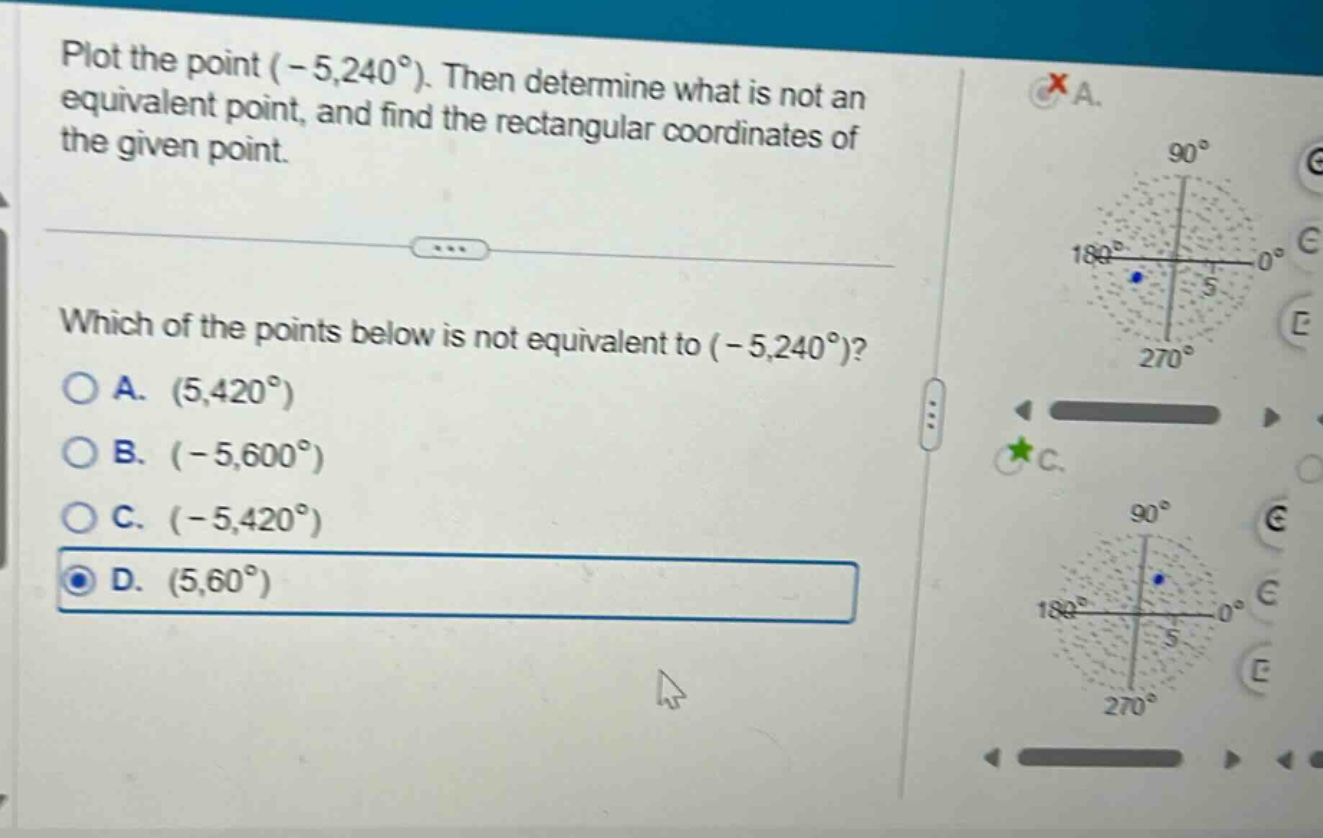
plot the point $(-5,240^{circ})$. then determine what is not an equivalent point, and find the rectangular coordinates of the given point. which of the points below is not equivalent to $(-5,240^{circ})$? a. $(5,420^{circ})$ b. $(-5,600^{circ})$ c. $(-5,420^{circ})$ d. $(5,60^{circ})$
Answer
Explanation:
Step1: Recall the polar - coordinate equivalence rules
For a polar point ((r,\theta)), equivalent points are of the form ((r,\theta + 360^{\circ}n)) or ((-r,\theta+(2n + 1)180^{\circ})), where (n\in\mathbb{Z}).
Step2: Analyze each option
- Option A: For ((-5,240^{\circ})), if we use the rule ((-r,\theta)) and ((r,\theta + 180^{\circ})). Here (r=-5), (\theta = 240^{\circ}), for ((5,420^{\circ})), since (420^{\circ}=240^{\circ}+ 180^{\circ}), and we change (r=-5) to (r = 5).
- Option B: For ((-5,600^{\circ})), since (600^{\circ}=240^{\circ}+360^{\circ}\times1) and (r=-5) remains the same.
- Option C: For ((-5,420^{\circ})), since (420^{\circ}=240^{\circ}+360^{\circ}\times0.5) (not in the standard form). Wait, no, (420^{\circ}=240^{\circ}+180^{\circ}), but using the formula ((r,\theta)=(r,\theta + 360^{\circ}n)) with (r=-5) and (n=\frac{180^{\circ}}{360^{\circ}}=\frac{1}{2}) (incorrect). Wait, actually (420^{\circ}=240^{\circ}+ 180^{\circ}), and for polar coordinates ((-r,\theta)) and ((r,\theta + 180^{\circ})) is a valid transformation. But another way: ((-5,420^{\circ})=(-5,240^{\circ}+180^{\circ})), and ((-5,240^{\circ})) and ((-5,420^{\circ})) are not equivalent. Wait, no! Wait, ((r,\theta)) and ((r,\theta + 360^{\circ}n)) are equivalent. ((-5,240^{\circ})) and ((-5,240^{\circ}+360^{\circ})) is ((-5,600^{\circ})) (Option B). For ((-5,420^{\circ})), (420^{\circ}-360^{\circ}=60^{\circ}), ((-5,420^{\circ})=(-5,60^{\circ})). And ((-5,240^{\circ})) and ((-5,60^{\circ})) are not equivalent. Wait, no! Wait, the general formula: ((r,\theta)=(r,\theta + 360^{\circ}n)) or ((-r,\theta+(2n + 1)180^{\circ})). For ((-5,240^{\circ})), if we take (n = 1) in ((r,\theta)=(r,\theta+360^{\circ}n)) with (r=-5), we get ((-5,240^{\circ}+360^{\circ})=(-5,600^{\circ})) (Option B). If we use ((-r,\theta)\to(r,\theta + 180^{\circ})), for ((-5,240^{\circ})\to(5,240^{\circ}+180^{\circ})=(5,420^{\circ})) (Option A). For ((5,60^{\circ})), if we use the rule ((-r,\theta)\to(r,\theta + 180^{\circ})), ((-5,240^{\circ})\to(5,240^{\circ}+180^{\circ})=(5,420^{\circ})\neq(5,60^{\circ}))
Answer:
D. ((5,60^{\circ}))