plot the point at the right given in polar coordinates, and find other polar coordinates (r,θ) of the point…
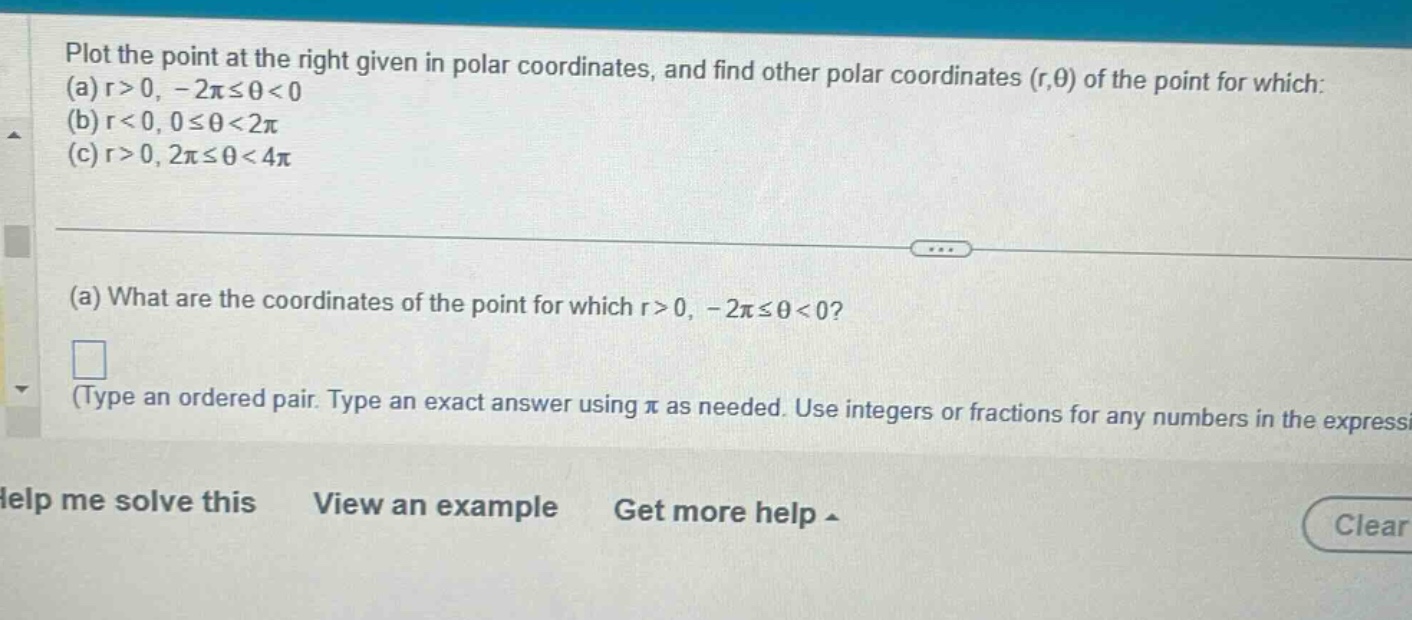
plot the point at the right given in polar coordinates, and find other polar coordinates (r,θ) of the point for which: (a) r>0, -2π≤θ<0 (b) r<0, 0≤θ<2π (c) r>0, 2π≤θ<4π (a) what are the coordinates of the point for which r>0, -2π≤θ<0? (type an ordered pair. type an exact answer using π as needed. use integers or fractions for any numbers in the express help me solve this view an example get more help clear
Answer
- Recall the general rules for converting between polar - coordinate representations:
- A point in polar coordinates is represented as ((r,\theta)), and other representations of the same point are ((r,\theta + 2k\pi)) when (r>0) and ((-r,\theta+(2k + 1)\pi)) when (r < 0), where (k\in\mathbb{Z}) (the set of integers).
- (a) For (r>0,-2\pi\leq\theta<0):
- If the original polar - coordinate of the point is ((r_0,\theta_0)), to get (\theta) in the range (-2\pi\leq\theta<0) when (r>0), we use the formula (\theta=\theta_0+2k\pi) and choose (k) such that (-2\pi\leq\theta_0 + 2k\pi<0).
- Let the original point be ((r,\theta)). If we want (r>0) and (-2\pi\leq\theta<0), and assume the original angle is (\theta_1), we find (k) such that (\theta=\theta_1+2k\pi) with (k\in\mathbb{Z}). For example, if the original point is ((r,\theta_1)) and (\theta_1>0), we choose (k) such that (\theta=\theta_1 - 2\pi) (when (k=- 1)).
- Without knowing the original point ((r_0,\theta_0)), in general, if the original point is ((r,\theta)) and (r>0), to get (\theta) in the range (-2\pi\leq\theta<0), we set (\theta=\theta_0-2\pi) (assuming (\theta_0\geq0)). So if the original point is ((r,\theta_0)), the new point for (r > 0,-2\pi\leq\theta<0) is ((r,\theta_0 - 2\pi)).
- (b) For (r<0,0\leq\theta<2\pi):
- If the original point is ((r_0,\theta_0)) with (r_0>0), to get (r<0) and (0\leq\theta<2\pi), we use the transformation ((r,\theta)=(-r_0,\theta_0+\pi)). Because when we change the sign of (r) (from positive to negative), we add (\pi) to the angle (\theta) to get to the same point in the plane.
- (c) For (r>0,2\pi\leq\theta<4\pi):
- If the original point is ((r_0,\theta_0)) with (r_0>0), to get (\theta) in the range (2\pi\leq\theta<4\pi), we use the formula (\theta=\theta_0 + 2\pi) (by choosing (k = 1) in (\theta=\theta_0+2k\pi)). So the new point is ((r,\theta_0 + 2\pi)).
Since the original point is not given in the problem - statement, we'll assume the original point is ((r_0,\theta_0)):
Explanation:
Step1: For (r>0,-2\pi\leq\theta<0)
If the original point is ((r_0,\theta_0)) with (r_0>0), we find (\theta=\theta_0-2\pi) to get the new coordinates ((r_0,\theta_0 - 2\pi))
Step2: For (r<0,0\leq\theta<2\pi)
If the original point is ((r_0,\theta_0)) with (r_0>0), we use the transformation ((-r_0,\theta_0+\pi))
Step3: For (r>0,2\pi\leq\theta<4\pi)
If the original point is ((r_0,\theta_0)) with (r_0>0), we find (\theta=\theta_0 + 2\pi) to get the new coordinates ((r_0,\theta_0 + 2\pi))
Let's assume the original point is ((r,\theta)) (where (r>0) and (\theta) is some angle). (a) If the original point is ((r,\theta)) and we want (r>0,-2\pi\leq\theta<0), and (\theta\geq0), the new point is ((r,\theta - 2\pi)) (b) If the original point is ((r,\theta)) and we want (r<0,0\leq\theta<2\pi), the new point is ((-r,\theta+\pi)) (c) If the original point is ((r,\theta)) and we want (r>0,2\pi\leq\theta<4\pi), the new point is ((r,\theta + 2\pi))
Answer:
(a) ((r,\theta - 2\pi)) (b) ((-r,\theta+\pi)) (c) ((r,\theta + 2\pi))