1. point p has polar coordinates (2, 5π/3). which of the following is not an alternative set of coordinates…
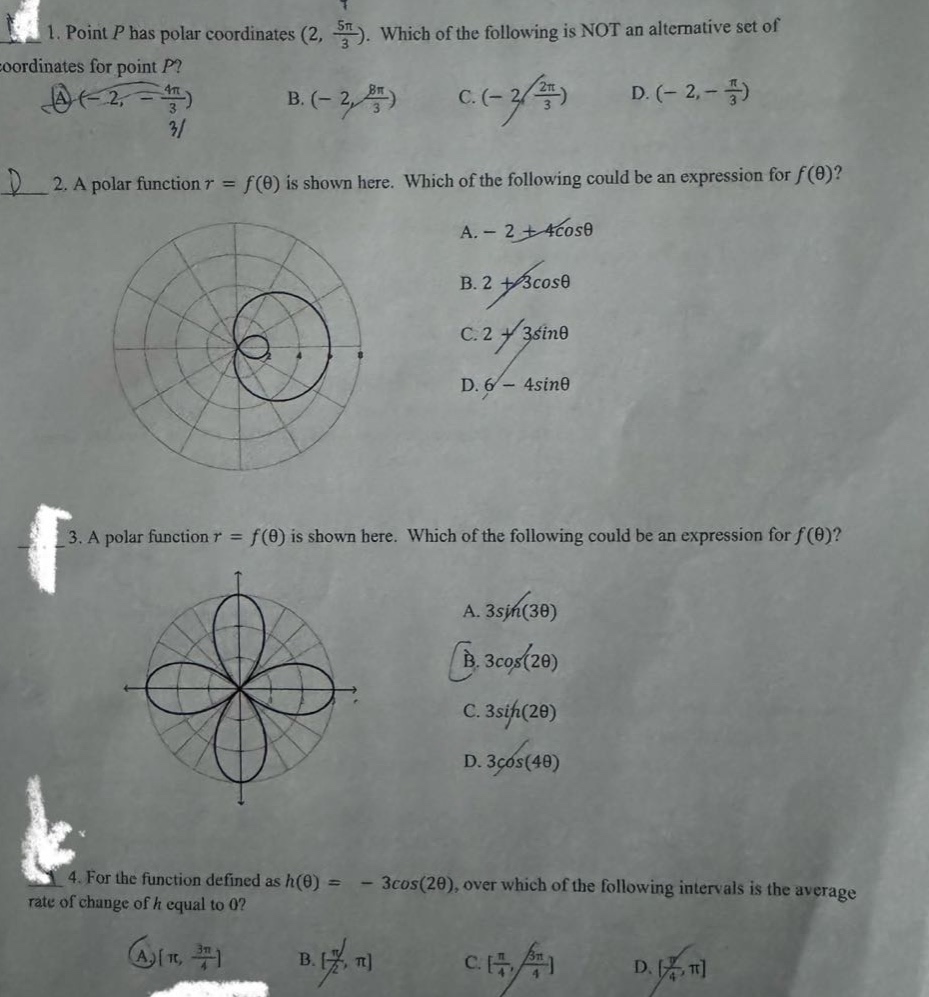
1. point p has polar coordinates (2, 5π/3). which of the following is not an alternative set of coordinates for point p? a. (-2, -4π/3) b. (-2, 8π/3) c. (-2, 2π/3) d. (-2, -π/3) 2. a polar function r = f(θ) is shown here. which of the following could be an expression for f(θ)? a. - 2 + 4cosθ b. 2 + 3cosθ c. 2 + 3sinθ d. 6 - 4sinθ 3. a polar function r = f(θ) is shown here. which of the following could be an expression for f(θ)? a. 3sin(3θ) b. 3cos(2θ) c. 3sin(2θ) d. 3cos(4θ) 4. for the function defined as h(θ) = - 3cos(2θ), over which of the following intervals is the average rate of change of h equal to 0? a. π, 3π/4 b. π/2, π c. π/4, 3π/4 d. π/4, π
Answer
Explanation:
Step1: Recall polar - coordinate conversion rules
If a point has polar coordinates ((r,\theta)), then ((r,\theta + 2k\pi)) and ((-r,\theta+(2k + 1)\pi)) for (k\in\mathbb{Z}) are also polar - coordinates of the same point. For the point (P=(2,\frac{5\pi}{3})), we can convert it to other forms. If (r=- 2), then (\theta=\frac{5\pi}{3}+\pi=\frac{8\pi}{3}) or (\theta=\frac{5\pi}{3}-\pi=\frac{2\pi}{3}) or (\theta=\frac{5\pi}{3}-3\pi=-\frac{4\pi}{3}). So options A, B, and C are alternative sets of coordinates for point (P). Option D ((-2,-\frac{\pi}{3})) is not an alternative set of coordinates for point (P).
Step2: Analyze polar - function graphs
For a polar function (r = a\pm b\cos\theta) or (r=a\pm b\sin\theta), the general shape of the graph:
- If (r = a + b\cos\theta) or (r=a + b\sin\theta) ((a,b>0)), when (a>b), the graph is a limacon without an inner loop. When (a < b), the graph is a limacon with an inner loop.
- For the second graph (a limacon with an inner loop), comparing with (r=a + b\cos\theta), we know that (a = 2) and (b = 3) ((a < b)) and the graph is symmetric about the (x) - axis, so (r=2 + 3\cos\theta) is a possible function.
Step3: Identify rose - curve equations
The equation of a rose curve is (r = a\cos(n\theta)) or (r=a\sin(n\theta)). If (n) is even, the number of petals is (2n); if (n) is odd, the number of petals is (n). The given rose - curve has 4 petals, so (n = 2) and since the petals are symmetric about the (x) - axis, the equation is (r = 3\cos(2\theta)).
Step4: Calculate the average rate of change
The average rate of change of a function (y = h(\theta)) over the interval ([\alpha,\beta]) is given by (\frac{h(\beta)-h(\alpha)}{\beta-\alpha}). For (h(\theta)=-3\cos(2\theta)), we want (\frac{h(\beta)-h(\alpha)}{\beta - \alpha}=0), which means (h(\beta)=h(\alpha)). Let's check each option:
- For option A: (h(\pi)=-3\cos(2\pi)=-3), (h(\frac{3\pi}{4})=-3\cos(\frac{3\pi}{2}) = 0), (\frac{h(\frac{3\pi}{4})-h(\pi)}{\frac{3\pi}{4}-\pi}\neq0).
- For option B: (h(\frac{\pi}{2})=-3\cos(\pi)=3), (h(\pi)=-3\cos(2\pi)=-3), (\frac{h(\pi)-h(\frac{\pi}{2})}{\pi-\frac{\pi}{2}}\neq0).
- For option C: (h(\frac{\pi}{4})=-3\cos(\frac{\pi}{2}) = 0), (h(\frac{5\pi}{4})=-3\cos(\frac{5\pi}{2}) = 0), (\frac{h(\frac{5\pi}{4})-h(\frac{\pi}{4})}{\frac{5\pi}{4}-\frac{\pi}{4}}=0).
- For option D: (h(\frac{\pi}{4})=-3\cos(\frac{\pi}{2}) = 0), (h(\pi)=-3\cos(2\pi)=-3), (\frac{h(\pi)-h(\frac{\pi}{4})}{\pi-\frac{\pi}{4}}\neq0).
Answer:
- D. ((-2,-\frac{\pi}{3}))
- B. (2 + 3\cos\theta)
- B. (3\cos(2\theta))
- C. ([\frac{\pi}{4},\frac{5\pi}{4}])