at what points c does the conclusion of the mean value theorem hold for f(x)=x³ on the interval -13,13? the…
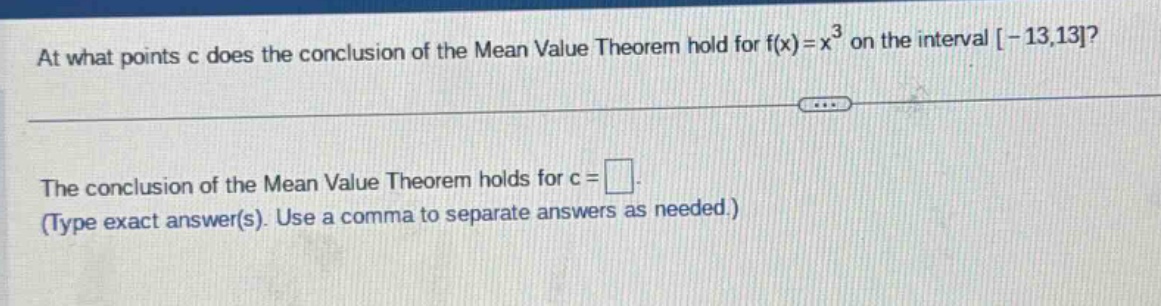
at what points c does the conclusion of the mean value theorem hold for f(x)=x³ on the interval -13,13? the conclusion of the mean value theorem holds for c = (type exact answer(s). use a comma to separate answers as needed.)
Answer
Explanation:
Step1: Recall Mean - Value Theorem
The Mean - Value Theorem states that if (y = f(x)) is continuous on the closed interval ([a,b]) and differentiable on the open interval ((a,b)), then there exists at least one number (c\in(a,b)) such that (f^{\prime}(c)=\frac{f(b)-f(a)}{b - a}). Here, (a=-13), (b = 13), and (f(x)=x^{3}).
Step2: Calculate (f(a)) and (f(b))
First, find (f(-13)=(-13)^{3}=-2197) and (f(13)=13^{3}=2197). Then (\frac{f(13)-f(-13)}{13-(-13)}=\frac{2197-(-2197)}{26}=\frac{4394}{26}=169).
Step3: Find the derivative of (f(x))
The derivative of (f(x)=x^{3}) using the power - rule ((x^{n})^\prime=nx^{n - 1}) is (f^{\prime}(x)=3x^{2}).
Step4: Solve for (c)
Set (f^{\prime}(c)=169), so (3c^{2}=169). Then (c^{2}=\frac{169}{3}), and (c=\pm\frac{13}{\sqrt{3}}=\pm\frac{13\sqrt{3}}{3}).
Answer:
(\frac{13\sqrt{3}}{3},-\frac{13\sqrt{3}}{3})