5. -/7 points details my notes larcalcet7 4.6.027. analyze and sketch a graph of the function. find any…
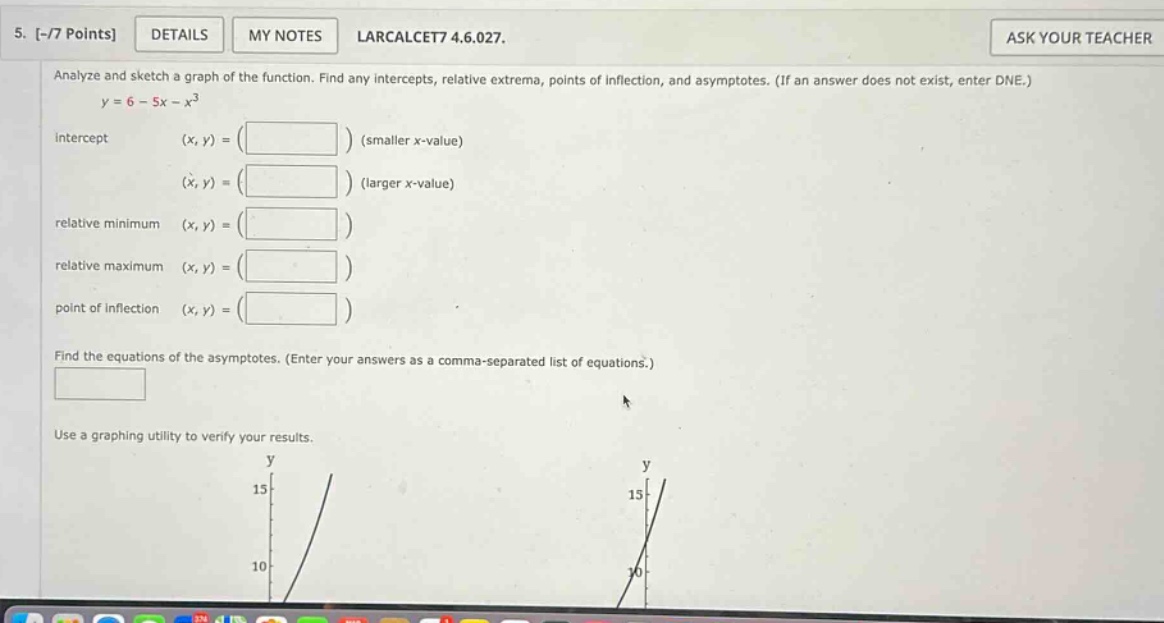
5. -/7 points details my notes larcalcet7 4.6.027. analyze and sketch a graph of the function. find any intercepts, relative extrema, points of inflection, and asymptotes. (if an answer does not exist, enter dne.) y = 6 - 5x - x^3 intercept (x, y) = ( ) (smaller x - value) (x, y) = ( ) (larger x - value) relative minimum (x, y) = ( ) relative maximum (x, y) = ( ) point of inflection (x, y) = ( ) find the equations of the asymptotes. (enter your answers as a comma - separated list of equations.) use a graphing utility to verify your results.
Answer
Answer:
Intercepts:
- $(x,y)$ (smaller $x$-value): Let $y = 0$, so $6-5x - x^{3}=0$. By inspection or using a numerical - method (such as Newton - Raphson), we find the roots. One root is approximately $x\approx - 2.58$. When $x=-2.58$, $y = 0$. So, $(x,y)=(-2.58,0)$.
- $(x,y)$ (larger $x$-value): Another root of $6 - 5x-x^{3}=0$ is approximately $x\approx1.21$. When $x = 1.21$, $y = 0$. So, $(x,y)=(1.21,0)$.
- To find the $y$-intercept, let $x = 0$. Then $y=6$. So the $y$-intercept is $(0,6)$.
Relative minimum:
First, find the first - derivative $y'=-5 - 3x^{2}$. Set $y' = 0$, then $-5 - 3x^{2}=0$, $3x^{2}=-5$. Since $x^{2}=-\frac{5}{3}$ has no real solutions, there are no relative extrema. So, $(x,y)=\text{DNE}$.
Relative maximum:
Since $y'=-5 - 3x^{2}<0$ for all real $x$ (because $x^{2}\geq0$ for all real $x$, so $-3x^{2}\leq0$ and $-5 - 3x^{2}<0$), there are no relative extrema. So, $(x,y)=\text{DNE}$.
Point of inflection:
Find the second - derivative $y''=-6x$. Set $y'' = 0$, then $-6x = 0$, which gives $x = 0$. When $x = 0$, $y=6$. So the point of inflection is $(0,6)$.
Asymptotes:
Since $y = 6-5x - x^{3}$ is a polynomial function of degree 3, there are no vertical or horizontal asymptotes. So the equations of the asymptotes are $\text{DNE}$.
Explanation:
Step1: Find $x$-intercepts
Set $y = 0$, solve $6-5x - x^{3}=0$.
Step2: Find $y$-intercept
Set $x = 0$, get $y = 6$.
Step3: Find first - derivative
$y'=-5 - 3x^{2}$.
Step4: Check for relative extrema
Set $y' = 0$, no real solutions.
Step5: Find second - derivative
$y''=-6x$.
Step6: Find point of inflection
Set $y'' = 0$, solve for $x$ and find $y$.
Step7: Check for asymptotes
Polynomial function, no asymptotes.