1. -/1 points details my notes osca19.3.146.tut. use the power - reduction formulas to rewrite the…
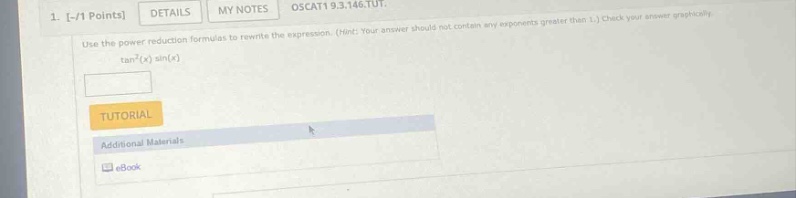
1. -/1 points details my notes osca19.3.146.tut. use the power - reduction formulas to rewrite the expression. (hint: your answer should not contain any exponents greater than 1.) check your answer graphically. tan²(x) sin(x)
Answer
Explanation:
Step1: Recall power - reduction formula for $\tan^{2}x$
The power - reduction formula for $\tan^{2}x=\frac{1 - \cos(2x)}{1+\cos(2x)}$. But we can also use another approach. First, recall $\tan^{2}x=\frac{\sin^{2}x}{\cos^{2}x}$, and the power - reduction formula for $\sin^{2}x=\frac{1 - \cos(2x)}{2}$. So, $\tan^{2}x\sin x=\frac{\sin^{2}x}{\cos^{2}x}\sin x=\frac{\sin^{3}x}{\cos^{2}x}$. We rewrite $\sin^{3}x=\sin x\cdot\sin^{2}x=\sin x\cdot\frac{1 - \cos(2x)}{2}$.
Step2: Simplify the expression
[ \begin{align*} \tan^{2}x\sin x&=\frac{\sin x(1 - \cos(2x))}{2\cos^{2}x}\ &=\frac{\sin x-\sin x\cos(2x)}{2\cos^{2}x} \end{align*} ] We know that $\sin A\cos B=\frac{1}{2}[\sin(A + B)+\sin(A - B)]$, so $\sin x\cos(2x)=\frac{1}{2}[\sin(3x)-\sin x]$. [ \begin{align*} \tan^{2}x\sin x&=\frac{\sin x-\frac{1}{2}(\sin(3x)-\sin x)}{2\cos^{2}x}\ &=\frac{\sin x-\frac{1}{2}\sin(3x)+\frac{1}{2}\sin x}{2\cos^{2}x}\ &=\frac{\frac{3}{2}\sin x-\frac{1}{2}\sin(3x)}{2\cos^{2}x}\ &=\frac{3\sin x-\sin(3x)}{4\cos^{2}x} \end{align*} ] Another way: We know that $\tan^{2}x=\frac{\sin^{2}x}{\cos^{2}x}$, and $\sin^{2}x = 1-\cos^{2}x$. [ \begin{align*} \tan^{2}x\sin x&=\frac{(1 - \cos^{2}x)\sin x}{\cos^{2}x}\ &=\frac{\sin x}{\cos^{2}x}-\sin x \end{align*} ] We also know that $\frac{\sin x}{\cos^{2}x}=\sec x\tan x$. So $\tan^{2}x\sin x=\sec x\tan x-\sin x$
Answer:
$\sec x\tan x-\sin x$