1. 0/1 points details my notes oscat1 9.3.146.tut. previous answers ask your teacher use the power reduction…
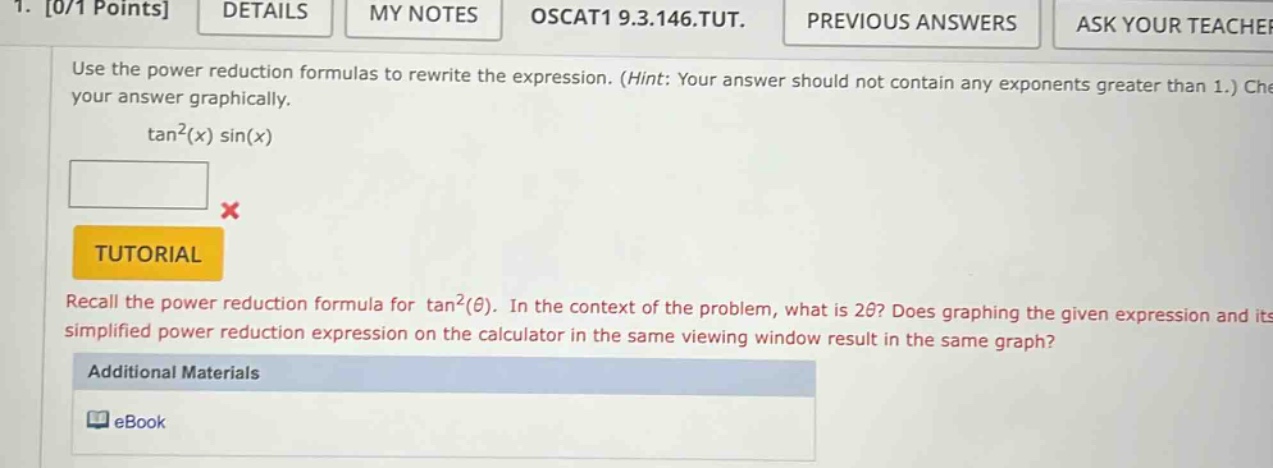
1. 0/1 points details my notes oscat1 9.3.146.tut. previous answers ask your teacher use the power reduction formulas to rewrite the expression. (hint: your answer should not contain any exponents greater than 1.) check your answer graphically. tan²(x) sin(x) tutorial recall the power reduction formula for tan²(θ). in the context of the problem, what is 2θ? does graphing the given expression and its simplified power reduction expression on the calculator in the same viewing window result in the same graph? additional materials ebook
Answer
Explanation:
Step1: Recall power - reduction formula for $\tan^{2}\theta$
The power - reduction formula for $\tan^{2}\theta=\frac{1 - \cos(2\theta)}{1+\cos(2\theta)}$. Here $\theta = x$, so $\tan^{2}x=\frac{1 - \cos(2x)}{1+\cos(2x)}$.
Step2: Substitute into the original expression
The original expression is $\tan^{2}(x)\sin(x)$. Substituting $\tan^{2}x$ gives $\frac{1 - \cos(2x)}{1+\cos(2x)}\sin(x)$.
Step3: Multiply through
$\frac{\sin(x)-\sin(x)\cos(2x)}{\ 1+\cos(2x)}$. We also know the double - angle formula $\cos(2x)=1 - 2\sin^{2}x$. Another way: We know $\tan^{2}x=\frac{\sin^{2}x}{\cos^{2}x}$, and the power - reduction formula for $\sin^{2}x=\frac{1 - \cos(2x)}{2}$ and $\cos^{2}x=\frac{1+\cos(2x)}{2}$. So $\tan^{2}x\sin(x)=\frac{\sin^{2}x}{\cos^{2}x}\sin(x)=\frac{\frac{1 - \cos(2x)}{2}}{\frac{1+\cos(2x)}{2}}\sin(x)=\frac{1 - \cos(2x)}{1+\cos(2x)}\sin(x)=\frac{\sin(x)-\sin(x)\cos(2x)}{1+\cos(2x)}$
We can also use the identity $\cos(2x)=1 - 2\sin^{2}x$ to further simplify: [ \begin{align*} \tan^{2}x\sin(x)&=\frac{\sin^{2}x}{\cos^{2}x}\sin(x)\ &=\frac{1 - \cos(2x)}{1+\cos(2x)}\sin(x)\ &=\frac{\sin(x)-\sin(x)\cos(2x)}{1+\cos(2x)}\ &=\frac{\sin(x)-\sin(x)(1 - 2\sin^{2}x)}{1+(1 - 2\sin^{2}x)}\ &=\frac{\sin(x)-\sin(x)+2\sin^{3}x}{2 - 2\sin^{2}x}\ &=\frac{2\sin^{3}x}{2(1 - \sin^{2}x)}\ &=\frac{\sin^{3}x}{\cos^{2}x} \end{align*} ]
A more standard way using power - reduction: The power - reduction formula for $\tan^{2}x=\frac{1-\cos(2x)}{1 + \cos(2x)}$ [ \begin{align*} \tan^{2}(x)\sin(x)&=\frac{1-\cos(2x)}{1+\cos(2x)}\sin(x)\ &=\frac{\sin(x)-\sin(x)\cos(2x)}{1+\cos(2x)} \end{align*} ] We know that $\sin(A)\cos(B)=\frac{1}{2}[\sin(A + B)+\sin(A - B)]$, so $\sin(x)\cos(2x)=\frac{1}{2}[\sin(3x)-\sin(x)]$ [ \begin{align*} \tan^{2}(x)\sin(x)&=\frac{\sin(x)-\frac{1}{2}(\sin(3x)-\sin(x))}{1+\cos(2x)}\ &=\frac{\sin(x)-\frac{1}{2}\sin(3x)+\frac{1}{2}\sin(x)}{1+\cos(2x)}\ &=\frac{\frac{3}{2}\sin(x)-\frac{1}{2}\sin(3x)}{1+\cos(2x)} \end{align*} ]
The power - reduction formula for $\tan^{2}x$ is $\tan^{2}x=\frac{1-\cos(2x)}{1+\cos(2x)}$, so $\tan^{2}(x)\sin(x)=\frac{(1 - \cos(2x))\sin(x)}{1+\cos(2x)}$
We can also rewrite it as follows: Since $\tan^{2}x=\frac{\sin^{2}x}{\cos^{2}x}$ and $\sin^{2}x=\frac{1 - \cos(2x)}{2},\cos^{2}x=\frac{1+\cos(2x)}{2}$ [ \begin{align*} \tan^{2}(x)\sin(x)&=\frac{\sin^{2}x}{\cos^{2}x}\sin(x)\ &=\frac{\frac{1 - \cos(2x)}{2}}{\frac{1+\cos(2x)}{2}}\sin(x)\ &=\frac{1 - \cos(2x)}{1+\cos(2x)}\sin(x) \end{align*} ]
The final rewritten expression without exponents greater than 1: $\frac{(1 - \cos(2x))\sin(x)}{1+\cos(2x)}$
Answer:
$\frac{(1 - \cos(2x))\sin(x)}{1+\cos(2x)}$