2. 0/4 points details my notes scalc9 2.9.005. find the linear approximation l(x) of the function f(x) = √(1…
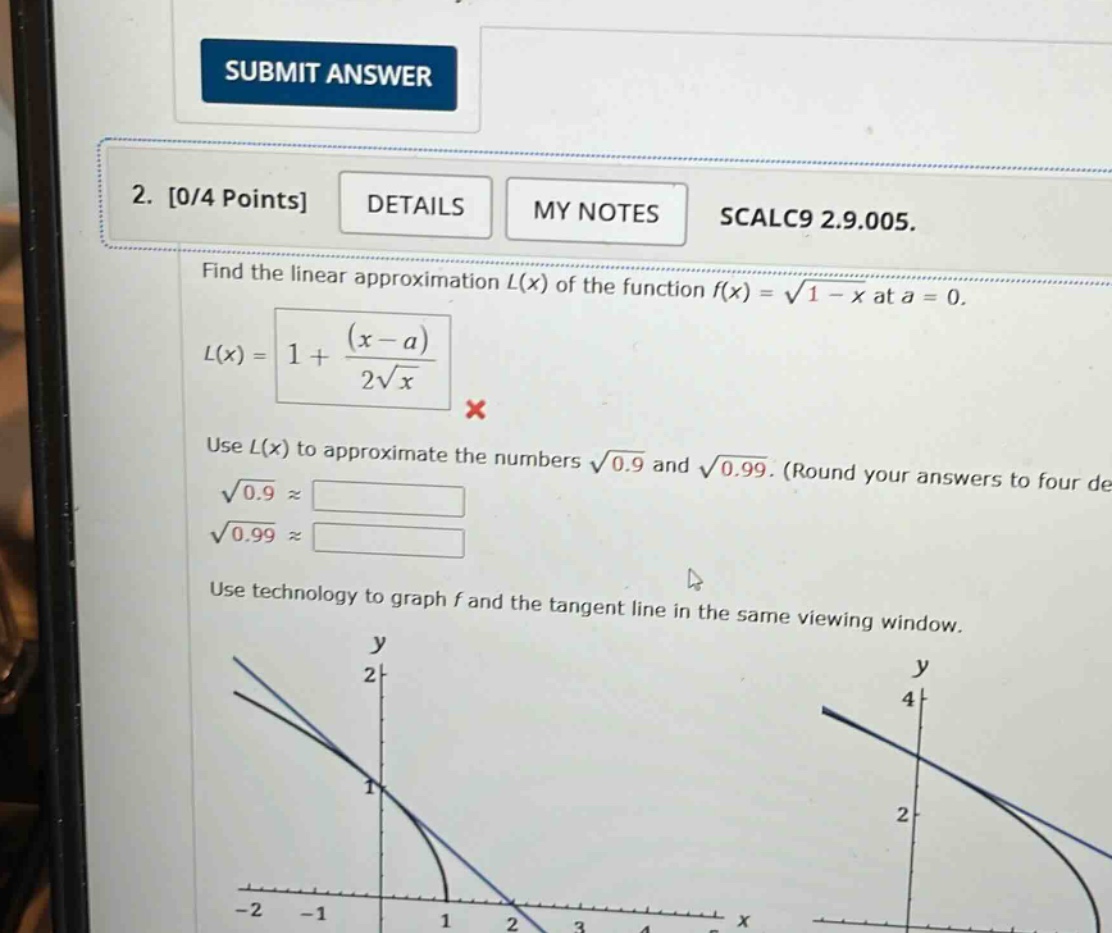
2. 0/4 points details my notes scalc9 2.9.005. find the linear approximation l(x) of the function f(x) = √(1 - x) at a = 0. l(x) = 1 + (x - a)/2√x x use l(x) to approximate the numbers √0.9 and √0.99. (round your answers to four de √0.9 ≈ √0.99 ≈ use technology to graph f and the tangent line in the same viewing window.
Answer
Explanation:
Step1: Recall linear - approximation formula
The linear approximation of a function $y = f(x)$ at $x = a$ is given by $L(x)=f(a)+f^{\prime}(a)(x - a)$. First, find $f(a)$ and $f^{\prime}(x)$ for $f(x)=\sqrt{1 - x}=(1 - x)^{\frac{1}{2}}$. Differentiate $f(x)$ using the chain - rule. If $u = 1 - x$, then $y = u^{\frac{1}{2}}$. $\frac{dy}{du}=\frac{1}{2}u^{-\frac{1}{2}}$ and $\frac{du}{dx}=-1$. So, $f^{\prime}(x)=\frac{-1}{2\sqrt{1 - x}}$. When $a = 0$, $f(0)=\sqrt{1-0}=1$ and $f^{\prime}(0)=\frac{-1}{2\sqrt{1 - 0}}=-\frac{1}{2}$.
Step2: Find the linear approximation $L(x)$
Substitute $f(0)$ and $f^{\prime}(0)$ into the linear - approximation formula: $L(x)=f(0)+f^{\prime}(0)(x - 0)=1-\frac{1}{2}x$.
Step3: Approximate $\sqrt{0.9}$
To approximate $\sqrt{0.9}$, set $1 - x=0.9$, then $x = 0.1$. $L(0.1)=1-\frac{1}{2}(0.1)=1 - 0.05 = 0.95$.
Step4: Approximate $\sqrt{0.99}$
To approximate $\sqrt{0.99}$, set $1 - x=0.99$, then $x = 0.01$. $L(0.01)=1-\frac{1}{2}(0.01)=1 - 0.005 = 0.995$.
Answer:
$\sqrt{0.9}\approx0.95$ $\sqrt{0.99}\approx0.995$