4. 1/2 points details my notes scalc9 3.2.018. does the function satisfy the hypotheses of the mean value…
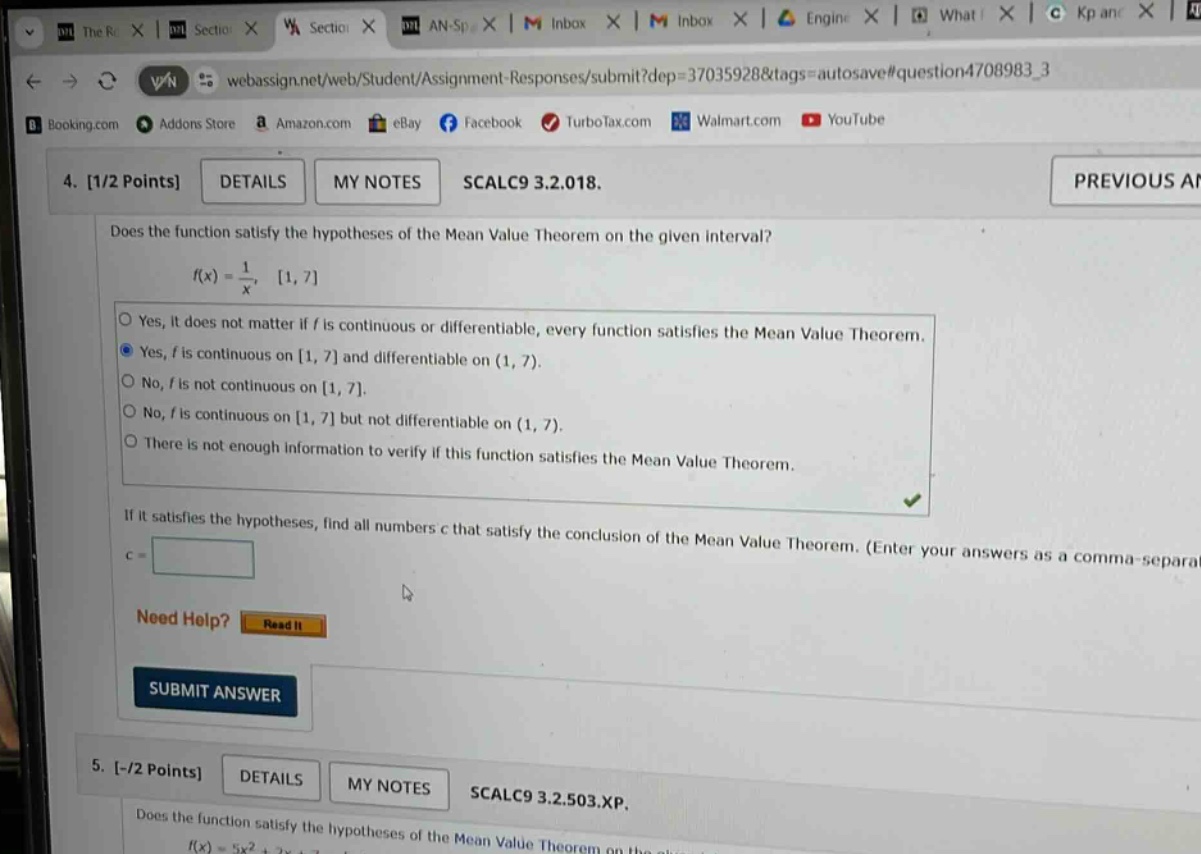
4. 1/2 points details my notes scalc9 3.2.018. does the function satisfy the hypotheses of the mean value theorem on the given interval? f(x)=1/x, 1,7 yes, it does not matter if f is continuous or differentiable, every function satisfies the mean value theorem. yes, f is continuous on 1,7 and differentiable on (1,7). no, f is not continuous on 1,7. no, f is continuous on 1,7 but not differentiable on (1,7). there is not enough information to verify if this function satisfies the mean value theorem. if it satisfies the hypotheses, find all numbers c that satisfy the conclusion of the mean value theorem. (enter your answers as a comma - separa need help? read it submit answer 5. -/2 points details my notes scalc9 3.2.503.xp. does the function satisfy the hypotheses of the mean value theorem on the
Answer
Explanation:
Step1: Recall Mean - Value Theorem hypotheses
The Mean - Value Theorem states that for a function (y = f(x)) on the closed interval ([a,b]), (f(x)) must be continuous on ([a,b]) and differentiable on ((a,b)). For (f(x)=\frac{1}{x}), the domain of (f(x)) is (x\neq0). On the interval ([1,7]), the function (y = f(x)=\frac{1}{x}) is continuous since there are no breaks in the graph of (y=\frac{1}{x}) on ([1,7]). The derivative of (f(x)=\frac{1}{x}=x^{-1}), and using the power - rule (f^\prime(x)=-x^{-2}=-\frac{1}{x^{2}}), which exists for all (x\in(1,7)). So (f(x)) is differentiable on ((1,7)).
Step2: Apply the Mean - Value Theorem formula
The Mean - Value Theorem formula is (f^\prime(c)=\frac{f(b)-f(a)}{b - a}). Here, (a = 1), (b = 7), (f(x)=\frac{1}{x}), so (f(1)=1) and (f(7)=\frac{1}{7}). Then (\frac{f(7)-f(1)}{7 - 1}=\frac{\frac{1}{7}-1}{6}=\frac{\frac{1 - 7}{7}}{6}=\frac{-\frac{6}{7}}{6}=-\frac{1}{7}). Also, (f^\prime(x)=-\frac{1}{x^{2}}), so we set (f^\prime(c)=-\frac{1}{c^{2}}=-\frac{1}{7}).
Step3: Solve for (c)
Cross - multiply the equation (-\frac{1}{c^{2}}=-\frac{1}{7}) to get (c^{2}=7). Since (c\in(1,7)), we take the positive square root, so (c = \sqrt{7}).
Answer:
Yes, (f) is continuous on ([1,7]) and differentiable on ((1,7)); (c=\sqrt{7})