4/6 points details my notes scalccc4 4.4.001. produce graphs of f that reveal all the important aspects of…
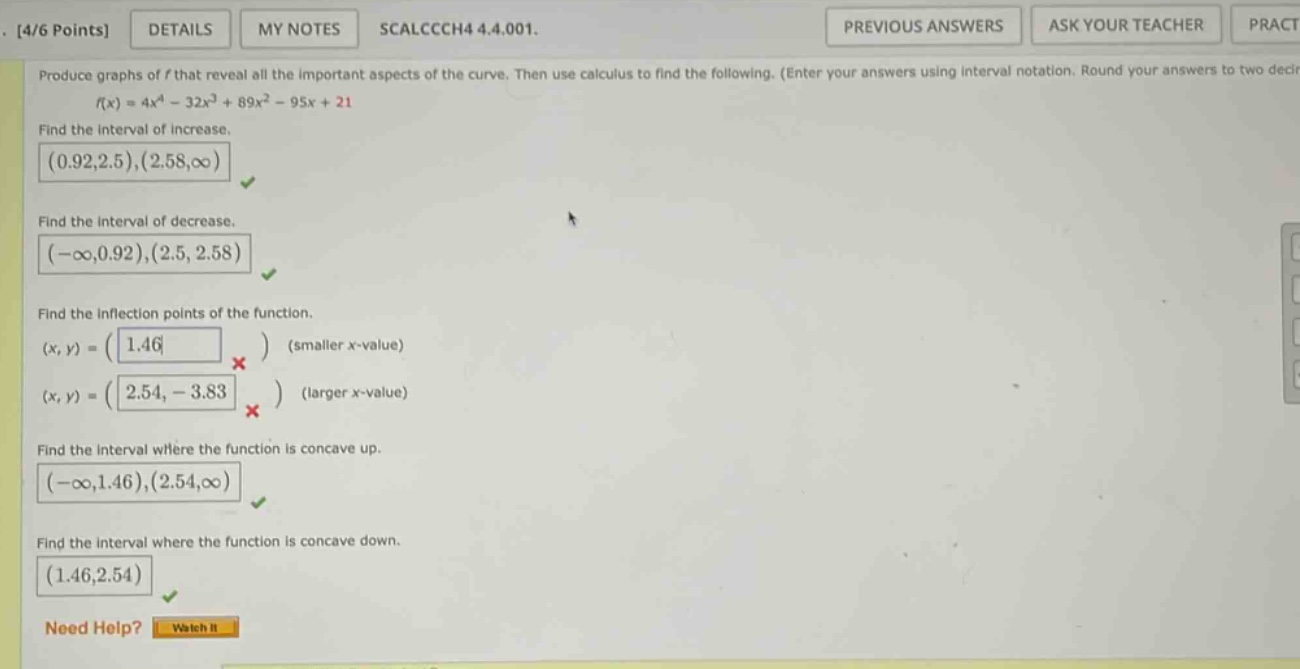
4/6 points details my notes scalccc4 4.4.001. produce graphs of f that reveal all the important aspects of the curve. then use calculus to find the following. (enter your answers using interval notation. round your answers to two decim f(x)=4x^4 - 32x^3 + 89x^2 - 95x + 21 find the interval of increase. (0.92,2.5),(2.58,∞) find the interval of decrease. (-∞,0.92),(2.5,2.58) find the inflection points of the function. (x,y)=(1.46) (smaller x - value) (x,y)=(2.54, - 3.83) (larger x - value) find the interval where the function is concave up. (-∞,1.46),(2.54,∞) find the interval where the function is concave down. (1.46,2.54) need help? watch it
Answer
Explanation:
Step1: Find the first - derivative
First, find the derivative of $f(x)=4x^{4}-32x^{3}+89x^{2}-95x + 21$. Using the power - rule $(x^n)^\prime=nx^{n - 1}$, we have $f^\prime(x)=16x^{3}-96x^{2}+178x - 95$.
Step2: Find critical points
Set $f^\prime(x) = 0$. We can use numerical methods (such as Newton - Raphson method) or a graphing utility to find the roots of $f^\prime(x)$. The critical points are approximately $x = 0.92,2.5,2.58$. Then, test the intervals $(-\infty,0.92)$, $(0.92,2.5)$, $(2.5,2.58)$ and $(2.58,\infty)$ using a test point in each interval. If $f^\prime(x)>0$ on an interval, the function is increasing on that interval; if $f^\prime(x)<0$, the function is decreasing.
Step3: Find the second - derivative
Differentiate $f^\prime(x)$ to get the second - derivative $f^{\prime\prime}(x)=48x^{2}-192x + 178$.
Step4: Find inflection points
Set $f^{\prime\prime}(x)=0$. Using the quadratic formula $x=\frac{-b\pm\sqrt{b^{2}-4ac}}{2a}$ for the quadratic equation $ax^{2}+bx + c = 0$ (here $a = 48$, $b=-192$, $c = 178$), we have $x=\frac{192\pm\sqrt{(-192)^{2}-4\times48\times178}}{2\times48}=\frac{192\pm\sqrt{36864 - 34176}}{96}=\frac{192\pm\sqrt{2688}}{96}\approx1.46,2.54$.
Step5: Determine concavity
Test the intervals $(-\infty,1.46)$, $(1.46,2.54)$ and $(2.54,\infty)$ using a test point in each interval. If $f^{\prime\prime}(x)>0$, the function is concave up; if $f^{\prime\prime}(x)<0$, the function is concave down.
Answer:
For the inflection points: $(x,y)$ with smaller $x$ - value: $(1.46,f(1.46))$. First, calculate $f(1.46)=4\times(1.46)^{4}-32\times(1.46)^{3}+89\times(1.46)^{2}-95\times1.46 + 21\approx - 10.17$. So the point is $(1.46,-10.17)$ $(x,y)$ with larger $x$ - value: $(2.54,f(2.54))$. Calculate $f(2.54)=4\times(2.54)^{4}-32\times(2.54)^{3}+89\times(2.54)^{2}-95\times2.54 + 21\approx - 10.17$. So the point is $(2.54,-10.17)$