1. 2/5 points details my notes scalcet9 11.5.001. (a) what is an alternating series? an alternating series…
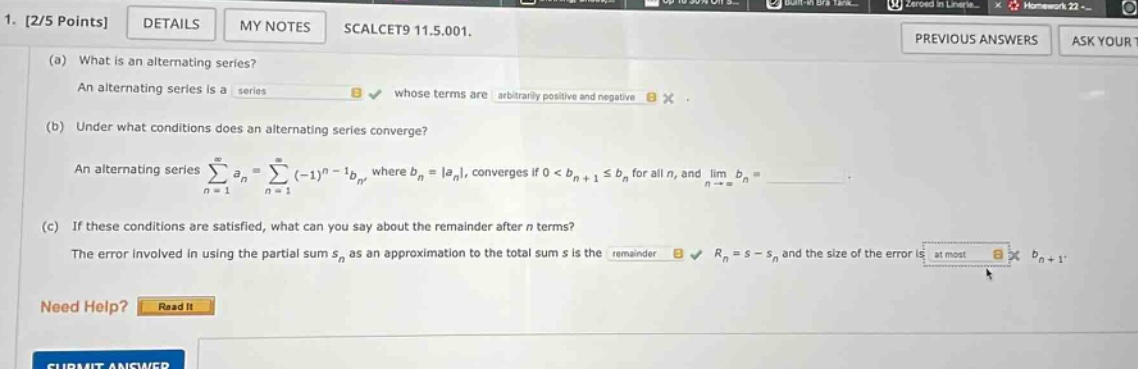
1. 2/5 points details my notes scalcet9 11.5.001. (a) what is an alternating series? an alternating series is a series whose terms are arbitrarily positive and negative. (b) under what conditions does an alternating series converge? an alternating series ∑n = 1∞an=∑n = 1∞(−1)n−1bn, where bn = |an|, converges if 0 < bn+1 ≤ bn for all n, and limn→∞bn =. (c) if these conditions are satisfied, what can you say about the remainder after n terms? the error involved in using the partial sum sn as an approximation to the total sum s is the remainder rn = s - sn and the size of the error is at most bn+1.
Answer
Brief Explanations:
(a) An alternating series has terms that alternate in sign. (b) An alternating series $\sum_{n = 1}^{\infty}a_n=\sum_{n = 1}^{\infty}(- 1)^{n - 1}b_n$ (where $b_n=\vert a_n\vert$) converges if $0 < b_{n+1}\leq b_n$ for all $n$ and $\lim_{n\rightarrow\infty}b_n = 0$. (c) When the conditions are met, the error in using the partial - sum $s_n$ to approximate the total sum $s$ (the remainder $R_n=s - s_n$) has a size at most $b_{n + 1}$.
Answer:
(a) A series whose terms alternate in sign. (b) $\lim_{n\rightarrow\infty}b_n = 0$ (c) At most $b_{n + 1}$